How to Turn AI Search Observations Into a GEO Experiment Backlog
A practical framework for turning AI Search answers, citations, and brand inaccuracies into bounded GEO experiments with fixed prompts, evidence ledgers, and honest retests.
The short answer
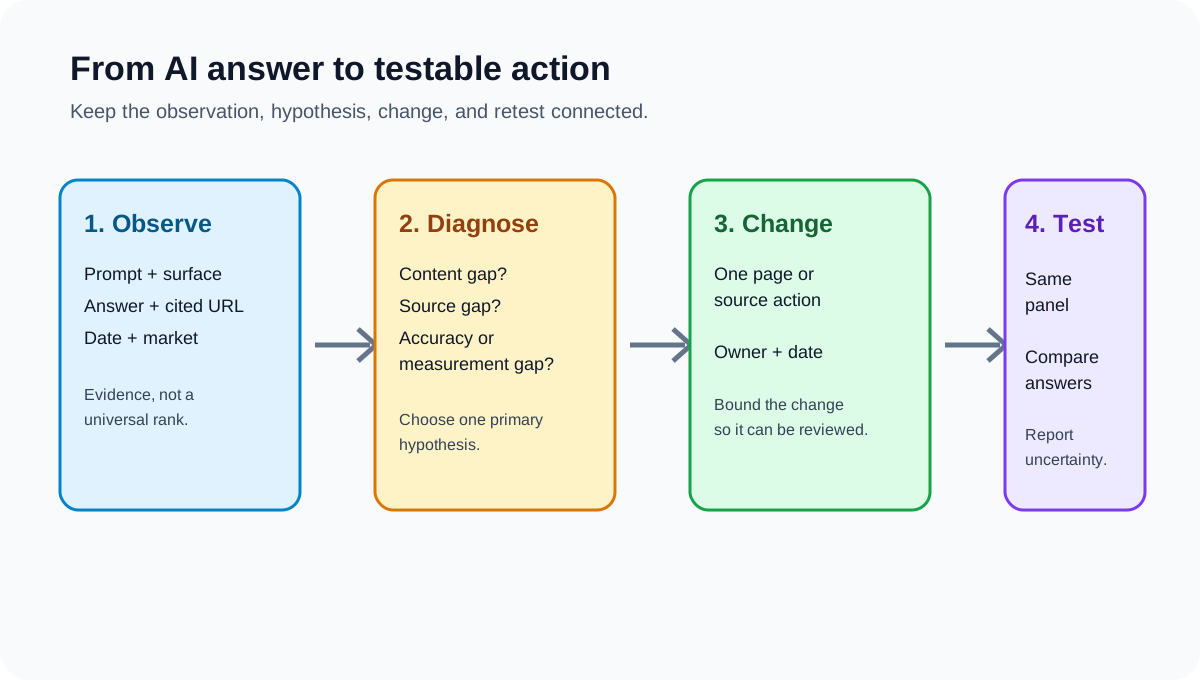
A useful GEO experiment backlog does not start with “publish more content.” It starts with a reproducible AI Search observation, a diagnosis, one bounded change, and a retest under the same measurement conditions.
Use this chain:
AI answer → evidence ledger → diagnosis → bounded action → fixed-panel retestThe result is a prioritised list of hypotheses, not a list of guarantees. A changed answer can be evidence that an observation changed; it does not, on its own, prove that a content edit caused the change, generated a click, or increased revenue.
Why an experiment backlog is better than a visibility to-do list
AI Search results are observations made under a particular prompt, surface, model or mode, market, language, time, and sampling method. Google says its AI features may show links to supporting web resources, while also advising site owners to follow normal Search fundamentals; that is useful context, but it is not a promise that a page will be selected or cited (Google Search Central: AI features and your website, checked August 26, 2026).
A dashboard can tell you that a brand appeared less often. It cannot automatically tell you whether the cause was:
- A missing or unclear answer on the owned site
- A stronger third-party source being retrieved
- An inaccurate or outdated brand description
- A prompt, model, region, or timing change
- A parser or citation-definition difference
- A temporary answer variation
Those causes imply different actions. A content rewrite is a poor response to a measurement mismatch, and a crawler-access change is not a substitute for correcting a comparison page.
Products such as Peec AI, PromptWatch, AI Search Console, and Otterly.AI can support different monitoring workflows. Treat their outputs as collection and analysis aids, not as a standardised causal experiment. Before comparing them, record what each one samples and preserves.
1. Define the decision before collecting ideas
An experiment should answer a decision that someone can act on. Examples:
| Decision | Evidence needed | Bad shortcut |
|---|---|---|
| Should we improve a comparison page? | Exact answers, competitor order, cited URLs, and missing criteria | Assuming the absent brand needs more articles |
| Is the product described accurately? | Branded answers, first-party facts, and current documentation | Treating positive sentiment as factual accuracy |
| Which sources shape the category narrative? | Repeated source URLs by prompt group and market | Copying the most visible publisher |
| Is a technical access issue plausible? | Crawler logs, robots rules, and fetch evidence | Calling a crawler request a citation |
| Did the observation change after an edit? | Fixed prompts, matched context, timestamps, and answer captures | Comparing unrelated dashboard totals |
Write the decision in one sentence. If the team cannot name the decision-maker, scope, and next review date, the item is probably an observation rather than an experiment.
2. Build a balanced observation panel
A backlog built only from branded prompts will overemphasise identity and factual correctness. A panel should cover the buying journey and the risks that matter to the business.
| Prompt group | What it tests | Example pattern |
|---|---|---|
| Category | Unprompted discovery | “What tools help an agency monitor AI citations?” |
| Problem | Use-case relevance | “How can a small team audit AI brand visibility?” |
| Branded | Identity and accuracy | “What does [brand] do?” |
| Comparison | Positioning and tradeoffs | “[Brand] vs [competitor] for [use case]” |
| Evaluation | Purchase criteria | “What should I verify before buying a GEO platform?” |
| Risk | High-impact factual claims | “Does [brand] support [feature]?” |
| Regional | Market and language differences | “Best [category] tools for a UK team” |
Keep a stable core panel for retests, then maintain a separate exploratory panel for new questions. Do not combine the results without labelling the two samples.
For every observation, save:
- Exact prompt text or a stable prompt ID
- AI surface and mode; model/version when disclosed
- Country, language, and relevant location settings
- Collection date, time zone, and run number
- Complete answer or an allowed capture
- Mentioned brands and competitor order
- Cited URLs and the claim each source appears to support
- Rules for mention, recommendation, position, and citation
If a tool hides one of these fields, record the omission. Missing metadata lowers reproducibility; it should not be filled with an assumption.
3. Separate four kinds of evidence
Do not put every signal into one “GEO score.” Keep these layers distinct:
Answer evidence
What the AI system actually said, including whether the brand was mentioned, recommended, described accurately, or compared with alternatives.
Source evidence
Which domains and URLs were cited, and which claim each source appears to support. A citation is not automatically an endorsement, a quality rating, or a click.
Access evidence
Whether relevant systems requested pages, as shown by logs or other permitted technical evidence. A crawler request is not proof that an answer used the page.
Visit and business evidence
Detectable referrals, engaged sessions, leads, sales, or other business events. Analytics can measure tagged or detectable visits, but it cannot recover every influence that occurred before a visit or outside the measurement setup. Google Analytics documents campaign URL parameters as a way to identify campaign traffic; that is an attribution mechanism, not proof of all AI influence (Google Analytics: Campaign URL builder, checked August 26, 2026).
A backlog item should state which layer it is meant to change and which layers it will merely observe.
4. Create an evidence ledger
An evidence ledger prevents a vague finding such as “competitor wins AI” from becoming an unreviewable task.
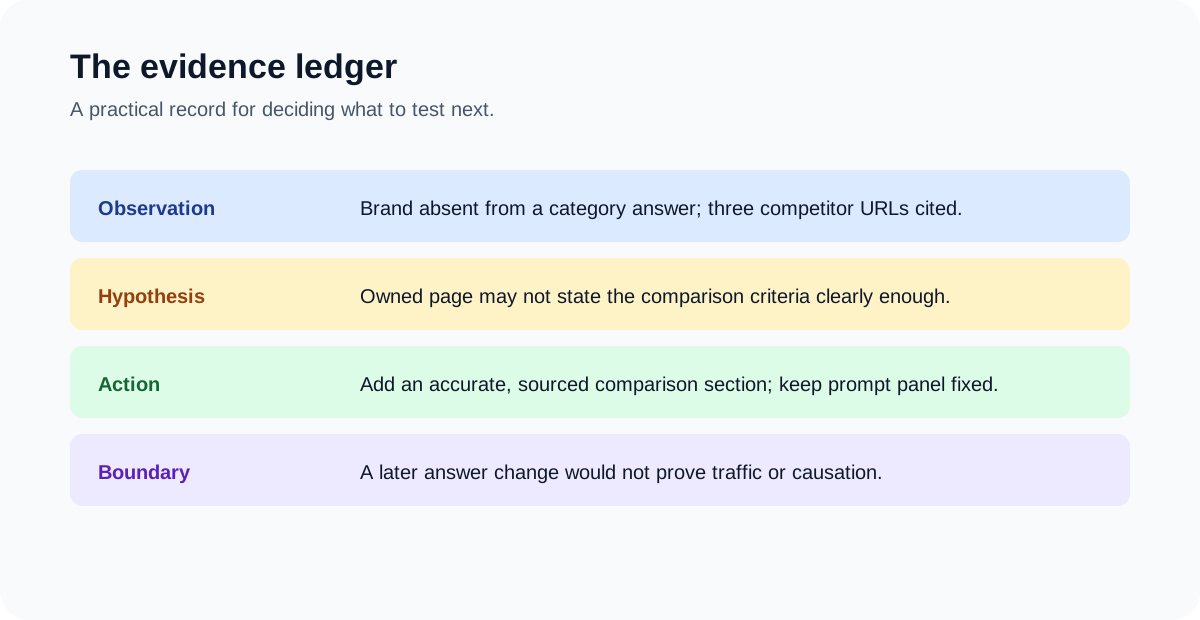
Use one row per observation:
| Field | Example |
|---|---|
| Observation ID | CAT-014 |
| Prompt and intent | Category: agency AI citation monitoring |
| Context | Perplexity, US English, 2026-08-26 |
| Observation | Two competitors recommended; brand absent |
| Source evidence | Three publisher URLs, with one recurring comparison page |
| Accuracy check | No claim made about why the answer was produced |
| Diagnosis | Possible source or content gap; confidence medium-low |
| Proposed action | Improve one comparison section with dated, sourced facts |
| Owner and due date | Content lead, 2026-09-02 |
| Retest rule | Same core prompt panel and context where possible |
| Boundary | Does not prove traffic, causation, or revenue |
The ledger should preserve uncertainty. “Unknown because raw answer evidence was unavailable” is a stronger record than an invented explanation.
5. Diagnose before assigning the task
Use the smallest diagnosis that explains the observation without claiming more than the evidence supports.
Content gap
The owned page does not answer the user’s question clearly, lacks decision criteria, or makes important facts difficult to verify. Inspect the page against the prompt’s intent before rewriting it.
Source gap
AI answers repeatedly rely on relevant independent publishers, communities, directories, or review pages that provide context the owned site does not. This is a research finding, not proof that outreach will earn a citation.
Accuracy gap
The answer contains an outdated price, feature, product description, comparison, or policy. Check the current first-party source and record the discrepancy. Do not treat a rating or citation position as evidence that the claim is true.
Technical or access gap
A page may have an indexing, rendering, robots, availability, or discoverability issue. Verify the relevant technical evidence separately. Google’s Search documentation describes AI features as part of its Search experience and points site owners back to standard technical and content guidance; it does not offer a guaranteed AI-citation control (Google Search Central: AI features, checked August 26, 2026).
Measurement gap
The comparison changed prompt wording, engine, region, date, sample size, parser, or metric definition. Fix the measurement record before changing the page.
A single observation may have several plausible diagnoses. Rank them as hypotheses and state what evidence would distinguish them.
6. Prioritise with evidence, impact, and reversibility
A backlog does not need a magic formula. A transparent scoring rubric is more useful than false precision.
Score each candidate from 1 to 3:
- Decision relevance: How directly does it affect an important customer or business question?
- Evidence strength: Can the team inspect the answer, source, and context?
- Potential harm: Could the issue create misinformation, compliance, or purchase friction?
- Actionability: Is there a bounded change the team controls?
- Reversibility: Can the change be reviewed or rolled back safely?
Mark an item high priority when it is decision-relevant, well evidenced, and carries meaningful accuracy or customer risk. A low-confidence visibility dip should usually be investigated before it is used to justify a large editorial programme.
Do not score “expected traffic increase” unless you have a separate, valid measurement design for it. A model-generated answer change is not a forecast of clicks.
7. Design one bounded experiment
A useful experiment changes one main variable while holding the observation universe as steady as possible.
Example: comparison-page clarity
Observation: In a fixed category/comparison panel, competitor pages are cited more often and the brand is absent from several answers.
Hypothesis: The owned comparison page does not clearly state the criteria and current product facts that the prompts require.
Change: Add a concise comparison section with accurate definitions, dated dynamic facts, and links to primary documentation. Do not change the whole content library at the same time.
Retest: Run the same prompt IDs, surface, market, and language in a defined window. Capture complete answers and cited URLs.
Interpretation: Compare answer-level observations. If the result changes, record the change without claiming that the page caused it unless the design supports that inference. If it does not change, preserve the result and revisit the diagnosis.
Other bounded actions might include correcting an entity fact, improving a page’s information architecture, adding a clearly sourced FAQ, or fixing a verified technical access issue. None guarantees selection, citation, ranking, traffic, or conversion.
8. Report the retest honestly
A retest report should include:
- What changed and when.
- Which prompts, surfaces, markets, languages, and dates were used.
- How many observations were collected.
- What changed in answer text, mentions, recommendations, or citations.
- Which results were stable, mixed, or unknown.
- What alternative explanations remain.
- What the next bounded action is.
Use language such as:
“After the page update, the brand appeared in 3 of 12 matched observations versus 1 of 12 in the prior run. The sample is small and answers varied; this is an observed change, not evidence of causal traffic or revenue impact.”
Do not write “the update increased AI visibility by 200%” when the denominator, prompt universe, answer captures, or comparison conditions are unclear.
A reusable GEO experiment template
Experiment ID:
Decision:
Owner and review date:

Observation:
Prompt IDs and intent groups:
Surface/model/mode:
Market and language:
Collection dates and sample size:
Answer and source evidence:

Primary diagnosis:
Alternative explanations:
Confidence and missing evidence:

Bounded change:
What remains unchanged:
Retest rule:

Result:
What changed in the answers:
What did not change:
Evidence boundary:
Next action:
What this method cannot prove
Even a careful matched retest cannot automatically prove:
- A universal AI ranking
- That every future answer will behave the same way
- That a citation caused a visit
- That a visit came from an AI answer when analytics cannot identify it
- That a content edit caused a business outcome without controlling for other factors
- That a vendor-selected case study is independent evidence
For related measurement boundaries, see AI Visibility vs AI Citations vs AI Traffic, and for prompt design see How to Build a Reliable AI Search Prompt Set.
FAQ
How many prompts should one GEO experiment use?
There is no universal number. Use enough matched prompts to represent the decision, intent groups, market, and important competitors. A smaller documented panel is more useful than a large changing sample.
Should every AI answer become a content task?
No. First classify the observation as a content, source, accuracy, technical, timing, or measurement issue. Some findings require no content change.
Is a competitor citation a reason to copy that page?
No. Inspect which claim the source supported, verify the claim independently, and create an original source that serves the user’s need. A cited page may be outdated, biased, inaccessible, or simply relevant to one prompt.
Can I use a GEO tool’s visibility score as the experiment result?
Use the score as a directional summary only if its prompt panel, definitions, sample, and refresh method are documented. Prefer answer-level evidence for diagnosing a change.
What should agencies put in a client report?
Include the fixed prompt panel, collection context, answer examples, source URLs, the bounded change, the retest window, uncertainty, and separate visibility, citation, access, visit, and business signals. Avoid guaranteed-outcome language.
Related AICiteKit tools
- Peec AI — prompt-level visibility, competitor, sentiment, and citation workflows.
- PromptWatch — visibility, crawler, API, and answer-evidence workflows.
- AI Search Console — prompts, competitors, sources, and citations.
- Otterly.AI — recurring prompt and brand visibility monitoring.
Sources and verification
- Google Search Central: AI features and your website — official guidance on AI features, supporting links, and standard Search fundamentals; checked August 26, 2026.
- Google Analytics: Campaign URL builder — official guidance on campaign parameters for identifying traffic; checked August 26, 2026.
- Google Search Console Help — official Search Console reporting and performance context; checked August 26, 2026.
- AICiteKit: How to Build an AI Search Measurement Baseline Before You Optimize — related editorial methodology on fixed panels and evidence capture.
- AICiteKit: How to Evaluate AI Search Source Quality Before You Change Your Content — related editorial framework for relevance, accuracy, freshness, and provenance.
This is AICiteKit editorial methodology. It does not claim that any tool or content change guarantees rankings, citations, traffic, or revenue.