Field notes / ai-search
AI Search Recommendation Evidence: How to Audit Why a Brand Gets Chosen
A practical framework for auditing AI Search recommendations by separating the answer, buyer criteria, visible sources, and evidence limits.
The short answer
An AI Search recommendation is not one metric. It is a bundle of observations: which brands were mentioned, which were recommended, what buyer criteria were used, which sources were visible, and whether those sources support the explanation.
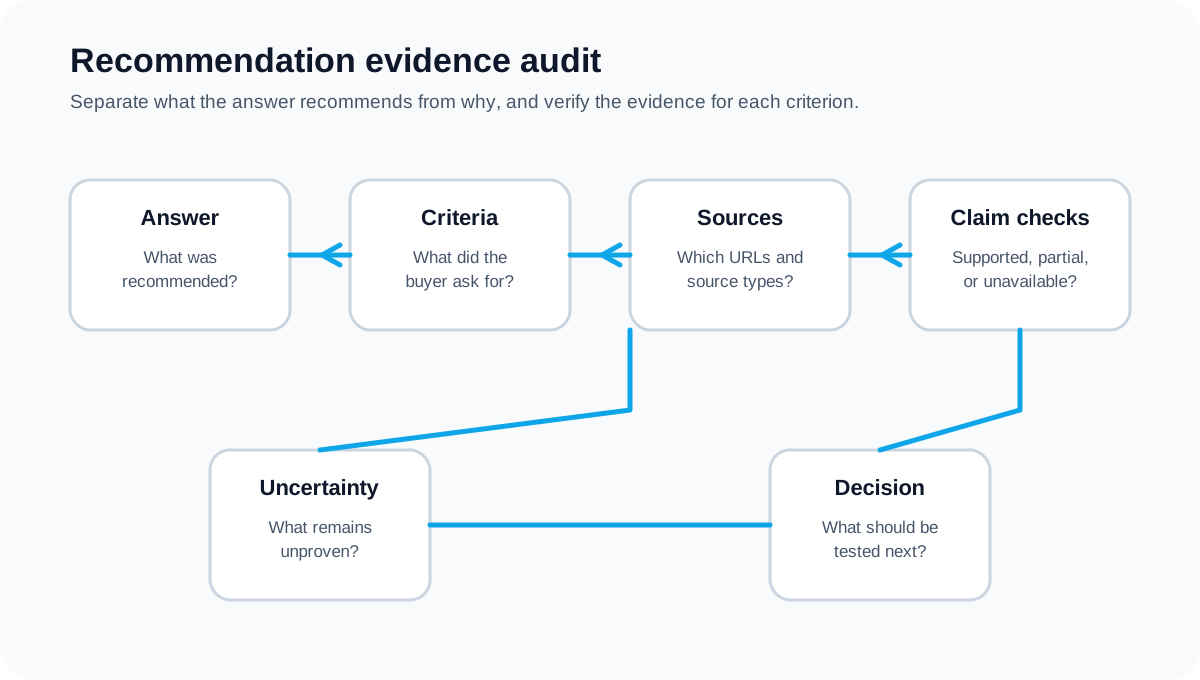
Audit the bundle in this order:
recommendation → buyer criteria → answer reasons → visible sources → claim checks → bounded decisionThis matters because “mentioned,” “recommended,” and “chosen for this buyer” are different outcomes. A brand can appear in an answer without being selected. A product can be recommended for one constraint and rejected for another. A visible citation can support a feature claim without proving that the source caused the recommendation.
This guide addresses searches such as “why does AI recommend one tool over another?”, “how do I measure AI product recommendations?”, and “does an AI citation prove a recommendation?” The method is intentionally narrower than a universal ranking study. It describes the answer captures and sources you actually reviewed.
Recommendation is not the same as visibility
A visibility report may count a brand mention or a linked domain. A recommendation audit asks an additional question: what role did the brand play in the answer, and which stated criteria were used to justify that role?
| Observation | What it supports | What it does not prove |
|---|---|---|
| Brand name appears in an answer | The brand was visible in the captured output | That it was recommended or preferred |
| Brand is listed as an option | It was included among the answer’s options | That it ranked first or fit every buyer |
| Brand is selected for a stated use case | The answer recommended it under those conditions | Universal preference or purchase intent |
| A URL is cited beside the recommendation | The surface exposed that URL | That the URL caused the selection |
| A source supports one product fact | That fact is supported under the checked scope | That the recommendation as a whole is justified |
| The answer changes after a page edit | Two observations differ | That the edit caused the change |
Google’s documentation on AI features and your website, checked October 12, 2026, describes links to supporting web resources and recommends foundational Search practices. It does not publish a universal recommendation formula. OpenAI’s web search documentation, also checked October 12, 2026, documents citation and source fields for a particular API tool. It should not be generalized to every consumer surface or answer engine.
1. Define the buyer and decision before the prompt
“Which is the best GEO tool?” is not a complete recommendation test. Add the conditions that make an answer actionable:
- Buyer type and team size
- Primary job: monitoring, research, content planning, or reporting
- Required surfaces or markets
- Budget or procurement constraint
- Integrations, exports, or access requirements
- Freshness, localization, or compliance needs
- Whether the buyer needs evidence for a client or only internal exploration
The same product can be a reasonable recommendation for one constraint and a poor fit for another. Preserve the exact prompt rather than reducing it to a topic label.
A useful prompt record is:
Prompt ID: REC-07-v1
Decision: select a GEO monitoring workflow
Buyer: small agency with monthly client reporting
Market/language: United States / English
Constraints: prompt history, source URLs, export, no enterprise procurement
Exact prompt: Which AI Search visibility tools fit a small agency that needs...
Surface and mode: recorded at collection time
Collection date: 2026-10-12 UTC
Do not infer a buyer constraint from the answer after the fact. If the prompt did not specify budget, the output is not evidence about budget fit.
2. Split the answer into recommendation claims
An answer often compresses several claims into one sentence:
Tool A is the best choice for agencies because it tracks more engines, has reliable reporting, and is affordable.
Review it as separate claims:
- Tool A was selected for the agency use case.
- It tracks the stated engines or surfaces.
- Its reporting supports the described workflow.
- “Reliable” has a defined evidence basis.
- It is affordable for the named buyer and budget.
Only the first claim is directly observable from the recommendation. The remaining claims need source and scope checks. “Best” is especially dangerous: it may be a model-generated conclusion, not a published measurement.
Classify each sentence or clause as one of:
- Mention: the brand or product is named.
- Recommendation: the answer says it fits or should be chosen.
- Criterion: a buyer requirement or comparison dimension.
- Fact: a feature, limit, integration, price, or availability statement.
- Reason: the explanation offered for the recommendation.
- Qualification: a caveat, market, plan, date, or uncertainty statement.
A recommendation record can then look like this:
Answer ID: REC-07 / run 02
Recommendation: Tool A for small-agency reporting
Reason: visible source URLs and scheduled tracking
Criterion match: partial; export requirement not addressed
Fact check: source URL supports tracking, not the current plan limit
Status: recommended in answer; rationale partially supported
Confidence: medium for the captured answer, low for universal fit
The status describes the evidence reviewed. It is not the model’s hidden confidence.
3. Capture the visible source relationship
Record where each source appeared and which answer text it was adjacent to. At minimum, preserve:
- Exact prompt and conversation state
- Surface, mode, model or version when disclosed
- Market, language, date, and time zone
- Full answer or an allowed near-raw representation
- Brand role: mentioned, shortlisted, recommended, rejected, or compared
- Visible URL, title, and position or citation marker
- Claim or reason apparently associated with the source
- Unavailable, login-gated, or failed source states
A citation marker can be close to a sentence without proving that it supports every clause in that sentence. Open the URL and check the relevant passage. If the URL is unavailable, mark the relationship unverified rather than treating it as evidence or as proof of error.
For recurring observation, tools such as AI Search Console, Peec AI, Otterly.AI, PromptWatch, Profound, and Rankscale may expose different combinations of prompts, answers, sources, and derived metrics. Their workflows are not automatically interchangeable. During a trial, verify whether the export preserves the exact prompt, answer text, source URL, timestamp, surface, market, and failed run.
4. Test whether the reasons match the buyer criteria
A recommendation is more inspectable when every reason maps to a criterion. Use a matrix rather than a single score:
| Buyer criterion | Answer says | Source checked | Result | Boundary |
|---|---|---|---|---|
| Source-level reporting | Product includes source reporting | Official docs or product UI | Supported / partial / unavailable | Check plan and export scope |
| Multi-surface coverage | Product monitors named surfaces | Official documentation | Supported for named surface or unclear | Coverage may vary by plan or region |
| Agency workflow | Suitable for client reporting | Workflow evidence and trial | Editorial judgment | Not proved by a feature list alone |
| Current price | Fits stated budget | Official pricing page | Date- and plan-bound | Currency, billing, and credits matter |
| User experience | Easy to configure | Independent reviews or trial | Sample-dependent | Reviews may cover only broader product |
The GEO research paper by Aggarwal et al., checked October 12, 2026, is independent academic context for evaluating generative-engine visibility in a defined experimental setting. It does not validate a vendor’s recommendation score, current platform coverage, traffic forecast, or revenue claim.
When evidence covers the broader product but not the specific GEO feature, say so. Traditional SEO or writing-tool reviews do not automatically prove the quality of AI-visibility monitoring. A competitor-authored comparison can reveal workflow tradeoffs, but it is not neutral evidence.
5. Separate evidence classes
Use source type deliberately:
| Evidence class | Good use | Limitation |
|---|---|---|
| Official docs and pricing | Current features, plans, limits, integrations | Vendor-controlled and scope-specific |
| Independent review platforms | Recurring usability themes and complaints | Sample size, age, incentives, and edition matter |
| Academic research | Definitions, methods, and experimental context | May not describe current commercial behavior |
| Competitor or affiliate content | Practical comparisons and workflow observations | Commercial bias must be disclosed |
| Vendor case study | What a selected customer and vendor report | Vendor-selected customer evidence, not independent proof |
| AICiteKit analysis | Conditional interpretation and buying guidance | Editorial judgment, not causal validation |
Do not turn a source count into a quality score. Five pages repeating one vendor claim are not five independent confirmations. Trace repeated claims to the earliest or most authoritative source you can identify.
Google’s helpful, reliable, people-first content guidance, checked October 12, 2026, is useful editorial context for avoiding unsupported claims and writing for people. It does not promise inclusion in AI answers or establish a recommendation ranking.
6. Report recommendation outcomes with denominators
For a fixed prompt panel, report separate rates:
mention rate = answers with a brand mention ÷ qualifying captures
recommendation rate = answers recommending the brand ÷ qualifying captures
citation rate = answers showing a target URL ÷ qualifying captures
supported-reason rate = mapped reasons with supporting evidence ÷ reasons reviewed
Always name the panel, surface, market, date range, and outcome rules. For example:
In 9 of 30 qualifying US-English captures, the brand was mentioned; in 4, it was recommended for the stated agency use case; 3 included a visible owned URL. This describes the fixed panel and collection conditions, not universal AI preference or market share.
Do not combine mention and recommendation into one “visibility” number unless the definitions remain visible. Keep unavailable and failed runs in a separate disclosed category. A tiny denominator may be useful for an exploratory check, but it should not be presented with false precision.
For panel design, see AI Search Prompt Mapping and How Many AI Search Prompts Should You Track?. For the difference between citation presence and business attribution, see AI Search Citation Attribution Audit.
7. Investigate a recommendation gap
If a competitor is recommended more often, do not immediately conclude that the competitor has better content or that one page caused the result. Compare the evidence chain:
- Are the prompts genuinely matched by buyer, market, and constraint?
- Is the competitor more often mentioned, or actually selected?
- Do the answers cite different source types?
- Are the recommendation reasons factual, evaluative, or unsupported?
- Does the target’s source portfolio answer the buyer’s stated criteria?
- Are pricing, limits, availability, and product facts current and consistent?
- Does the result repeat across a fixed panel and declared conditions?
Then choose one bounded action: correct a conflicting fact, improve a missing comparison page, add independently supportable evidence, or run a better-controlled retest. Treat a changed answer after an edit as an association unless the design isolates other explanations.
What this audit can and cannot prove
| Finding | Reasonable interpretation | Boundary |
|---|---|---|
| A brand is recommended in repeated captures | It was recommended under the sampled conditions | Not universal preference or conversion intent |
| A reason maps to a current official fact | The fact is supported for the checked scope | Not proof that the fact caused selection |
| Independent reviews repeat a usability concern | A public feedback signal exists | Not every user’s experience or current behavior |
| A cited source contradicts the answer | The claim-source relationship is weak or partial | Not proof of the entire answer being false |
| A page edit is followed by more recommendations | The observations changed in sequence | Not causal proof without controlled testing |
| A tool reports a recommendation score | The tool calculated a metric under its method | Not a universal ranking |
A practical monthly workflow
- Define the buyer decision. Write the audience, constraints, and intended action.
- Freeze the core prompts. Version wording, cohort, surface, market, and mode.
- Capture full answer evidence. Save recommendation role, reasons, URLs, dates, and unavailable states.
- Segment claims. Separate selection, criteria, facts, reasons, and qualifications.
- Check sources. Verify the smallest relevant passage, scope, date, and commercial relationship.
- Compare by cohort. Keep mention, recommendation, citation, and supported-reason rates separate.
- Choose one bounded change. Fix a factual conflict or fill a documented evidence gap.
- Retest the same panel. Report the observation and its uncertainty without claiming causation.
FAQ
Does an AI recommendation mean the product is the best?
No. It means the captured answer recommended the product under the prompt and conditions you recorded. “Best” requires a defined buyer, criteria, comparison set, and evidence method.
Does a citation prove why the product was recommended?
No. It shows a visible source relationship. Check whether the source supports the particular reason, scope, and product fact. A citation may support one claim while leaving the recommendation judgment unverified.
Should I optimize for being mentioned or recommended?
Measure both, because they answer different questions. Mentions show presence; recommendations show a selection under stated conditions. Neither alone proves a click, lead, sale, or revenue effect.
How many prompts do I need?
There is no universal number. Build a panel around the buyer decisions, intent cohorts, markets, surfaces, and repeatability you need. A documented smaller panel is more interpretable than a larger opaque score.
Can server logs prove an AI recommendation?
No. A crawler request can show access, not that a user-facing answer cited or recommended the page. Keep access logs separate from answer captures; AI Crawler Analytics covers that boundary.
Evidence snapshot
| Source | Public signal | What it supports | Confidence |
|---|---|---|---|
| Google Search Central: AI features and your website | Official guidance on AI-feature links and Search practices | Product context and the absence of a universal recommendation formula | High for documented guidance |
| OpenAI Developer Docs: Web search | Official API documentation for source and citation fields | Product-specific context for exposed web-search citations | High for the API documentation; not every OpenAI surface |
| Aggarwal et al., “GEO: Generative Engine Optimization” | Independent academic research in a defined experimental setting | Research context for generative-engine visibility evaluation | Medium; not commercial metric validation |
| Google Search Central: Creating helpful, reliable, people-first content | Official editorial guidance | Boundary against unsupported or manipulative claims | High for the guidance |
| AICiteKit editorial framework | Claim-level recommendation audit in this article | Practical interpretation and trial questions | Editorial |
Sources and verification
The following sources were checked on October 12, 2026:
- Google Search Central: AI features and your website — official guidance on AI-feature links and foundational Search practices.
- OpenAI Developer Docs: Web search — official documentation for an OpenAI API web-search tool and its citation fields.
- Aggarwal et al., “GEO: Generative Engine Optimization,” arXiv — independent academic research context.
- Google Search Central: Creating helpful, reliable, people-first content — official content-quality guidance.
Last reviewed: October 12, 2026
Data confidence: High for the linked official and academic source descriptions; medium for the operational framework, which is AICiteKit editorial guidance and depends on the fields each AI Search surface exposes.
This article does not guarantee citations, recommendations, rankings, traffic, or revenue.