Field notes / ai-search
AI Search Citation Attribution Audit: How to Map Sources to Claims Without Overcounting
A practical audit for connecting AI Search claims to visible source URLs, checking the supporting passages, and keeping citation evidence separate from clicks and revenue.
The short answer
An AI Search citation attribution audit maps each material claim in a captured answer to the visible source URL and the smallest source passage that can support it. It prevents a common reporting error: treating one citation as if it validates every sentence, proves the cited page caused the answer, or records a downstream visit.
Use this chain:
captured answer → claim segments → visible URLs → source passages → evidence boundaryThe output is a traceable record of what was observed. It is not a hidden retrieval trace, a universal ranking, or a conversion model.
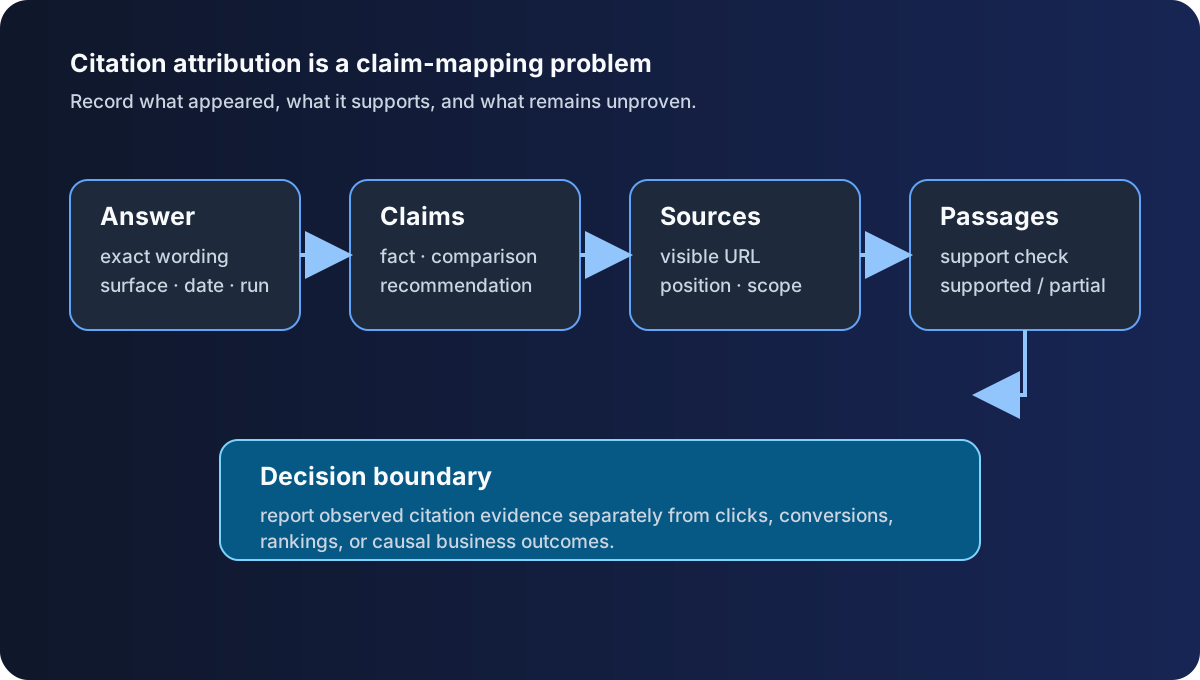
This workflow addresses practical searches such as “how do I audit AI Search citations?”, “does an AI citation prove the answer is accurate?”, and “how can I attribute a source to one claim instead of the whole answer?” It complements AI Search Answer Provenance, AI Search Answer Claim Audit, and AI Visibility vs AI Citations vs AI Traffic.
What citation attribution can—and cannot—show
Google’s AI features documentation, checked October 10, 2026, says AI features may show links to supporting web resources and recommends foundational Search practices. It does not publish a universal citation-attribution format or guarantee that an eligible page will appear.
OpenAI’s web search documentation, checked October 10, 2026, documents source and citation fields for a specific API tool. That is useful product-level evidence for that tool, not proof that every ChatGPT surface or other answer engine exposes the same fields.
| Observation | It supports | It does not prove |
|---|---|---|
| A URL is visible beside an answer | The surface exposed that URL in the captured run | That every sentence came from the URL |
| A source passage supports one fact | The passage supports that fact under the checked scope | That the source caused retrieval or recommendation |
| A brand is mentioned without a URL | The answer contains a mention | That the brand was cited, endorsed, or visited |
| A citation is followed by a referral | A referral was recorded in the analytics system | That the citation caused the visit or conversion |
| A retest changes citations | The sampled output changed | That one edit caused the change |
| Several pages repeat the same claim | Repetition exists across those pages | Independent corroboration, if the pages copy one another |
Keep mention, recommendation, citation, source support, referral, and conversion as separate fields. Combining them creates a metric that looks precise but cannot be audited.
1. Define the unit you are attributing
Do not audit a whole answer as one claim. Split it wherever the truth conditions change.
Answer: Tool A supports daily tracking, is suitable for agencies,
and costs $X per month.

Claim A: daily tracking is documented
Claim B: agency fit is an editorial recommendation
Claim C: current price and billing basis
These claims require different evidence. A product document may support a feature; it does not automatically prove that the tool is suitable for every agency. A pricing page may support a published amount only for a stated currency, plan, and billing interval.
Classify each segment as one of these units:
- Fact: a product, company, policy, or market statement.
- Recommendation: a judgment that an option fits a need.
- Comparison: a relationship between alternatives.
- Qualification: a condition, exception, date, or uncertainty marker.
- Citation: a visible relationship between answer text and a URL.
The first four are answer content. The last is an exposed source relationship. They should not be scored as interchangeable outcomes.
2. Preserve the answer context
Attribution becomes unreliable when two captures were collected under different conditions. Save at least:
- Exact prompt and prompt-set version
- New conversation or prior-turn context
- Surface, mode, and model/version when disclosed
- Country, language, device, and account state when relevant
- Collection date, time zone, and run number
- Full answer or a permitted near-raw representation
- Every visible URL and its location in the answer
- Search, browse, or tool state when exposed
If a field is not exposed, record not disclosed or not available. Do not infer a hidden model, query, retrieval order, or source priority from the final text.
A minimal capture record might look like this:
Prompt ID: GEO-021 v1
Question: Which GEO monitoring tool fits a small agency?
Surface: named AI Search surface; web-search mode recorded if exposed
Market: United States / English
Run: 3 of 5
Model: not disclosed
Prior context: new conversation
Visible URLs: 6
Hidden retrieval trace: not available
A screenshot can preserve appearance, but a useful audit also needs structured fields. When permitted, retain the raw answer and canonical URLs alongside the screenshot.
3. Map each claim to a visible source
Start with the answer, not with a source list. For every material claim, record which URL appears to support it and where that URL is shown.
| Field | Example | Audit question |
|---|---|---|
| Claim ID | GEO-021-C03 | Can another reviewer locate the exact segment? |
| Answer wording | “Includes daily prompt tracking” | What is actually asserted? |
| Claim role | capability | Is this a fact, recommendation, comparison, or qualification? |
| Visible URL | exact canonical URL | Was the link exposed in this run? |
| Link position | inline / source panel / footnote | What relationship did the surface show? |
| Source scope | public docs; plan unspecified | Does the source cover the requested edition? |
| Checked passage | heading plus short excerpt | Does the page support this wording? |
| Result | supported / partial / contradicted / unavailable | What did inspection find? |
| Checked date | 2026-10-10 | Could the fact have changed? |
A URL appearing near a paragraph is not proof that it supports every sentence in the paragraph. Use partial when a source supports only one component, such as the existence of an export but not the stated export limit.
Avoid copying more source text than necessary. A heading and short supporting excerpt are usually enough for an internal audit, subject to the source’s terms and your copyright policy.
4. Apply a support classification
Use a small, explicit vocabulary rather than an opaque confidence score.
Supported
The visible source contains a passage that supports the claim under the same product, plan, market, and date conditions. “Supported” does not mean independently verified or causally proven.
Partial
The source supports only part of the wording, omits a condition, or documents a nearby capability. Examples include a feature documented for an enterprise plan while the answer implies it is available on every plan.
Contradicted
The checked source states a materially different fact under comparable conditions. Record the conflict and check whether time, market, scope, or product edition explains it.
Unavailable
The URL could not be checked because of a timeout, login wall, deletion, paywall, robots response, or other access problem. Unavailable is not the same as false.
Not applicable
The claim is an editorial recommendation or interpretation that the source was not intended to establish. Keep the recommendation, but do not report it as source-verified fact.
The GEO research paper by Aggarwal et al., checked October 10, 2026, provides independent academic context for visibility experiments. It does not validate a commercial citation metric, establish current production retrieval behavior, or prove that an optimization caused traffic or revenue.
5. Distinguish direct, indirect, and unclear attribution
A practical attribution label describes the evidence you can see, not the system’s hidden reasoning.
| Attribution label | Use when | Do not infer |
|---|---|---|
| Directly mapped | The surface associates a URL with a claim and the source passage supports it | That the URL was the only source used |
| Indirectly related | The URL is visible for the answer but its exact claim relationship is unclear | That it supports every nearby sentence |
| Source-supported, answer-link unclear | The page supports a claim but the surface does not show which sentence it belongs to | That the answer used the passage |
| Unsupported by checked URL | The visible URL does not support the claim inspected | That the whole answer is false |
| Unavailable | The source or answer context cannot be checked | That the claim is wrong |
This vocabulary is intentionally conservative. It is more useful to tell a client “two of five product claims were directly mapped; one was partial; two were unavailable” than to report a single citation score with no denominator or mapping rules.
6. Report the denominator
If you calculate a support rate, define the cohort first:
claim support rate = supported claims ÷ claims reviewedReport:
- Number of answers and runs
- Number of material claims reviewed
- Claim segmentation rules
- Number of supported, partial, contradicted, unavailable, and not-applicable claims
- Surface, market, prompt version, and date range
- Whether URLs were visible, accessible, and canonicalized
- Whether repeated pages were treated as independent evidence
Do not silently remove unavailable sources from the denominator. You may publish a separate accessible-source rate, but label it separately.
Example:
In 12 captured US-English answers, 36 material claims were reviewed. Twenty-one were directly supported by an accessible visible URL, five were partial, two were contradicted, and eight were unavailable. This is a claim-support result for the recorded panel from October 10, 2026; it is not a probability of citation or a prediction of traffic.
This is a sample statistic, not a universal ranking. If the claim set changes, the rate is no longer directly comparable.
7. Separate source attribution from web analytics
A citation audit and an analytics report answer different questions.
| Layer | Question | Appropriate evidence |
|---|---|---|
| Answer observation | What did the surface show? | Captured answer, visible URLs, timestamp |
| Claim support | Does the source support this wording? | Checked passage, scope, date |
| Referral | Did a measurable visit arrive? | Referrer, tagged link, analytics session |
| Engagement | What did that visit do? | Session and event data with defined windows |
| Conversion | Was a business action recorded? | Conversion event, CRM, transaction data |
| Causality | Did the citation cause the outcome? | Stronger attribution design and alternatives |
Google Analytics’ campaign URL guidance, checked October 10, 2026, explains how campaign parameters can help identify campaign traffic. It does not turn a visible AI citation into a causal conversion measurement. Referrers can be missing, rewritten, grouped, or shared by other paths.
A useful report can join these layers without collapsing them:
answer capture ID → visible URL → landing page session → event → conversionOnly claim the links your data actually preserves. If the capture ID is not carried into analytics, report the citation and referral as adjacent observations rather than as a person-level causal chain.
8. Handle common attribution failures
One citation is treated as an endorsement
A source may support one factual sentence while failing to support the recommendation, superiority claim, price, or outcome claim around it. Map the passage to the narrowest supported statement.
A brand mention is counted as a citation
A mention without a visible URL is not the same field as a citation. Record both separately. A mention may still matter to a buyer, but it does not establish source attribution.
A domain is counted instead of a URL
Store the exact URL. The domain may remain visible while the cited page changes from a product page to a review, pricing page, or unrelated article.
Several copied articles are counted as corroboration
Check whether sources are independent. Repetition can amplify one unverified claim without adding a new evidence base.
A dashboard’s “source” field is treated as a raw answer
Ask whether the product preserves answer text, exact URLs, claim context, timestamps, prompt version, failed runs, and source-definition documentation. AI Search Console, Peec AI, Otterly.AI, PromptWatch, Profound, and Rankscale may support different monitoring workflows; their metrics should not be assumed interchangeable.
A changed retest is reported as a causal result
A before-and-after citation difference is an observation. Prompt wording, surface behavior, source changes, model routing, collection time, and parser changes can also affect the result. Keep the panel fixed and describe association unless the design isolates a cause.
A defensible weekly audit workflow
- Choose one buyer question and a stable prompt-set version.
- Capture the full answer, visible URLs, surface, market, date, and run number.
- Split the answer into facts, recommendations, comparisons, and qualifications.
- Map each material claim to the URL visibly associated with it, if any.
- Open each source and record the smallest supporting passage and scope.
- Classify each mapping as supported, partial, contradicted, unavailable, or not applicable.
- Report mention, recommendation, citation, support, referral, and conversion separately.
- Preserve failures and missing fields instead of silently discarding them.
- Retest a fixed panel after one bounded change, and disclose concurrent changes.
Teams with only occasional questions can begin with a spreadsheet and a small manual cohort. A monitoring tool becomes more useful when it preserves the raw evidence needed for this workflow and the team has a recurring decision to make.
Who should use this audit?
This is useful for SEO and content teams validating AI answer reports, agencies preparing client deliverables, product marketers checking whether commercial claims are supported, and analytics teams joining answer captures to measurable referrals.
It is not a substitute for a vendor’s hidden retrieval trace, an independent study of all AI Search users, a full fact-check of every public page, or a causal attribution model. If the business question is “did this citation create revenue?”, start with analytics identity and conversion definitions—not a visibility score.
FAQ
Does a citation prove that an AI answer is accurate?
No. It shows that the surface exposed a source relationship in the captured response. Accuracy requires checking whether the source supports the particular claim, scope, and date.
Is a brand mention the same as a citation?
No. A mention is answer text; a citation is a visible source relationship. Record both, because a brand can be mentioned without a link and a source can be linked without supporting every mention.
Can I attribute a click to a citation?
Sometimes you can observe that a measurable referral followed a captured answer, but the strength of the connection depends on preserved identifiers and analytics quality. A referral alone does not prove the citation caused the visit or conversion.
What should I do when the cited source is inaccessible?
Record the exact URL, failure type, collection date, and the claim that remains unverified. Do not silently mark it supported or false. Recheck later under the same conditions if the claim matters.
Should I use one citation score for client reporting?
Only if the metric has a documented definition, denominator, claim segmentation method, source-access policy, and stable collection conditions. A small evidence table with raw examples is often more auditable than an unexplained score.
Can source mapping reveal why an engine selected a page?
Usually not. It can show what URL was visible and whether the page supports the captured claim. It does not reconstruct hidden retrieval, ranking, weighting, or model reasoning unless the surface explicitly exposes those fields.
Sources and verification
- Google Search Central: AI features and your website — checked October 10, 2026; documented AI-feature links and the boundary around guaranteed appearance.
- OpenAI Developer Docs: Web search — checked October 10, 2026; product-specific context for source and citation fields in an API web-search tool.
- Aggarwal et al., “GEO: Generative Engine Optimization” — checked October 10, 2026; independent research context, not proof of current commercial retrieval or outcomes.
- Google Analytics: URL builders — checked October 10, 2026; campaign-parameter context for separating measurable traffic from citation observation.
- AI Search Answer Provenance — internal companion for claim-to-source records.
- AI Visibility vs AI Citations vs AI Traffic — internal companion for measurement boundaries.
The evidence boundary is deliberate: official documentation supports documented product or platform behavior; independent research supports research context; analytics documentation supports measurement mechanics; AICiteKit editorial judgment turns these inputs into a practical audit. No source cited here proves a universal citation-selection rule, guaranteed visibility, ranking improvement, traffic increase, or revenue causality.