Field notes / ai-search
How Many AI Search Prompts Should You Track? A Practical Sampling Framework
A practical framework for sizing an AI Search prompt panel by decision, intent cohort, surface, and evidence quality without pretending a small sample is a universal ranking.
The short answer
There is no universal number of AI Search prompts that makes a visibility study representative. The right panel is large enough to cover the decisions you need to make, balanced across declared intent groups, and stable enough to rerun. More prompts can reduce blind spots, but they do not turn a biased or changing sample into a market-wide ranking.
A useful sizing sequence is:
business decision → intent cohorts → minimum coverage → fixed panel → retestStart with the decision, not a vendor’s maximum prompt allowance. If the question is whether a SaaS brand appears for category discovery, a panel dominated by branded product questions answers the wrong question. If the question is whether product facts are accurate, a large set of generic “best tools” prompts may add volume without adding evidence.
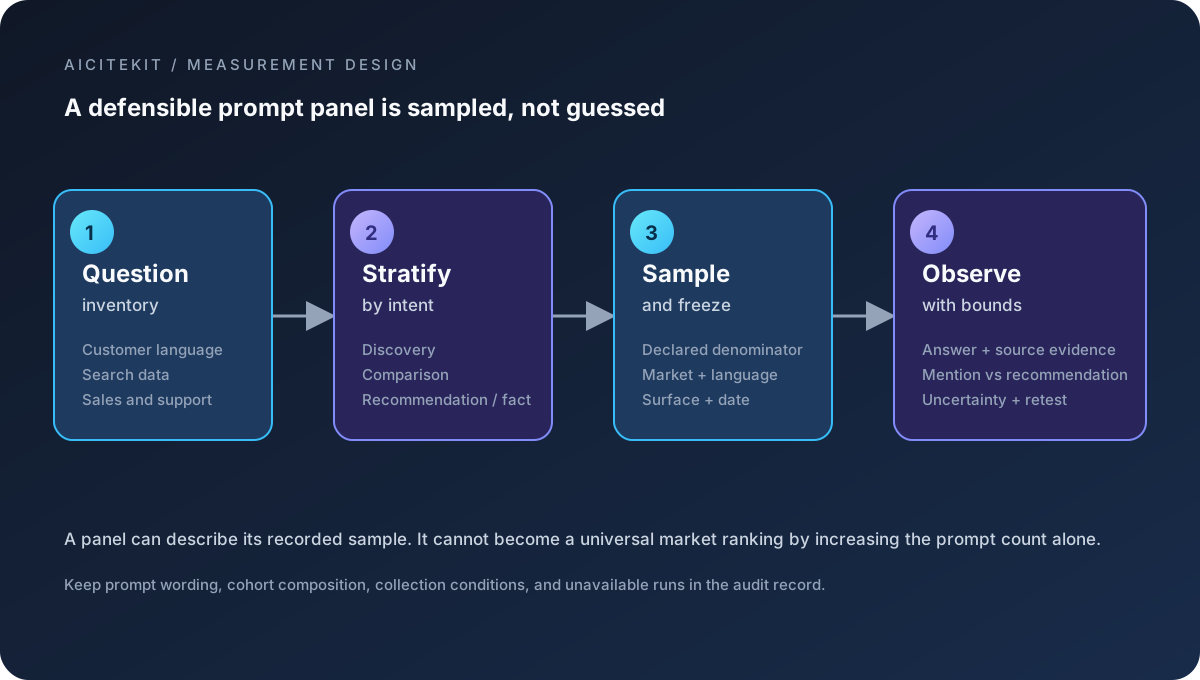
This guide addresses searches such as “how many prompts should I track for GEO?”, “what is a good AI visibility sample size?”, and “how do I build an AI Search prompt set?” The answer is a measurement design, not a magic threshold.
Why prompt count alone is a weak answer
An AI Search result depends on more than the wording of a question. The surface, mode, model or product configuration, market, language, date, retrieval state, and sampling rule can all affect the observation. Google describes AI features as Search experiences that may show links to supporting web resources (AI features and your website, checked September 27, 2026). OpenAI’s web-search documentation describes a particular tool that can return citations and source information (Web search, checked September 27, 2026). Neither source publishes a cross-platform prompt sample size that guarantees visibility or citation measurement.
The academic paper GEO: Generative Engine Optimization studies visibility in a defined experimental setting (Aggarwal et al., arXiv, checked September 27, 2026). It is useful independent research context for thinking about generative-engine visibility. It does not establish a commercial dashboard’s score, current platform coverage, traffic forecast, or revenue effect.
Treat every count as a denominator with a scope:
| Statement | What it can support | What it cannot support |
|---|---|---|
| Brand appeared in 8 of 20 captured runs | 40% appearance in this defined sample | 40% of the market or all AI answers |
| Target URL appeared in 4 of 20 answers | 20% visible source rate in the sample | That the page caused the answer or a click |
| Result repeated across three dates | Repetition under the recorded conditions | A permanent ranking or causal trend |
| Tool reports 1,000 monitored prompts | The tool’s configured or available prompt count | That the 1,000 prompts represent buyer demand |
| A larger panel finds more mentions | More observations in that panel | Better measurement if cohorts are unbalanced |
1. Define the decision the panel must support
Write one primary decision before collecting prompts. A secondary use is fine, but do not allow a single blended score to hide incompatible jobs.
| Decision | Prompts should cover | Minimum output |
|---|---|---|
| Category discovery | Unbranded problems and category terms | Brands, criteria, and visible source URLs |
| Comparison | Named alternatives and buyer constraints | Mention, recommendation, criteria, and evidence |
| Product accuracy | Product facts such as limits, integrations, and audience | Claim-by-claim fact check and source |
| Recommendation fit | A defined buyer, use case, market, or budget constraint | Why the answer selected or rejected an option |
| Source development | Questions where independent sources matter | Source type, page, claim, and recurrence |
| Change monitoring | A stable set of previously observed questions | Before/after answer evidence and conditions |
If the decision is “should we update our pricing page?”, include product-fact and pricing questions. If the decision is “are we visible to category buyers?”, include unbranded discovery and comparison questions. Do not call either panel a complete measure of AI visibility.
2. Build a broad question inventory before sampling
A panel should be drawn from a documented inventory, not only from prompts an LLM generated for convenience. Candidate sources include:
- Search Console queries and site-search terms
- Sales-call notes and recurring objections
- Support conversations and onboarding questions
- Competitor comparison language
- Community discussions and review-platform questions
- Product documentation gaps
- Existing editorial or customer research
Label each candidate with its source and collection date. A question from one sales conversation is a useful candidate, but it is not automatically representative customer research. Generated variants can help find gaps; they should not be the only evidence that a prompt reflects demand.
Normalize only when meaning stays constant. Keep separate prompts when the audience, region, budget, product category, constraint, or requested action changes.
| Candidate | Can be grouped when | Keep separate when |
|---|---|---|
| “AI citation tracker” / “tool to track AI citations” | Both ask for the same category | One asks for a vendor and one asks for a method |
| “Best GEO tool for an agency” | Buyer context is identical | Agency size, market, or budget changes |
| “Does Product A support ChatGPT?” | Same surface and product mode | The question changes to API, consumer search, or another plan |
| “Alternatives to Product A” | Same replacement need | A new requirement such as localization or exports is added |
3. Stratify by intent before deciding the count
A balanced panel usually needs several cohorts. The exact labels depend on the business, but the reason for stratification is general: a single average can conceal strong performance in one question type and absence in another.
A practical starter panel
For a small team beginning a monthly baseline, use a declared starter panel such as:
- 10 category and problem-discovery prompts
- 10 comparison or alternative prompts
- 5 recommendation prompts with explicit buyer constraints
- 5 product-fact prompts
- 5 risk, implementation, or “what should I verify?” prompts
That is a design example, not a statistical standard or a claim that 35 prompts represent a market. Increase the cohort that maps to the decision, and document why. A local business may need regional and service-area variants; a publisher may need topic, recency, and source-type cohorts; a SaaS company may need integration, security, pricing, and competitor prompts.
Avoid silently replacing hard questions with easy branded variants just to raise the observed rate. Branded prompts test recognition or accuracy; category prompts test discovery. They are both useful, but they answer different questions.
4. Use coverage rules instead of a magic sample-size claim
A panel is ready for a baseline when it meets explicit coverage rules. For example:
- Every primary buyer decision has at least one cohort.
- Every important market, language, or region has a declared representation rule.
- High-risk facts such as pricing, availability, security, or medical claims have dedicated prompts.
- Branded and unbranded prompts are separated.
- Competitor prompts use the same constraints as the target-brand prompts.
- Each prompt has an owner, ID, exact wording, and version.
- The collection surface, date, mode, and model label are recorded when disclosed.
- Failed, unavailable, and partially collected runs remain visible in the denominator.
Coverage rules are more defensible than saying “track 100 prompts because that is what the industry uses.” They also make it possible to explain why a panel changed.
5. Separate repeated runs from unique prompts
A panel has at least two dimensions:
- Breadth: how many distinct questions and intent conditions are tested.
- Repeatability: how often the same question is collected under the same declared conditions.
A one-time panel with 200 unique prompts can reveal breadth but be hard to compare over time. A small panel repeated many times can reveal volatility but miss important buyer intents. Decide which uncertainty matters more for the current decision.
| Need | Favor | Caution |
|---|---|---|
| Find missing categories | More unique prompts across discovery cohorts | Do not average unrelated cohorts into one rate |
| Monitor a known change | Repeated fixed prompts | A stable panel may miss new intents |
| Compare two tools | Matched prompts and aligned conditions | Tool definitions may still differ |
| Study answer volatility | Repeated runs and timestamps | Changes may reflect surface or retrieval state |
| Validate a product fact | Fewer, precise prompts with claim review | A mention does not establish accuracy |
When budget is limited, preserve a core panel for continuity and rotate a smaller exploratory cohort. Mark the core and exploratory denominators separately.
6. Match the panel to the measurement budget
Credits, API calls, refreshes, and reviewer time constrain the practical panel. A simple planning model is:
collection volume = prompts × surfaces × runs × refreshesIf a workflow tests 35 prompts across 3 surfaces, with 2 runs per prompt each month, that is 210 prompt-surface runs before retries or failed collections. This is a planning formula, not a result about any tool or a recommendation to buy a particular plan. Confirm how a product counts credits: some workflows may charge by prompt, answer, model, refresh, or another unit.
AI Search Credit Budgeting covers this planning problem in more detail. The key principle is to protect evidence quality: a smaller panel with exact prompts, answer captures, and clear conditions can be more useful than a large opaque score.
7. Freeze the panel before comparing results
Create a record for each prompt:
Prompt ID: CAT-04-v1
Intent: category discovery
Audience: small B2B marketing team
Market/language: United States / English
Exact prompt: Which tools help a small B2B team monitor AI Search citations?
Surface and mode: recorded at collection time
Panel version: 2026-09-27-a
Output fields: mention, recommendation, visible URLs, claim support
Freeze the wording and cohort membership for the comparison period. If you edit a prompt, create a new version and explain the change. Otherwise a result may change because the measurement changed rather than because the observed answer changed.
Tools such as AI Search Console, Peec AI, Otterly.AI, PromptWatch, Profound, and Rankscale may expose different combinations of prompts, answers, sources, citations, and derived metrics. Their product pages are evaluations of workflows, not evidence that their metrics are interchangeable. During a trial, verify the exact prompt, surface, model, market, answer, source, and credit fields the product preserves.
8. Report uncertainty without fake confidence
A panel rate is descriptive. Say what was observed and retain the denominator:
The brand appeared in 12 of 30 qualifying captures in the fixed US-English panel collected on September 27, 2026. The result describes this panel and collection condition; it does not estimate universal AI Search visibility or market share.
Also report:
- Number of unique prompts and repeated runs
- Cohort composition
- Surfaces, modes, markets, and languages
- Collection dates and time zone
- Unavailable or failed runs
- Mention, recommendation, and citation rules
- Exact URLs and claims associated with sources
- Any prompt, plan, credit, or sampling limits
Do not hide a low denominator behind a percentage. “1 of 2” and “50%” are the same observation, but the count communicates its fragility more honestly.
What prompt sampling can and cannot prove
| Observation | Reasonable interpretation | Boundary |
|---|---|---|
| A brand appears repeatedly in one cohort | It appeared under those recorded conditions | Not universal preference |
| A competitor appears in more category prompts | It appeared more often in this panel and rule set | Not a stable market ranking |
| An owned URL is cited | The URL was visible in the captured answer | Not proof of a click or conversion |
| An answer changes after a page edit | Two observations differ after the edit | Not proof the edit caused the change |
| A larger panel finds a new source | The larger or different panel exposed it | Not proof the source is more authoritative |
| A tool reports a score | The tool calculated a metric under its method | Not proof the score is a universal measurement |
For the difference between presence and selection, see AI Search Mentions vs Recommendations. For mapping claims to their actual sources, see AI Search Answer Provenance.
A practical monthly workflow
- Review the decision. Remove prompts that no longer map to a current use case.
- Freeze the core panel. Keep IDs, wording, cohort, and collection rules stable.
- Run the exploratory cohort. Add new customer language without mixing it into the core rate.
- Capture the answer evidence. Preserve visible citations, exact URLs, claim relationships, and unavailable states.
- Review high-risk facts. Check pricing, limits, availability, integrations, and other claims against current first-party sources.
- Compare by cohort. Show counts and denominators before any blended view.
- Choose one bounded action. Fix a factual conflict, improve a source page, or investigate a missing criterion.
- Retest the core panel. Record what changed and what remains uncertain.
A panel is a measurement contract. It becomes more useful when the team can explain why each prompt exists and what decision its evidence can inform.
FAQ
Is 10 prompts enough for GEO?
Ten prompts can be a useful exploratory cohort or a narrow fact-check, but the number is not enough to establish universal visibility. It may be too small for a broad category study and unnecessarily large for one tightly scoped product claim. Define the decision and cohort first.
Is 100 prompts a statistically valid AI Search sample?
Not automatically. Validity depends on the population definition, sampling frame, intent coverage, collection conditions, and outcome rule. A hundred duplicated branded prompts can be less informative than a smaller panel that covers the relevant buyer questions.
Should every prompt run on every AI platform?
Only if the decision requires that comparison and the collection method is aligned. If budget is limited, assign surfaces to decisions and keep a smaller matched subset for cross-surface comparison. Do not compare platform rates without recording different answer, citation, and availability rules.
How often should prompts be refreshed?
Keep a core panel stable for the period needed to compare observations, then review it on a declared cadence. Add new questions as a versioned exploratory cohort. Refreshing every prompt every time can erase continuity; never refreshing can miss changed customer language.
Should I use the prompt count from a GEO tool’s plan page?
Use it as a commercial limit to verify, not as a research standard. Check what the unit means, whether runs across platforms consume separate credits, what happens to failed answers, and whether the tool preserves the raw evidence behind its metric.
What is the first panel I should build?
Start with the decisions that matter most, then create separate discovery, comparison, recommendation, product-fact, and risk cohorts as needed. A modest fixed core plus a smaller exploratory set is often easier to audit than an unstructured maximum-sized list.
Sources and verification
- Google Search Central: AI features and your website — checked September 27, 2026; used for the boundary around AI-feature links and foundational Search practices.
- OpenAI Developer Docs: Web search — checked September 27, 2026; used for the distinction between a documented web-search tool and other answer surfaces.
- Aggarwal et al., “GEO: Generative Engine Optimization” — checked September 27, 2026; independent academic context for measuring generative-engine visibility.
- AI Search Credit Budgeting — internal guide for translating prompt, surface, run, and refresh choices into collection volume.
- How to Evaluate an AI Search Visibility Tool Before You Buy — internal trial framework for checking prompt contracts and raw evidence.
The examples and panel sizes in this article are editorial planning patterns, not results from an AICiteKit measurement. No claim here establishes a guaranteed citation, ranking, traffic increase, or revenue outcome.
Last reviewed: September 27, 2026
Evidence confidence: Medium for the measurement guidance; high for the linked official documentation and academic paper; the proposed panel sizes are editorial recommendations rather than externally validated standards.