Field notes / ai-search
AI Search for B2B SaaS Comparison Pages: How to Audit Alternatives Queries
A practical AI Search and GEO audit for B2B SaaS comparison pages: capture alternatives prompts, verify product claims, map citations, and avoid mistaking a recommendation for proof of demand.
The short answer
A B2B SaaS comparison-page audit checks whether AI Search answers represent your product accurately when buyers ask for alternatives, migration options, or a shortlist. Capture the exact prompt, answer, surface, date, market, recommendation language, and cited URLs. Then verify each product claim against current first-party documentation and independent evidence.
Use this sequence:
buyer intent → answer capture → claim ledger → source review → bounded page actionA mention is not a recommendation. A recommendation is not proof of fit. A citation is not proof that the cited page supports every sentence around it. None of these observations, by themselves, proves pipeline, revenue, or causation.
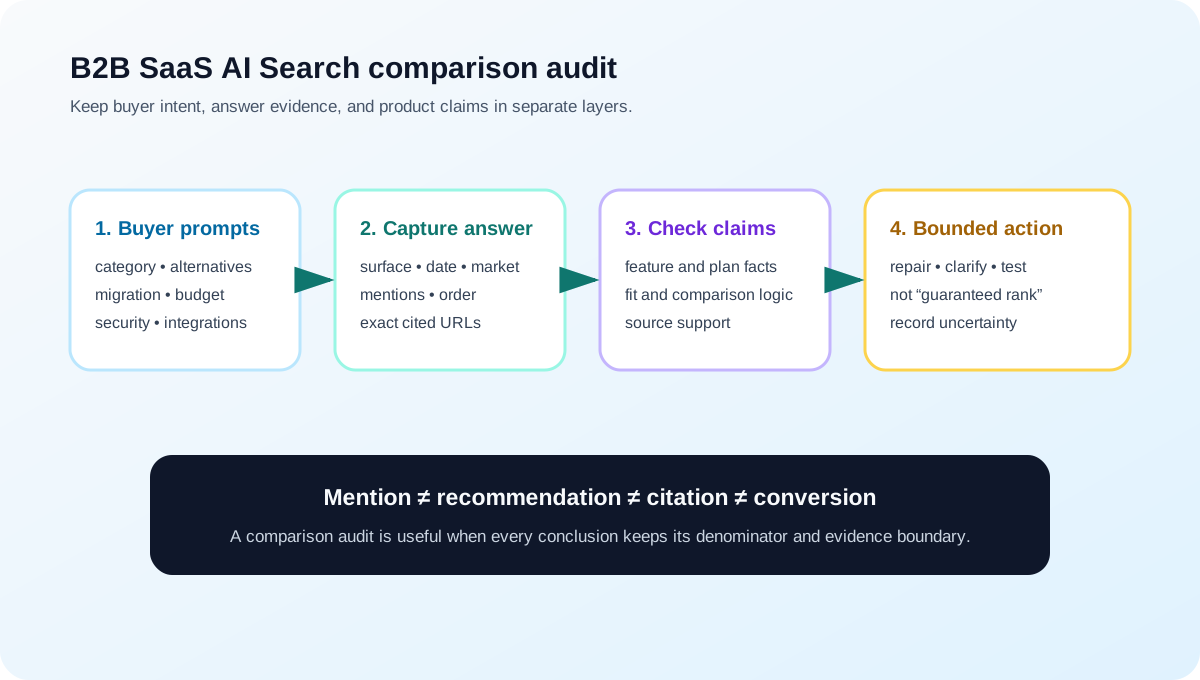
This guide addresses searches such as “how do I get my SaaS listed in AI comparisons?”, “why does ChatGPT recommend competitors instead of my software?”, and “how should I audit an alternatives page for GEO?” It is a measurement and editorial workflow, not a promise of inclusion or a substitute for product research.
Why comparison prompts deserve their own audit
A category prompt and an alternatives prompt are not interchangeable. “What tools monitor AI citations?” asks for a category set. “What are alternatives to Product X for a five-person agency?” adds a competitor, audience, and implied switching decision. “Which option supports our security requirements?” adds a qualification criterion.
Those differences affect what a useful answer should contain:
- Category discovery: which products are considered relevant at all?
- Alternative selection: which products are presented as substitutes for a named tool?
- Migration fit: which constraints are considered during a switch?
- Shortlist recommendation: which options are ranked or recommended, and why?
- Fact verification: are pricing, integrations, limits, and security claims current?
Google says its AI features may show links to supporting web resources and recommends foundational Search practices (AI features and your website, checked October 5, 2026). That is official guidance about Search features and supporting resources. It is not a published rule that a comparison page will be selected, nor does it establish a universal AI Search position.
OpenAI’s web-search documentation describes a tool that can return citations and source information (Web search, checked October 5, 2026). This documents one API implementation. It does not make API output interchangeable with consumer ChatGPT, Google Search, Perplexity, or another answer surface.
The independent paper GEO: Generative Engine Optimization studies visibility in a defined experimental setting (Aggarwal et al., arXiv, checked October 5, 2026). It is useful research context, but it does not validate a commercial tool score, current platform behavior, or a revenue outcome.
What this audit can and cannot establish
For a declared prompt sample and collection context, the audit can establish:
- Whether your product was mentioned, recommended, compared, or omitted.
- Which alternatives appeared and how the answer described them.
- Which exact URLs were visibly cited, where the surface exposes them.
- Whether a cited page supports the specific claim it appears beside.
- Whether your own comparison page contains current, scoped, and inspectable facts.
It cannot establish from a single answer or dashboard percentage:
- A universal rank across AI Search products or users.
- That an answer’s order represents market share or buyer preference.
- That a citation caused an answer, visit, lead, or deal.
- That an AI-generated recommendation is an independent product review.
- That changing a comparison page caused a later answer change.
- That a competitor’s absence means low product quality or low demand.
Write the evidence boundary into the report before discussing optimization. Otherwise, “we appeared in one answer” can quietly become “we win the category.”
1. Define the switching decision
Start with the decision a buyer is trying to make, not the keyword you want to rank for. A useful comparison panel has explicit audience and constraints.
| Prompt family | Example intent | Evidence to capture | Do not infer alone |
|---|---|---|---|
| Alternatives | Find substitutes for a named product | Products listed, rationale, source URLs | That the listed products are equally suitable |
| Migration | Replace a current workflow or platform | Switching criteria, migration concerns, integrations | That a page mention creates migration demand |
| Budget | Find options within a price or team-size limit | Price language, billing scope, limits | That a displayed price is current without checking it |
| Security or compliance | Shortlist products under a risk constraint | Security claims, certifications, regional scope | That a vague security phrase is proof of compliance |
| Use case | Find a tool for a specific team or job | Audience fit, workflow, exclusions | That a generic category page answers the use case |
| Comparison | Compare named products against criteria | Criteria, product facts, citations | That one answer is a stable benchmark |
A prompt record should include:
- Exact wording and prompt-set version.
- Named competitor, if any.
- Audience, team size, use case, and constraints.
- Market, language, and location setting.
- Surface and mode; model or version when disclosed.
- Collection date, time zone, and run number.
- Full answer or permitted capture.
- Every visible citation URL and the claim it appears to support.
- Labels for mention, recommendation, citation, and uncertainty.
Do not replace an unfavorable question with a more convenient one. If the wording changes, create a new prompt version.
2. Separate mention, recommendation, and citation
A comparison report should never use one column called “visibility” for all answer behavior.
| Observation | Operational definition | What it supports | What it does not prove |
|---|---|---|---|
| Mention | Brand or product name appears | The product appeared in the captured answer | That it was endorsed or suitable |
| Inclusion | Product appears in a set of alternatives | The answer treated it as relevant to the question | That it is a serious substitute for every buyer |
| Recommendation | Answer uses recommending language or presents a shortlist | The answer made a recommendation under the recorded conditions | Independent validation of the recommendation |
| Position | Product appears in a particular order | The captured answer used that order | A stable rank or market share |
| Citation | A URL is shown as a source | The URL was visible in that capture | That it supports every nearby claim |
| Referral | Analytics records a separately identifiable visit | A referral signal was observed | That the citation caused the visit or a deal |
A useful audit can report these as a small vector rather than one score:
mention: yes
recommended: qualified
owned citation: two URLs
claim accuracy: one current, one unresolved
referral: not attributed
This prevents a product being counted as “winning” merely because its name appeared in an answer.
3. Build an alternatives prompt panel
Use a mix of branded and unbranded questions. Branded alternatives prompts test substitution context; unbranded prompts test category discovery. Keep their denominators separate.
Branded alternatives prompts
- What are alternatives to [named product] for a [team or use case]?
- Which tools can replace [named product] if we need [constraint]?
- Compare [your product], [competitor A], and [competitor B] for [workflow].
- What should a buyer verify before switching from [named product]?
Unbranded qualification prompts
- Which AI Search visibility tools support [specific workflow]?
- What should a small agency look for in a prompt-monitoring platform?
- Which products track citations and competitor sources for [category]?
- What are the tradeoffs between a self-serve tracker and an enterprise platform?
Risk and fact prompts
- Which of these products has [integration or capability]?
- What does [product] cost on a monthly plan?
- Which option supports [region, language, or security requirement]?
- What limitations should a buyer check before choosing [product]?
Hold the panel stable for trend checks. Add new prompts in a separate discovery set rather than silently replacing questions that produced inconvenient results.
For sampling context, see How Many AI Search Prompts Should You Track? and AI Search Prompt Mapping. Those methods can improve repeatability, but no fixed sample becomes representative of every buyer automatically.
4. Create a claim ledger for the answer
Read the answer sentence by sentence. Extract product claims instead of treating one paragraph or one citation marker as a complete unit.
| Claim family | Example | Preferred verification |
|---|---|---|
| Identity | Product name, parent company, or category | Current official company and product pages |
| Capability | Supports prompt tracking, exports, integrations, or a workflow | Current documentation or reproducible product behavior |
| Commercial | Price, billing interval, credits, users, or limits | Official pricing or help-center page checked on the same date |
| Fit | Suitable for agencies, enterprises, or a team size | Declared criteria plus workflow evidence |
| Comparison | Better, cheaper, faster, or more complete than a named rival | Matched criteria and independent evidence; often unresolved |
| Outcome | Improves traffic, pipeline, citations, or revenue | Defined study or analytics design; never a citation alone |
A source URL can be present while the claim remains only partially supported. Common mismatches include:
- A source documents one plan while the answer generalizes to every plan.
- A product page describes an available feature while the answer claims a measurable outcome.
- A review describes a user’s workflow while the answer turns it into a universal product judgment.
- A pricing page is current in one market while the answer applies it to another.
- A source is about traditional SEO or content generation while the answer applies it to a newer GEO feature.
Mark each claim as supported, partial, conflicting, unresolved, or not evidenced. “Not evidenced” is more honest than filling a gap with vendor copy.
5. Review your comparison page as a buyer would
A comparison page should make its scope and evidence inspectable. Review it in five passes.
Pass 1: product identity and scope
Check that the page names the correct product, company, edition, market, and intended audience. Avoid merging a parent company’s broad capabilities with a specific plan or module.
Pass 2: current commercial facts
Verify prices, billing interval, credits, seats, projects, prompt limits, trial conditions, and enterprise language from the official source on the same research pass. Record the date checked. If the vendor does not publish a fact, say “not publicly disclosed” rather than estimating.
Pass 3: comparison criteria
Explain why the criteria matter to the buyer. “Best” is not a criterion. A defensible comparison might use:
- Prompt and surface coverage
- Geographic and language controls
- Raw answer and citation retention
- Export or API access
- Team and agency workflow
- Historical data and change handling
- Ease of verifying a claim
- Documented limitations
Pass 4: independent evidence
Separate first-party claims from independent evidence. A vendor-selected customer story can illustrate a reported use case, but it is not independent proof of a typical result. Traditional product reviews do not automatically validate a GEO monitoring feature. If independent feedback is sparse, state that scarcity.
Pass 5: update and correction path
Give each volatile claim an owner and review date. Add a visible correction path for stale pricing, capability, or competitor information. A comparison page that cannot be maintained is a liability even if it is currently accurate.
Google’s people-first guidance asks whether content is created to help people and whether a site has a primary purpose (Creating helpful, reliable, people-first content, checked October 5, 2026). That supports reviewing usefulness, accuracy, and purpose. It does not provide an AI citation threshold or guarantee selection of a comparison page.
6. Map citations to claims, not just domains
Record the exact URL and the sentence or criterion it appears to support.
| Capture field | Why it matters |
|---|---|
| Exact answer and prompt | Prevents a paraphrase becoming the evidence |
| Surface, mode, and date | Makes the observation reproducible enough to review |
| Product and competitor names | Distinguishes identity from category presence |
| Recommendation language | Separates inclusion from buying guidance |
| Exact cited URL | Domain totals hide page-level differences |
| Claim beside the citation | Shows what the source appears to support |
| Source type | Distinguishes first-party, independent, community, or vendor-selected evidence |
| Verification result | Records current, partial, stale, conflicting, or unresolved |
A simple ledger can look like this:
Prompt: ALT-004 v2
Surface: recorded AI Search surface and mode
Collected: 2026-10-05 UTC
Answer observation: Product A recommended for agencies
Visible source: exact URL captured from the answer
Claim checked: agency workspace and export workflow
Result: feature supported; suitability remains editorial interpretation
Referral: not inferred from citation
The example is a schema illustration, not a measured result. Production records should contain the actual captured answer and actual URL.
7. Turn a finding into one bounded content action
A comparison audit should end with a testable action, not a broad instruction to “optimize for AI.” Choose the smallest change that addresses the evidence.
| Finding | Reasonable action | Follow-up evidence |
|---|---|---|
| Product identity is unclear | Clarify product, company, and audience scope | Recheck identity claims in matched prompts |
| Pricing is stale | Correct the fact and add a review owner | Verify the page and future answer captures separately |
| Feature claim is unsupported | Remove, qualify, or document the claim | Recheck source support; do not assume visibility change |
| Comparison criteria are vague | Add explicit criteria and tradeoffs | Review whether answers describe the criteria accurately |
| Competitor source is cited instead | Inspect the competitor page and your coverage | Decide whether a useful evidence gap exists |
| Brand is mentioned but not recommended | Review prompt fit and buyer criteria | Do not infer low quality from one sample |
| Citation appears beside an unsupported claim | Record the mismatch and correct your page if needed | Preserve the original capture; avoid causal claims |
Do not make five unrelated edits and then attribute an answer change to one of them. A controlled retest can show that two observations differ; it rarely proves why they differ.
Tools such as AI Search Console, Peec AI, Otterly.AI, Profound, and Rankscale represent different monitoring and reporting workflows. During a trial, verify whether a tool preserves raw answers, exact URLs, prompt context, dates, failed runs, and metric definitions. Product pages and vendor documentation describe stated capabilities; they are not proof that outputs are interchangeable or that a tool causes recommendations.
A 30-day B2B SaaS comparison audit
Week 1: scope and baseline
- Select one category, one switching decision, and one buyer segment.
- Create 15–30 prompts across alternatives, migration, qualification, and fact-checking intents.
- Freeze prompt IDs, language, market, surface, and definitions.
- Capture answers and every visible source URL where permitted.
Week 2: claim and source review
- Extract atomic claims from each answer.
- Check prices, limits, integrations, security language, and audience fit against current official sources.
- Review independent evidence separately from vendor-selected material.
- Record partial and unresolved claims instead of forcing a binary score.
Week 3: one controlled page action
Choose one bounded change, such as correcting a plan fact, adding a clear audience limitation, or replacing an unsupported comparison claim with a documented criterion. Record the page version and change date.
Week 4: matched retest
- Re-run the same prompt version under the same declared conditions.
- Compare mention, inclusion, recommendation language, source URLs, and claim support separately.
- Check analytics independently for identifiable referrals.
- Report what changed, what did not, and what remains unknown.
A defensible conclusion might be:
In the October 5 retest, the product appeared in the captured answer for the same alternatives prompt, but the recommendation wording and source URLs changed. One feature claim remained supported by official documentation; suitability for the stated agency was still an editorial judgment. No referral or pipeline effect was inferred.
That is more useful than “the comparison-page update improved GEO.”
Common mistakes
Publishing a “best alternatives” list without criteria
A list is not a comparison. State the buyer, constraints, and reasons an option may or may not fit.
Treating competitor content as independent evidence
A competitor-authored comparison can reveal market language or a workflow observation. It has a commercial perspective and should be labeled accordingly.
Generalizing from traditional reviews
Evidence about a vendor’s writing assistant, SEO suite, or general usability does not automatically validate its AI Search monitoring feature. Keep the evidence boundary visible.
Counting a name as a recommendation
A product can be mentioned as an example, rejected for a constraint, or listed without a buying rationale. Preserve the wording.
Updating the page from an answer alone
An AI answer is a discovery signal. Verify volatile facts and product claims against current sources before editing the page.
Treating a citation as a conversion
A cited URL, a browser referral, a signup, and a qualified opportunity are different records. Use analytics and CRM evidence for outcome claims.
Trial checklist for buyers and publishers
Before choosing a GEO or AI Search monitoring workflow, verify:
- Can the system store exact prompt versions and collection dates?
- Does it distinguish mention, recommendation, citation, source position, and omission?
- Can you inspect the raw answer or only a derived score?
- Are market, language, location, surface, and mode visible?
- Are exact URLs retained, or only domains and counts?
- Can a reviewer map a URL to the claim it appears to support?
- How are unavailable runs, parser changes, and historical recalculations handled?
- Can you export evidence for an editorial or product-fact review?
- Are traditional SEO or content signals clearly separated from GEO-specific observations?
- Does the vendor avoid promising rankings, citations, traffic, or revenue?
FAQ
Should every B2B SaaS company create an alternatives page?
No. Create one when there is a real buyer decision, defensible product knowledge, and a maintenance owner. A thin page that repeats competitor names without criteria or evidence is not a useful comparison.
Does being recommended by an AI answer mean the product is a market leader?
No. It means a recommendation was observed under particular prompt and collection conditions. It does not establish market share, universal preference, or product quality.
How many comparison prompts should I track?
There is no universal number. Start with a small panel that covers the actual switching decisions, then expand when you can maintain the records. Report the numerator, denominator, prompt definitions, and collection conditions.
Should I add competitor names to improve AI visibility?
Not as a blanket tactic. Use competitor references when they help a reader understand a legitimate comparison, migration choice, or tradeoff. Do not add names merely to create an unsubstantiated association.
Can a comparison page guarantee AI citations?
No. Official Search documentation and independent GEO research do not support a guarantee. A page can be accurate, useful, and accessible without being cited in every answer.
Can a recommendation prove that a comparison-page edit worked?
No. A before-and-after change is an observation. To make a stronger causal claim, you would need a controlled design that accounts for prompt, surface, retrieval, source, and time changes—and even then, business outcomes need separate evidence.
Sources and evidence boundaries
- Google Search Central: AI features and your website — official Search guidance checked October 5, 2026 for AI-feature and supporting-link context; it does not guarantee inclusion or define a universal comparison-page ranking.
- Google Search Central: Creating helpful, reliable, people-first content — official guidance checked October 5, 2026 for usefulness, purpose, and quality review; it does not provide a GEO citation threshold.
- OpenAI Developer Docs: Web search — official API documentation checked October 5, 2026 for citations and source information; it is not evidence that API output matches every consumer or commercial search surface.
- Aggarwal et al., GEO: Generative Engine Optimization — independent academic research checked October 5, 2026 for experimental visibility context; it does not validate current vendor scores or business outcomes.
- AICiteKit editorial framework — the prompt panel, claim ledger, comparison classifications, and trial checklist in this article; editorial guidance, not a platform specification.
Final takeaway
A B2B SaaS comparison page should help a buyer make a constrained decision, not merely place more brand names in an AI answer. Capture alternatives prompts under declared conditions, distinguish mention from recommendation, map every citation to the claim it appears to support, and verify volatile product facts before changing the page.
The strongest conclusion is usually narrow: what appeared, what was supported, what was stale or unresolved, and what should be tested next. This article does not guarantee citations, recommendations, rankings, traffic, pipeline, or revenue.