Field notes / ai-search
AI Search Share of Voice: Define the Denominator Before You Compare Brands
A practical framework for measuring AI Search share of voice with declared prompts, intent cohorts, source rules, and separate mention, recommendation, and citation rates.
The short answer
AI Search share of voice is not a single platform-defined number. It is a rate calculated over a declared set of prompts, surfaces, markets, dates, and inclusion rules.
A defensible measurement looks like this:
fixed prompt panel → captured answers → coded observations → rate with denominatorBefore comparing two brands, publish at least:
- Which prompts were run, and how they were grouped by intent
- Which AI Search surfaces, models, markets, languages, and dates were included
- Whether the metric counts mentions, recommendations, citations, or source appearances
- How empty answers, repeated brands, multiple citations, and failed runs were handled
- The numerator, denominator, and raw observation or export behind the result
A larger percentage is not automatically better evidence. A small branded prompt set can make a brand look highly visible while saying little about category discovery. A score that mixes prompt types, engines, and markets can be precise-looking without being comparable.
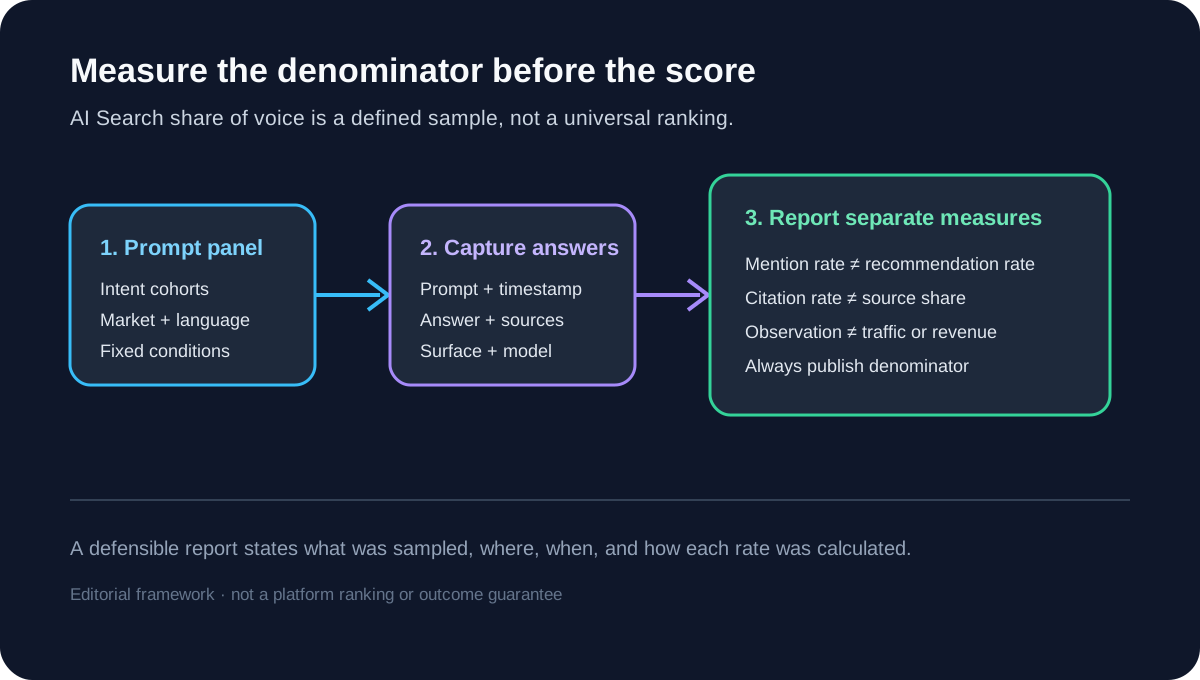
This guide addresses searches such as “how do I measure AI Search share of voice?”, “what is GEO share of voice?”, and “how do I compare brand visibility in ChatGPT or Google AI features?” It is a measurement framework, not a guarantee of retrieval, citation, recommendation, traffic, or revenue.
Why the phrase is easy to misuse
Traditional search share-of-voice discussions often imply a defined results page, query set, location, and ranking rule. AI answers add more moving parts: the answer may be generated from a changing retrieval process, the response may differ by surface or account state, and a brand can be mentioned without being recommended or cited.
Google’s guidance on AI features and your website, checked October 28, 2026, says AI features may show links to supporting web resources and points site owners toward foundational Search practices. It does not define a universal AI share-of-voice metric.
OpenAI’s web search documentation, checked October 28, 2026, documents citations and source information for a particular API tool. That supports inspecting what that implementation returns; it does not prove that all ChatGPT surfaces or other answer engines expose or rank sources identically.
The independent paper GEO: Generative Engine Optimization, checked October 28, 2026, provides research context for visibility in generative engines. It is not validation of a commercial dashboard score, current engine coverage, or business outcome.
Define what “share” means
Use a metric name that tells the reader what was counted. Avoid reporting only “AI visibility: 42%.”
| Metric | Numerator | Denominator | What it can show | What it cannot show alone |
|---|---|---|---|---|
| Mention rate | Runs where the brand is named | Eligible captured runs | Brand recognition in the sample | Preference, quality, or a click |
| Recommendation rate | Runs where the brand is proposed as an option or answer | Eligible recommendation prompts | Observed recommendation frequency | That the recommendation is correct or persuasive |
| Citation rate | Runs with at least one visible source from the brand’s declared domain set | Eligible runs with inspectable source output | Source visibility in the sample | That the page caused the answer or referral |
| Source share | Brand-domain source appearances | All counted source appearances | Relative source presence among cited URLs | Authority, traffic, or market share |
| First-position share | Runs where the brand is first in a declared list | Eligible runs with an ordered list | Position within the captured answer | Universal rank or stable preference |
These are different questions. A brand can have a high mention rate and a low citation rate if the answer names it but cites independent comparison pages. It can have citations without being recommended if its documentation is used for a factual detail about another product.
Example calculation
Suppose a fixed panel has 40 eligible prompt-surface runs. A brand appears by name in 18 answers, is recommended in 9, and has at least one visible domain citation in 7.
mention rate       = 18 / 40 = 45%
recommendation rate =  9 / 40 = 22.5%
citation rate      =  7 / 40 = 17.5%
This is an illustrative calculation, not an AICiteKit measurement or a benchmark. If one answer contains five citations from the same domain, source share may use a different denominator. State the rule instead of reusing the 40-run denominator for every metric.
Build a prompt panel that matches the decision
Start with the business question, not the maximum prompt allowance of a vendor tool. Useful cohorts include:
| Cohort | Example question | Primary observation |
|---|---|---|
| Category discovery | “What tools help a small team monitor AI citations?” | Unbranded discovery and criteria |
| Problem discovery | “How can an agency audit AI visibility for clients?” | Use-case fit |
| Comparison | “Compare three AI Search monitoring tools for weekly reporting.” | Inclusion, ordering, and tradeoffs |
| Recommendation | “What should a lean B2B team buy if it needs raw source URLs?” | Recommendation under constraints |
| Product fact | “Does Tool X export answer citations?” | Claim accuracy and source support |
| Branded | “What is Tool X used for?” | Recognition and factual representation |
Do not blend these cohorts into one headline without showing the breakdown. Branded prompts test a different property from category discovery. Recommendation prompts also contain an editorial choice that a simple mention count misses.
A practical starter panel might use 10 category prompts, 10 problem prompts, 10 comparisons, and 5 product-fact or branded prompts. That is an editorial design example, not a statistical minimum or a claim that 35 prompts represent a market. Expand the cohorts that correspond to the decision and record why.
Keep prompt wording stable for a baseline. If you revise a prompt to make the brand more likely to appear, create a new version rather than silently replacing the old observation.
Freeze the observation conditions
For each run, retain:
- Exact prompt text and prompt-set version
- Surface and mode, such as a search feature, chat surface, or API implementation
- Model label or version when exposed
- Market, language, device, account state, and location assumptions when material
- Collection date and timezone
- Full answer or permitted raw capture
- Every visible source title and direct URL
- Empty, blocked, failed, and no-source states
If a tool hides raw answers or exact URLs, record that limitation. A derived visibility score without a documented denominator cannot be assumed to equal another vendor’s score. AI Search Console, Peec AI, Otterly.AI, Profound, and PromptWatch may expose different combinations of prompts, answers, citations, history, and derived metrics. Verify the export and counting contract during a trial rather than comparing labels alone.
Choose an observation unit
The same dataset can produce different rates depending on whether you count runs, answers, brands, citations, or source URLs.
| Unit | Counting rule | Useful for | Main risk |
|---|---|---|---|
| Prompt-surface run | One prompt on one declared surface | Reproducible baseline | Unequal failed-run handling can bias the rate |
| Answer | One returned answer | Answer-level coding | Multiple surfaces may not be comparable |
| Brand appearance | Each brand appearance in an answer | Competitive set analysis | One answer can contain many brands |
| Citation URL | Each visible source URL | Source portfolio analysis | Duplicate URLs and domains need rules |
| Domain appearance | Each source from a domain | Domain-level source share | Subdomains and publisher ownership need normalization |
Pick one primary unit per metric. For example, recommendation rate may be run-level, while source share may be citation-level. Do not call both simply “visibility.”
Handle multiple appearances explicitly
Write rules before coding:
- Count a brand once per answer for mention rate, even if its name appears repeatedly.
- Count recommendation only when the answer language proposes the brand for the prompt’s decision, not when it merely lists an example.
- Count a citation when a visible source URL is attached to the answer or relevant passage, according to the declared surface.
- Deduplicate identical URLs only if the metric is intended to count unique sources.
- Normalize domains transparently; do not merge an independent publisher with a vendor domain without documenting the rule.
- Treat an answer with no accessible source list as not inspectable, not automatically as “no citation.”
Report the denominator with the result
A minimum report row should look like this:
| Field | Example |
|---|---|
| Metric | Recommendation rate |
| Numerator | 9 runs where Brand A was recommended |
| Denominator | 40 eligible prompt-surface runs |
| Cohort | Category, comparison, and recommendation prompts |
| Surface | Declared answer surface and mode |
| Market/language | United States / English |
| Collection window | 2026-10-21 through 2026-10-28 |
| Exclusions | 2 failed runs excluded under the predeclared rule |
| Evidence | Answer captures, source URLs, and coding ledger |
If a run is excluded, show the count and reason. A denominator that changes after seeing the result is a measurement risk. If the panel contains 40 prompts but only 28 answers returned, report both 40 planned and 28 eligible rather than presenting 70% without context.
Compare like with like
A comparison is more credible when it aligns:
- The same prompt IDs and prompt versions
- The same intent cohorts and brand set
- The same surface, mode, market, and language
- The same collection window or matched windows
- The same eligibility, duplicate, and citation rules
- The same definition of mention, recommendation, and citation
If those conditions cannot be aligned, present the results as separate observations. Do not rank tools or brands from incompatible denominators.
Interpret change without claiming causality
A change from 20% to 30% means the observed rate changed under the stated conditions. It does not by itself establish that a page edit, schema change, link, review, or vendor setting caused the change.
Use a change log:
| Observation | Safe conclusion | Unsupported leap |
|---|---|---|
| Brand appeared in 6 of 20 runs, then 8 of 20 | The later sample had a higher observed mention rate | The content edit caused visibility |
| Citation rate rose after a docs update | The two observations differ after the update | The update caused retrieval |
| A competitor was recommended more often | The competitor had more recommendations in this panel | The competitor is universally preferred |
| A dashboard score increased | The vendor’s defined score increased | Traffic or revenue increased |
For referrals and conversions, use analytics and a separately defined attribution method. Google Analytics documentation on traffic-source dimensions, checked October 28, 2026, describes how sessions and source dimensions can be analyzed in GA4. That is a separate measurement layer from an answer observation; an AI citation does not prove a session or conversion.
Evidence boundaries
Keep these claims separate:
- Observed: a brand, recommendation, or source appeared in a captured answer.
- Supported: the visible source actually supports the relevant claim after inspection.
- Measured: a declared coding rule produced a rate over a declared denominator.
- Attributed: analytics or an experiment links an outcome to a source under a stated method.
A share-of-voice report supports the measured observation only within its panel and conditions. It does not prove universal AI visibility, authority, ranking, sentiment, citation quality, traffic, leads, or revenue. An academic paper can inform methodology without validating a commercial score. A vendor case study is vendor-selected customer evidence, not independent proof of general outcomes.
A trial checklist for GEO tools
Before buying a monitoring or optimization product, ask it to demonstrate:
- Can I export the exact prompt text, answer, source URLs, timestamp, surface, and model label?
- What is the billing unit: prompt, run, answer, model, refresh, or another credit?
- How are failed, empty, blocked, and no-source results counted?
- Can I separate branded, category, comparison, recommendation, and product-fact cohorts?
- Can I see numerator and denominator behind every visibility or share metric?
- How are duplicate citations, repeated brands, subdomains, and publisher domains normalized?
- Can I rerun the same panel and compare versions without silently changing the prompt set?
- Which engine, market, language, and model combinations are actually supported on my plan?
- Does the product measure answers, citations, referrals, or only a derived score?
- Can I retain the evidence needed for an independent QA review?
A polished chart is useful only when the underlying observation contract is inspectable.
FAQ
Is AI Search share of voice the same as AI visibility?
Not necessarily. “AI visibility” is a broad label that may include mentions, recommendations, citations, sentiment, or a vendor-defined score. Share of voice should name its numerator, denominator, and observation unit.
How many prompts do I need?
There is no universal number. Use enough prompts to cover the decision’s relevant intent cohorts, then keep the core panel stable for comparison. A larger panel with duplicated branded questions can be less informative than a smaller, balanced panel.
Should I combine ChatGPT, Google AI features, and Perplexity into one score?
Only if you declare a defensible aggregation rule and preserve the per-surface breakdown. In most reporting, separate surfaces first; combine only when the reader can inspect the weights and denominators.
Does a citation count as a brand mention?
Not always. A source URL may cite a brand’s documentation without recommending the brand, and an answer may mention a brand without linking it. Code the two observations separately.
Does a higher share of voice prove better SEO or GEO performance?
No. It shows a higher observed rate under a defined sample. It does not prove causality, universal preference, rankings, traffic, or revenue.
Sources and verification
- Google Search Central: AI features and your website — checked October 28, 2026; official context for AI-feature links and the boundary around what Google documents.
- OpenAI Developer Docs: Web search — checked October 28, 2026; official documentation for one web-search implementation’s source and citation fields.
- Aggarwal et al., “GEO: Generative Engine Optimization” — checked October 28, 2026; independent academic research context, not validation of a vendor metric.
- Google Analytics Help: Traffic-source dimensions — checked October 28, 2026; official context for separating analytics traffic measurement from answer observations.
- How to Evaluate an AI Search Visibility Tool Before You Buy — internal trial framework for checking raw evidence and denominator definitions.
- AI Search Prompt Sampling — internal framework for building declared, repeatable prompt cohorts.
The examples and percentages in this article are editorial calculations, not collected AICiteKit results. No claim here guarantees retrieval, citation, recommendation, traffic, or revenue.
Last reviewed: October 28, 2026
Evidence confidence: High for the linked official documentation and the arithmetic examples; medium for the measurement framework because platform output and tool definitions vary; editorial for the proposed cohort and reporting rules.