Content Inventory vs Prompt Monitoring: Two GEO Workflows That Should Not Be Confused
A practical framework for connecting content inventory and topic planning with AI Search prompt monitoring without treating optimization scores as proof of citations, traffic, or revenue.
The short answer
Content inventory and prompt monitoring answer different questions:
- Content inventory: What do we have, what is missing, and which pages should we improve?
- Prompt monitoring: What do AI systems answer for a defined set of questions, and which brands or sources appear?
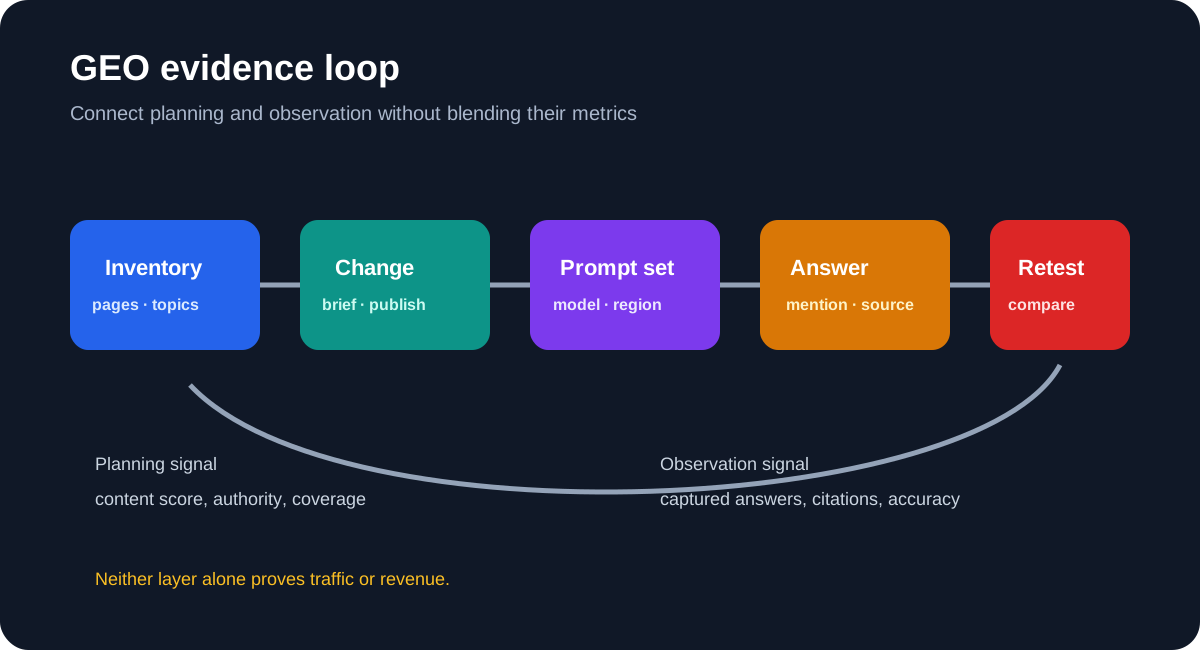
A good GEO program connects them in a loop, but does not merge their metrics:
inventory → content decision → publication → prompt sample → answer evidence → retestA content score is not a citation. A citation is not a click. A click is not proof of revenue causation.
MarketMuse is an example of the inventory and topic-model side. Tools such as AI Search Console and Otterly.AI serve a different monitoring job.
Why the distinction matters
A page can be comprehensive and still not appear in an AI answer. An AI answer can cite a page that has not changed recently. A tracker can report a visibility movement while the underlying prompt, model, country, or sampling schedule has changed.
If these signals are collapsed into one dashboard number, teams lose the ability to ask whether the issue is:
- Missing or unclear content
- Weak external source coverage
- Technical access
- Brand-entity confusion
- Prompt or model volatility
- A measurement definition that changed
The practical solution is to keep the planning layer and observation layer separate, then connect them with an explicit hypothesis.
1. What a content inventory measures
An inventory is a structured view of the site’s pages, topics, entities, owners, status, and opportunities. It can support decisions such as:
- Which pages overlap or compete with each other?
- Which important customer questions have no owned page?
- Which pages are stale, thin, or hard to maintain?
- Which topic clusters have strong or weak coverage?
- Which pages should be refreshed before creating new content?
Platforms may add proprietary metrics for difficulty, authority, topical coverage, or content quality. These can be useful for prioritization, but they are model outputs. Record the definition and version of the metric before using it in a before-and-after comparison.
Inventory checklist
| Field | Why keep it |
|---|---|
| URL and canonical URL | Prevent duplicate or ambiguous page decisions |
| Primary entity and topic | Keep the subject explicit |
| Audience and intent | Avoid optimizing for the wrong question |
| Owner and status | Make the next action accountable |
| Last meaningful update | Distinguish fresh from merely republished |
| First-party facts and sources | Support accuracy checks |
| Related prompts | Connect content work to observable answers |
| Change log | Preserve the experiment baseline |
2. What prompt monitoring measures
A prompt panel is a documented sample of questions run across selected AI surfaces, models, regions, languages, and dates. It can measure observations such as:
- Whether a brand appears in the captured answer
- Whether a domain or URL is cited
- Which competitors are recommended
- How the answer describes a product or limitation
- Which third-party sources recur
- Whether a result changes across repeated runs
The sample does not represent every AI conversation. It also does not automatically reveal why a system selected a source. For a construction method, see How to Build a Reliable AI Search Prompt Set.
3. Connect the layers with a hypothesis
Avoid this claim:
We raised the content score, so AI visibility improved.
Use a testable chain instead:
The category page lacked an explanation of implementation constraints and was absent from several comparison prompts. We added a sourced section, kept the prompt panel stable, and will compare answer captures and citations over the next defined observation window.
That statement identifies:
- The observed content gap
- The intended change
- The stable measurement conditions
- The evidence to inspect
- The limit of the conclusion
A result can be encouraging without being causal proof. Model updates, PR, competitors, seasonality, and prompt volatility may all contribute.
4. Build a crosswalk from topics to prompts
A useful crosswalk maps content decisions to question types rather than pretending that one keyword equals one AI answer.
| Content decision | Prompt groups to add | Evidence to inspect |
|---|---|---|
| Explain a category | Category and problem prompts | Recommendation, explanation, sources |
| Clarify product differences | Comparison and evaluation prompts | Feature framing, competitor order, citations |
| Correct stale facts | Branded and risk prompts | Price, limits, dates, factual accuracy |
| Expand a regional page | Regional and multilingual prompts | Local recommendations, language, sources |
| Address a source gap | Category and competitor prompts | Repeated third-party domains and URLs |
| Improve product discovery | Recommendation and purchase prompts | Product identity, fit, caveats, citation |
This crosswalk helps an editor write for a real question while giving the measurement owner a reason for each prompt.
5. Use answer-level evidence
Store the observation behind every important trend where the tool or platform permits:
- Exact prompt and prompt-set version
- Engine or model
- Country and language
- Run date and sampling rule
- Full answer or capture
- Mentioned brands
- Linked URLs and source position
- Accuracy notes
- Relevant site change and publication date
A percentage without a denominator or answer sample is hard to audit. A source list without the answer context can also hide whether the page was actually cited or merely related to the topic.
6. Avoid common interpretation errors
Error: treating topical coverage as a ranking guarantee
Topic models can identify gaps and related concepts. They cannot guarantee an organic position or an AI citation.
Error: treating crawler activity as citation evidence
A crawler request shows automated access, not that a model used the page in an answer. See How to Audit AI Crawler Access for the technical distinction.
Error: treating a citation as traffic
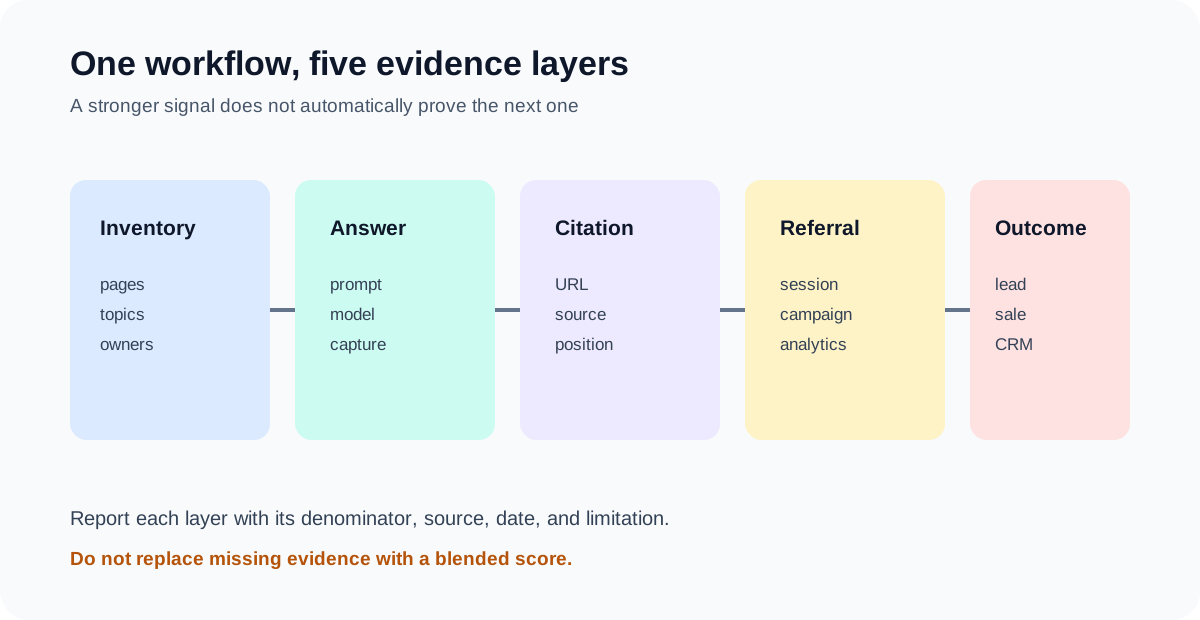
A visible link may not be clicked, and analytics may not preserve the originating AI context. Keep citation and referral data in separate columns.
Error: treating traffic as revenue causation
Even a detectable AI referral and conversion need an attribution definition and competing explanations. Do not turn correlation into a causal claim.
Error: changing the prompt panel after an inconvenient result
Version the prompt set. A new sample may be valuable, but it is a new measurement period rather than a seamless continuation.
7. A 30-day operating rhythm
Week 1: inventory and baseline
- Freeze the page list, topic definitions, and known facts.
- Select a balanced prompt panel.
- Capture several baseline runs where possible.
- Note model, country, language, date, and competitor settings.
Week 2: diagnosis
- Find prompts where the answer is inaccurate, incomplete, or competitor-led.
- Classify the gap as content, source, entity, technical, or sampling-related.
- Assign one owner and one bounded change.
Week 3: publish and document
- Update one page or a clearly defined cluster.
- Record the exact change and publication date.
- Do not change unrelated prompts or competitors at the same time if comparison matters.
Week 4: retest and report
- Re-run the same panel.
- Compare answer evidence, citations, accuracy, organic data, and detectable referrals separately.
- State what changed, what did not, and what remains unknown.
Reporting template
| Layer | Example observation | Safe conclusion |
|---|---|---|
| Inventory | Page lacks a sourced comparison section | A content action is justified |
| Content change | Section published on August 18 | The intervention is documented |
| AI answer | Brand appeared in 7/20 category answers after retest | The defined sample changed |
| Citation | Client URL linked in 3/20 answers | The URL was cited in that sample |
| Referral | Analytics recorded tagged AI referrals | Detectable visits occurred under the attribution setup |
| Conversion | CRM recorded leads with source metadata | Those leads meet the defined attribution rule |
Do not fill an unanswered layer with the number from another layer.
When to use which tool category
- Choose a content-optimization platform when the problem is prioritization, topical coverage, briefs, or editorial workflow.
- Choose an AI visibility tracker when the problem is recurring answers, mentions, competitors, citations, or trend sampling.
- Choose crawler analytics when the problem is automated access, response codes, or log behavior.
- Choose web analytics and CRM tooling when the problem is detectable visits and business outcomes.
MarketMuse can be evaluated alongside Frase or Surfer AI Tracker for content workflows. For answer monitoring, compare products by prompt limits, engine coverage, raw answer access, citation definitions, region controls, exports, and sampling—not by a universal score.
Practical checklist
- The content inventory has URL, entity, topic, intent, owner, and source fields.
- Every priority prompt has a documented reason.
- Branded prompts do not dominate category visibility claims.
- Model, engine, country, language, date, and sample size are recorded.
- The change and publication date are frozen before retesting.
- Answer captures and cited URLs are retained where possible.
- Content score, visibility, citation, traffic, and conversion remain separate.
- Vendor-selected case studies are labeled as such.
- No result is described as a guaranteed citation, ranking, traffic, or revenue outcome.
FAQ
Can content optimization improve AI visibility?
It can make a page clearer, more complete, and easier for readers and retrieval systems to interpret. That is a plausible intervention, not a guarantee. Measure AI answers separately with a defined prompt panel.
Is a content score a GEO score?
Not automatically. A content score usually summarizes a platform’s model of topical coverage or optimization. A GEO score may use answer observations, prompts, citations, or other inputs. Confirm the definition before comparing them.
How many prompts should a team track?
There is no universal number. Start with a balanced set that represents discovery, use cases, branded accuracy, comparisons, evaluation, regional needs, and risk. Stability and coverage matter more than an arbitrary volume.
Should content teams and SEO teams share one dashboard?
They can share a workspace, but the evidence layers should remain distinct. A shared dashboard should show the definitions and underlying samples rather than hide them behind one blended score.
Sources and verification
- MarketMuse pricing — official inventory, topic, brief, and quota descriptions; checked August 18, 2026.
- Google Search Central: AI features and your website — official guidance that foundational SEO remains relevant to AI features; checked August 18, 2026.
- Google Search Central: Creating helpful, reliable, people-first content — content-quality context; checked August 18, 2026.
- Google Analytics campaign URL guidance — context for tagged referral measurement; checked August 18, 2026.
- AICiteKit: How to Build a Reliable AI Search Prompt Set — internal prompt methodology reference.
This is AICiteKit editorial guidance. It does not claim that any inventory method, tool, or optimization change guarantees visibility, citations, traffic, rankings, or revenue.