Field notes / ai-search
Does llms.txt Improve AI Search Visibility? An Evidence-Led Test Plan
Does llms.txt improve AI Search visibility? Learn what the proposal, crawler documentation, and controlled GEO tests can actually establish—and what they cannot.
The short answer
There is not enough public evidence to say that adding llms.txt improves AI Search visibility by itself. The proposal describes a way to offer a curated Markdown index for language-model use. Crawler documentation can explain how a particular system accesses websites. Neither one, alone, proves that an answer engine will fetch the file, use it for retrieval, cite a listed page, recommend a brand, or generate traffic.
Treat llms.txt as a technical experiment or documentation layer—not as a citation switch:
define the claim → publish and log the file → test matched prompts → inspect sources → report the boundary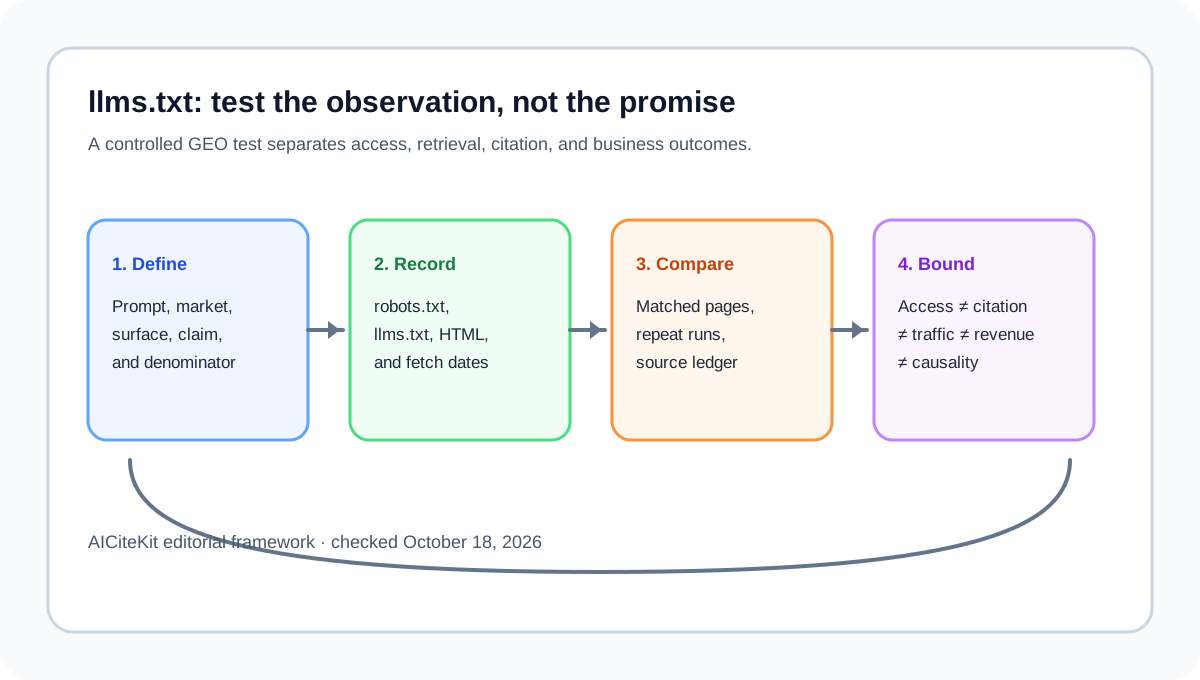
This guide addresses searches such as “does llms.txt improve SEO?”, “does llms.txt help ChatGPT citations?”, and “should I add an llms.txt file for GEO?” The practical answer is conditional: it may be a reasonable, low-cost way to make a site’s important resources easier for some automated readers to discover, but buyers and publishers should verify actual access and answer behavior rather than assume an effect.
What the public evidence says
The llms.txt proposal, checked October 18, 2026, describes a Markdown file at /llms.txt containing a short site summary and links to important resources. It is a proposal and specification-style document, not a statement that every search engine or AI product implements the convention.
Google’s AI features and your website documentation, checked October 18, 2026, describes how pages may appear in Google AI features and points site owners toward ordinary Search technical and content guidance. It does not say that llms.txt is required for eligibility or that publishing one guarantees inclusion.
OpenAI’s web crawler documentation, checked October 18, 2026, documents OpenAI bots and their purposes. It is useful for understanding the distinction between a crawler request and an answer-generation outcome. A bot being allowed to fetch a URL does not prove that the URL will be used or cited in a later answer.
Cloudflare’s Markdown for Agents announcement, checked October 18, 2026, describes a separate way to make Markdown representations available through Cloudflare’s infrastructure. It is a vendor-authored technical announcement, not independent evidence that llms.txt increases visibility across AI engines.
Evidence boundary at a glance
| Observation | What it supports | What it does not prove |
|---|---|---|
/llms.txt returns HTTP 200 | The file was reachable at the check time | An AI engine fetched or used it |
A crawler requests /llms.txt | That crawler requested the path under recorded conditions | A user saw a citation or recommendation |
| A page is listed in the file | The publisher selected that URL for the index | The page is authoritative, ranked, or cited |
| A prompt answer changes after publication | The tested answer changed between captures | The file caused the change |
| The file is referenced in documentation | A source describes the convention or implementation | Broad adoption or measurable business impact |
The evidence is stronger for what the file contains and whether a documented bot can access it than for whether the file changes retrieval, citation, referral, or conversion. Keep those questions separate.
1. Decide which question you are testing
“Does llms.txt work?” is not a measurable question. Pick one outcome and define the observation before publishing:
- Access: Can a named crawler retrieve the file and the linked pages?
- Parsing: Is the Markdown valid enough for the intended reader to interpret?
- Discovery: Does the file make a known page easier to find in a controlled retrieval test?
- Citation: Does a tested answer display a listed URL under a fixed prompt and surface?
- Business referral: Do analytics show identifiable visits from a documented AI surface?
The last three are not interchangeable. A file can be accessible without being used. A page can be cited without producing a visit. A visit does not by itself establish that llms.txt caused the citation or the visit.
Write a test record before the change:
Test ID: LLMS-2026-10-18-01
Claim: Adding a curated /llms.txt will make selected documentation pages easier to inspect in our defined AI Search panel.
Primary observation: visible source URL and source position in a qualifying answer.
Panel: fixed prompts, surface, market, language, and run schedule.
Not established by this test: universal eligibility, ranking, traffic, leads, or revenue.
This is a measurement contract, not a promise. If the question changes from “does the file get fetched?” to “does it increase citations?”, create a new outcome field and a new analysis rule.
2. Check the file as a technical resource
Before asking an AI engine to use the file, make the file inspectable to a human and to ordinary HTTP tooling.
Record:
- Exact URL and redirect behavior
- HTTP status, content type, and response size
robots.txtstate and any relevant bot rules- Last-modified or deployment timestamp when exposed
- Link targets and whether they resolve
- Canonical URL of each linked page
- Language, market, product edition, and date qualifiers
- Whether important content is omitted or duplicated
A minimal file should be curated, not a complete sitemap. The proposal’s own guidance describes a concise summary followed by important links. Do not use it to hide material limitations, stale pricing, or market qualifiers. A shorter index is not automatically a more trustworthy one.
A practical review table:
| Check | Record | Safe conclusion |
|---|---|---|
| File fetch | Status, headers, timestamp | The resource was reachable then |
| Link resolution | Status for each target | The target was or was not reachable then |
| Content scope | Included and omitted sections | The publisher’s declared selection |
| Freshness | Deployment and source dates | Whether a stale-file risk exists |
| Access rules | Relevant crawler directives | What the recorded rules allow or disallow |
| Answer observation | Exact prompt and visible URLs | What appeared in that capture |
Do not infer a crawler’s behavior from a browser test. A browser receiving 200 OK is not proof that a named AI crawler requested the same URL, from the same region, with the same policy.
3. Keep access evidence separate from citation evidence
Server logs can answer a narrow question: whether a request occurred. They usually cannot tell you why a later answer selected a source.
For an access record, retain:
- Timestamp and timezone
- Request path and normalized query handling
- User-agent string as logged
- Response status and bytes sent
- Cache status if exposed
- Redirect chain when applicable
- Relevant
robots.txtstate - Whether the request was verified as a known service or merely claimed a name
For an answer record, retain:
- Exact prompt and prompt version
- Surface and mode
- Country, language, and location context
- Collection timestamp and run number
- Complete answer or permitted near-raw capture
- Every visible source title and direct URL
- Whether the listed URL was in
llms.txt - Failed, empty, or no-source state
A useful join is possible only when timestamps, URLs, and collection rules are preserved. Even then, a nearby fetch is a correlation to investigate, not proof of causation.
This is the same evidence discipline used in AI Search Monitoring Data Retention: preserve the observation before compressing it into a dashboard metric.
4. Build a controlled prompt panel
If the outcome is citation or recommendation, use a fixed panel rather than occasional anecdotal searches. Keep the prompt, context, and counting rule stable long enough to identify what changed.
A small panel can include:
| Intent | Example question | Primary observation |
|---|---|---|
| Branded | What is [brand] and who is it for? | Mention and visible source URLs |
| Category | Which providers fit [declared constraint]? | Inclusion, recommendation, and source support |
| Fact | What is the current limit or integration? | Claim accuracy and source freshness |
| Comparison | How does [brand] compare with alternatives? | Criteria, qualifiers, and source mapping |
The examples are templates; use real buyer language for the category. Preserve qualifiers such as geography, budget, team size, edition, and date. Changing “best GEO tool” to “GEO monitoring tool with source exports for a five-person agency” changes the intent and should create a new prompt version.
For each run, record:
Prompt ID and exact text
Surface and mode
Market, language, and device context
Model label only if disclosed
Run timestamp and retry status
Answer status and visible source URLs
Whether each source URL appeared in /llms.txt
The panel should include control prompts that do not depend on the file. Otherwise, a broad change in the surface or source index may be mistaken for an llms.txt effect.
5. Compare matched observations, not before-and-after anecdotes
A credible test needs a comparison design. The simplest practical design is a staggered rollout:
- Freeze the prompt panel and collection conditions.
- Capture a baseline over multiple scheduled runs.
- Publish or materially revise
llms.txtand record the exact diff. - Continue the same panel and logging process.
- Compare answer-level source observations using the predeclared rule.
- Investigate changes against controls and platform changes.
Possible comparison fields include:
- Qualifying answers with at least one visible source
- Answers containing a selected URL
- Answer-source relationships containing a selected URL
- Source position within the captured answer, if exposed
- Claim-to-source support status
- Access requests for the file and linked pages
State the denominator. “Citations increased” is incomplete. A bounded report might say:
In the fixed panel, 8 of 40 qualifying captures before the change and 10 of 42 after the change displayed one of the selected URLs. The panel and surface were held constant as recorded. This observation does not identify whether
llms.txtcaused the difference and does not estimate visibility outside the panel.
Do not turn a small before-and-after difference into a universal lift. Answer variation, source updates, prompt drift, parser changes, and platform changes remain alternative explanations.
6. Inspect the claim-to-source relationship
A URL appearing in an answer is not proof that every sentence is supported by that URL. When a listed page is cited, inspect the relationship:
| Review question | Evidence to preserve |
|---|---|
| Was the URL visible in the answer? | Exact displayed URL and position |
Was the page listed in llms.txt at collection time? | Versioned file or content hash |
| Does the page support the nearby claim? | Relevant passage and checked date |
| Is the claim current for the market and plan? | First-party source and qualifier |
| Could another source explain the selection? | Other visible URLs and answer context |
If the file lists an outdated pricing page and the answer repeats an outdated limit, the problem is not solved by the file’s existence. Update the canonical source, remove stale links, and rerun the fact prompt. See AI Search Product Fact Audit for a claim-level workflow.
For technical access and source behavior, AI Search Access Audit is the relevant companion. For tool-based prompt capture, products such as AI Search Console, Otterly.AI, Peec AI, PromptWatch, and Profound can be compared by their documented panel, source, export, and retention behavior. The existence of a tool metric is not evidence that every tool measures the same thing.
7. Common failure modes
Treating the proposal as universal adoption
A public specification is evidence that someone defined a convention. It is not evidence that every crawler or answer surface implements it. Label support as documented, observed, or unknown for each named system.
Counting a fetch as a citation
A request to /llms.txt shows access under logged conditions. It does not show that a user saw the file, that a linked page was retrieved, or that a source was selected in an answer.
Publishing a second sitemap
A long list of URLs does not explain which pages are current, authoritative, or relevant to a question. Curate the file and keep the site’s ordinary crawl and navigation fundamentals healthy.
Changing the site at the same time
If you publish llms.txt, rewrite the page, change internal links, and alter structured data together, a later answer change cannot be assigned to one intervention. Record each change and use a control where practical.
Using one manual answer as the experiment
A single answer is useful for exploration. It is not a stable estimate of visibility. Preserve it, but label it anecdotal until the panel and repetition rules are applied.
Reporting a business outcome too soon
Citation, referral, engagement, lead, and revenue fields require separate measurement. A file publication date beside a later conversion is not a causal design.
A practical decision framework
Use the following decision tree:
- Need a curated machine-readable index? Publish a concise, maintained file if its operational cost is acceptable.
- Need to prove a crawler can access it? Test the URL and inspect verified request logs under a defined policy.
- Need to prove citation impact? Run a fixed prompt panel with preserved answers and source URLs.
- Need to prove traffic impact? Use analytics and referral definitions that identify the surface and attribution limits.
- Need to prove revenue impact? Design a separate controlled business measurement; do not reuse a citation percentage.
For most sites, llms.txt is a low-cost hypothesis worth testing only when the file can remain accurate. It is not a substitute for clear first-party documentation, crawlable pages, accurate product facts, or a reproducible AI Search measurement process.
FAQ
Is llms.txt an official Google ranking factor?
The checked Google AI features documentation does not identify llms.txt as a required eligibility mechanism or a guaranteed ranking factor. Do not describe it as one without a current, direct source that says so.
Will ChatGPT cite pages listed in llms.txt?
A listing does not guarantee a citation. OpenAI’s bot documentation and the llms.txt proposal answer different questions: one documents crawler roles and the other describes a site index convention. Test the actual answer surface and preserve the result.
Should every page be included?
Not necessarily. The proposal emphasizes a concise summary and important resources. Include pages that are current, useful, and accurately qualified. Do not use a curated file to conceal important limitations or stale content.
How long should I run a test?
There is no universal duration that makes a result causal. Choose the run count, panel, comparison window, and stopping rule before collection. Report qualifying and failed runs, not only favorable answers.
Can an AI Search tool prove that llms.txt worked?
A tool can expose observations under its own collection and counting method. It cannot, by a metric label alone, prove that the file caused a citation or business outcome. Verify raw prompts, answer captures, source URLs, timestamps, and the tool’s methodology.
Sources and verification
- The
llms.txtproposal — checked October 18, 2026; used to describe the proposed file format and scope. This is proposal evidence, not proof of broad implementation. - Google Search Central: AI features and your website — checked October 18, 2026; used for Google’s documented AI-feature and website guidance. It does not establish a guaranteed
llms.txteffect. - OpenAI: Bots — checked October 18, 2026; used to distinguish crawler access and bot roles from later answer selection.
- Cloudflare: Markdown for Agents — checked October 18, 2026; vendor-authored technical context for an adjacent Markdown delivery mechanism, not independent causal evidence.
- AI Search Monitoring Data Retention — companion AICiteKit methodology for preserving prompts, contexts, answers, sources, and metric rules.
- AI Search Access Audit — companion AICiteKit methodology for checking access signals without turning them into citation claims.
The evidence boundary is deliberate: official and vendor sources support documented conventions and platform behavior; the test design and recommendations are AICiteKit editorial judgment. No source checked here proves that llms.txt universally improves AI visibility, citations, traffic, leads, rankings, or revenue.
Last reviewed: October 18, 2026
Data confidence: Medium for the documented proposal and named platform guidance; low for any generalized causal claim about visibility or business impact.