Field notes / ai-search
AI Search Monitoring Data Retention: What to Export Before You Compare Tools
A practical AI Search monitoring data-retention framework for exporting prompts, answers, citations, timestamps, and scope fields before comparing GEO tools or reporting visibility changes.
The short answer
AI Search monitoring data retention is the practice of preserving the observation behind a visibility metric: the exact prompt, collection conditions, answer, visible source URLs, timestamps, model or surface labels when disclosed, and the rules used to calculate the report.
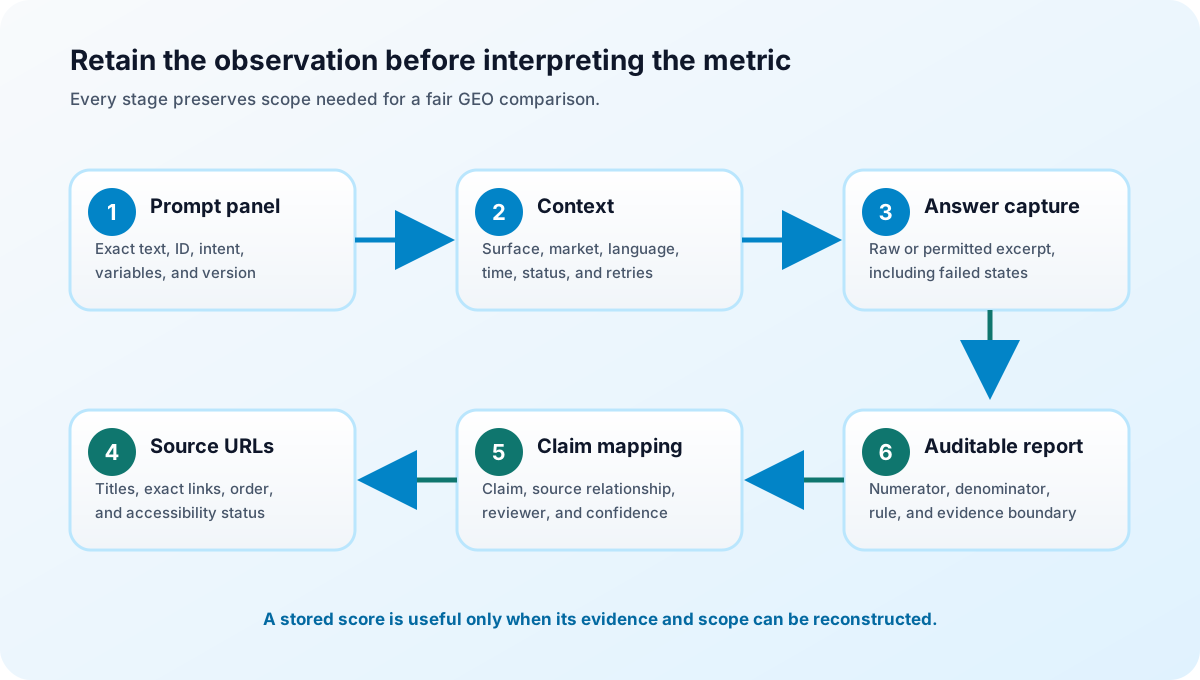
Export this evidence before comparing tools or changing a website:
prompt version → collection context → answer capture → source URLs → claim mapping → metric ruleA chart that says a brand was cited 42 times is not a durable evidence record by itself. Without a denominator, prompt panel, surface, date, and counting rule, a future reviewer cannot tell whether the number changed because the market changed, the tool changed, the prompt set changed, or the collection failed.
This guide is for teams asking:
- What data should a GEO or AI Search monitoring tool export?
- How can I compare two AI visibility tools fairly?
- What should I retain before changing a prompt set or website?
- How do I prove what a citation report actually measured?
- Which fields belong in an AI Search reporting archive?
Retention does not make a measurement representative, and an exported answer does not prove that a page caused a citation, visit, recommendation, or sale. It makes the observation inspectable.
Why retention is a measurement issue, not only a storage issue
AI Search observations are conditional. An answer can depend on the wording of the prompt, the selected surface, location, language, account state, collection date, and whether a search or browsing mode was active. A tool may then transform the capture into mentions, citations, source share, position, sentiment, or recommendation metrics.
If those inputs disappear, the metric loses its context.
Google’s documentation says that AI features can show links to supporting web resources and recommends foundational Search practices (AI features and your website, checked October 17, 2026). That supports inspecting the links that are actually visible in a defined capture. It does not define a universal AI visibility metric or guarantee that a stored citation will recur.
OpenAI’s web-search documentation describes citations and source fields for a specified API tool (Web search, checked October 17, 2026). That is useful evidence about the fields exposed by that tool in that context. It should not be generalized to every consumer interface, model, or third-party monitoring product.
The independent paper GEO: Generative Engine Optimization provides research context for studying visibility in generative-engine responses (Aggarwal et al., arXiv, checked October 17, 2026). It is not evidence that a commercial dashboard’s storage model, score, or source-selection explanation is valid.
The minimum durable record
A practical archive has six layers. Each layer answers a different audit question.
| Layer | Minimum fields | Audit question |
|---|---|---|
| Prompt | Exact text, prompt ID, version, intent | What question was tested? |
| Context | Surface, mode, market, language, device, account state when relevant | Under which conditions was it tested? |
| Collection | Run ID, timestamp, timezone, status, retry flag | When and how was the observation obtained? |
| Answer | Raw or permitted near-raw answer, answer status | What did the system actually return? |
| Sources | Visible title, exact URL, position, source type when known | Which sources were visible and where? |
| Interpretation | Claim mapping, metric rule, reviewer, notes | How was the observation converted into a conclusion? |
If a product does not expose a field, record not exposed rather than infer it. A vendor label such as “AI Overview tracking” does not reveal the exact query, location, sampling rule, or source-selection process.
A minimum record can look like this:
Record ID: GEO-2026-10-17-0042
Prompt ID: COMP-07 / version 3
Prompt: Which AI visibility tools support source-level exports for a small agency?
Intent: comparison
Surface: named surface; mode recorded when disclosed
Market: United States / English
Collected: 2026-10-17 14:20 UTC
Run status: qualifying capture
Answer: retained under the collection policy
Visible source URLs: retained in source rows
Metric rule: one citation per answer-source relationship
Unavailable fields: internal retrieval query, hidden model state
The record is not a claim that the answer is correct. It is a reproducible description of what was observed.
1. Version the prompt panel before collection
A prompt is part of the instrument. Store the exact wording, not only a topic label such as “brand visibility.”
For every prompt, retain:
- Stable prompt ID
- Exact text and any variables
- Panel version and change note
- Intent class: branded, category, comparison, fact, local, or risk
- Expected decision
- Brand, competitor, product, and market variables
- Language and localization rules
- Inclusion and exclusion criteria
A prompt change is a measurement change. Replacing “best AI visibility tool for a small agency” with “AI visibility tools with raw source exports for a small agency” may produce a more useful question, but the results should not be presented as a clean time series unless the panel change is disclosed.
A panel should also include controls. For example, a team might retain a stable branded prompt, a category prompt, a fact prompt, and a comparison prompt. The point is not to manufacture a universal sample; it is to make the decision and its scope visible.
See AI Search Prompt Mapping and How Many AI Search Prompts Should You Track? for related panel-design guidance.
2. Retain collection context and failed states
A successful answer is only one possible collection outcome. Retain empty, blocked, timed-out, login-gated, unavailable, and no-source states where the workflow permits it.
Record:
- Surface and mode
- Model label only when the tested system exposes it
- Country, region, language, and device context
- Account or personalization state when relevant and lawful to retain
- Collection timestamp and timezone
- Run number and retry status
- HTTP or application status exposed by the tool
- Whether the answer was truncated or transformed by an export
- Whether source links were visible, hidden, redirected, or unavailable
Do not convert “no source exported” into “no source existed.” The source may have been unavailable to the collector, omitted by the interface, or excluded by the product’s export policy. Use a distinct status such as not exposed, not observed, or collection failed.
This distinction matters when comparing products. One tool may export only links that a parser can resolve; another may preserve the displayed title and URL even when the target page is unavailable. Their citation counts can differ without either tool necessarily observing a different answer.
3. Preserve the answer before calculating a score
The raw answer is the primary observation. A score, screenshot, or summary is a derived view.
Where platform rules, privacy requirements, and the product’s terms permit, retain:
- The exact prompt and panel version.
- The answer text or an allowed near-raw capture.
- Every visible source title and direct URL.
- The order or location of each source when the interface exposes it.
- Brand mentions, recommendations, caveats, and omissions.
- Product facts and dates stated in the answer.
- Failed or empty collection states.
- The collection conditions and timestamp.
If full answer retention is not permitted, retain the narrowest lawful substitute: a structured claim ledger, source URLs, permitted excerpts, a content hash, and a note describing what was omitted. A hash can help detect file changes; it cannot reconstruct missing answer text.
Never treat a screenshot as a complete archive if it omits the prompt, date, market, or source URLs. It may be useful corroboration, but it is not a substitute for structured fields.
4. Store sources as relationships, not just a URL list
A URL list does not explain which claim a source appeared to support. Store one source row per visible source relationship when possible.
| Field | Example | Boundary |
|---|---|---|
| Source ID | RUN-0042-S03 | Internal record identifier |
| Source title | Visible title | May differ from the page title at fetch time |
| Exact URL | Displayed or exported URL | Preserve redirects separately |
| Answer position | 3 | Position in this capture, not a universal ranking |
| Claim mapping | Supports entry-plan fact | Reviewer interpretation unless explicitly stated |
| Source type | Official / independent / unknown | Classification needs a rule |
| Fetch or check status | Accessible / redirected / unavailable | Status at the check date |
| Checked date | 2026-10-17 | Dynamic pages can change |
A source appearing beside an answer is evidence that the link was visible in that capture. It is not automatic proof that the source supports every nearby sentence. Use AI Search Answer Claim Audit and AI Search Answer Provenance as separate claim-to-source workflows.
When the same URL appears in multiple answers, keep the answer-level relationship as well as the normalized URL. Otherwise, a later report may confuse “one source observed across 20 runs” with “one source cited 20 times under comparable conditions.”
5. Record the metric definition beside the value
A metric without its counting rule is not portable.
For each reported value, retain:
- Numerator
- Denominator
- Unit of analysis: prompt, answer, source, claim, or run
- Deduplication rule
- Treatment of retries and failures
- Treatment of multiple citations in one answer
- Treatment of competitor mentions
- Market, surface, and date window
- Whether the value is observed, estimated, or model-derived
- Version of the calculation code or rule
Examples of distinct measures include:
answer mention rate = answers containing the brand ÷ qualifying answers
citation relationship rate = answer-source relationships containing the brand URL ÷ qualifying answer-source relationships
source share = brand-owned source relationships ÷ all counted source relationships
recommendation rate = answers recommending the brand under the declared rule ÷ qualifying answers
These measures are not interchangeable. A brand can be mentioned without being recommended, cited without receiving a click, or recommended without its own URL appearing. Keep the fields separate.
Do not report a percentage without the denominator and cohort. “Brand visibility increased 12%” is incomplete unless the reader knows which prompts, surfaces, markets, dates, answer states, and counting rules were used.
6. Compare tools by raw evidence before dashboards
When evaluating AI Search Console, Otterly.AI, Peec AI, PromptWatch, Profound, or Rankscale, ask what can be exported and inspected—not only which score appears in the interface.
A fair trial should test whether each product exposes:
- Exact prompts and prompt-set versions
- Collection dates and timezone
- Surface, market, and language fields
- Raw answers or permitted excerpts
- Exact source URLs and source order
- Run status and failed collections
- Filters used in the dashboard
- Metric definitions and denominator rules
- Export formats and stable record IDs
- Retention period and deletion behavior
- API or scheduled export availability, if documented
These are evaluation questions, not claims that every named product supports every field. Verify the current documentation and trial behavior for the specific plan and product edition. If a capability is not documented or not exposed in the trial, record it as unknown.
A useful comparison table has three states:
| Export field | Tool A | Tool B | Decision |
|---|---|---|---|
| Exact prompt text | Exposed / not exposed / unknown | Exposed / not exposed / unknown | Required for reproducibility? |
| Raw answer | Exposed / excerpt / unavailable | Exposed / excerpt / unavailable | Required for claim review? |
| Direct source URL | Exposed / normalized / unavailable | Exposed / normalized / unavailable | Required for attribution audit? |
| Failed-run state | Exposed / partial / unknown | Exposed / partial / unknown | Required for coverage reporting? |
| Metric rule | Documented / partial / unknown | Documented / partial / unknown | Comparable without reconstruction? |
Do not turn this matrix into a product ranking. It describes fit for a defined evidence workflow.
7. Set a retention policy that matches the decision
Retention should answer a business question without keeping unnecessary personal or sensitive data.
A lightweight policy can define:
| Record class | Suggested purpose | Policy question |
|---|---|---|
| Prompt registry | Reproduce the panel | Who can change a prompt and how is it versioned? |
| Run metadata | Explain collection conditions | Which fields are necessary for the report? |
| Answer evidence | Review claims and sources | What may be retained under platform and privacy rules? |
| Derived metrics | Rebuild published charts | Can the numerator and denominator be recomputed? |
| Change log | Explain breaks in series | What changed in prompts, parser, plan, or rule? |
| Deletion log | Demonstrate governance | What was deleted, when, and why? |
Set access controls and deletion periods appropriate to the data. An AI Search archive can include customer prompts, account context, or sensitive query terms; retention is not permission to collect everything. Redact personal information where possible, document redaction, and avoid retaining credentials or private conversation content.
A data-retention policy also needs a version for the parser or importer. If a later parser strips source parameters or merges URLs differently, preserve the original export or record the transformation. Otherwise, a dashboard change can look like a market change.
8. Use an evidence ledger for before-and-after work
When a team edits a page and later sees a different AI answer, build a ledger instead of writing a causal story.
Hypothesis: the current pricing page is difficult to verify for the entry plan
Baseline: prompt panel v3, 20 qualifying runs, collected 2026-10-17
Observed issue: 6 answers stated a price without billing interval
Action: clarify billing interval and currency on the visible page
Retest: same panel and collection rules; date and results recorded separately
Conclusion: describe the answer difference; do not infer a causal business result
The ledger should preserve the baseline export, the changed page or content version, the retest export, and any collection failures. If the prompt, market, model, parser, or product plan changed at the same time, state that the comparison is confounded.
For a broader reporting workflow, see AI Search Regression Testing and AI Search Evidence Ledger.
What retention can and cannot prove
| Retained evidence | Defensible conclusion | Not established by itself |
|---|---|---|
| Exact prompt and answer | What appeared for that run | What every user sees |
| Visible source URL | The URL was shown in that capture | The URL caused the answer or a visit |
| Repeated panel exports | A pattern in the declared sample | Universal market share or ranking |
| Before-and-after captures | A difference between observations | The edit caused the difference |
| Referral analytics | A separately defined visit was recorded | The citation caused the visit |
| Review or vendor case study | An attributed experience or use case | Guaranteed traffic, revenue, or citations |
A rating is a user-experience signal, not evidence of traffic growth, revenue growth, guaranteed citations, or guaranteed rankings. Vendor-selected customer evidence should be labeled as such. Competitor-authored comparisons may help identify workflow tradeoffs, but their commercial relationship should be disclosed.
A practical export checklist
Before switching tools, changing a plan, or publishing a visibility report, export and verify:
- Prompt text, IDs, variables, and panel version
- Intent class and decision the panel is meant to inform
- Surface, mode, market, language, and relevant account context
- Timestamp, timezone, run ID, retry flag, and collection status
- Raw answer or permitted near-raw substitute
- Every visible source title and exact URL
- Source order or position when exposed
- Claim-to-source notes for material claims
- Failed, empty, blocked, and no-source states
- Metric numerator, denominator, unit, and deduplication rule
- Parser, export, and calculation version
- Retention, access, redaction, and deletion policy
- Data dictionary explaining unknown and unavailable fields
Open the export independently. Check that URLs are not silently truncated, dates are timezone-labeled, duplicate prompts remain distinguishable, and failed runs are not omitted from the denominator without a documented rule.
FAQ
How long should AI Search monitoring data be retained?
There is no universal period. Retain it long enough to support the decision, reporting cycle, and any planned retest, while following privacy, contractual, and platform requirements. Define the period by record type rather than keeping every raw answer indefinitely.
Is a screenshot enough to archive an AI Search citation?
Usually not. A screenshot can preserve visual context, but it may omit the exact prompt, URL, timestamp, market, or collection status. Pair it with structured metadata and a permitted answer or source record.
Can I compare two GEO tools if both report citation rate?
Only after checking their prompt panels, surfaces, markets, sampling cadence, source parsing, denominator, deduplication, retry handling, and retention behavior. Identical metric names do not establish identical measurements.
Should I store the complete AI answer?
Store the complete answer only when it is permitted and appropriate for your privacy and governance rules. Otherwise, retain a documented structured substitute: claim rows, visible URLs, permitted excerpts, timestamps, and an integrity marker. State what was omitted.
Does retained citation data prove SEO or GEO success?
No. It proves what was captured under defined conditions. Traffic, conversions, rankings, revenue, and causal impact require separate measurements and rules. A citation is not a conversion, and a change in a captured answer is not automatically caused by a website edit.
What is the most important export field?
The most important field depends on the decision. For reproducibility, exact prompt and timestamp are foundational. For claim review, the answer and direct source URL matter most. For metric comparison, the denominator and counting rule are essential. A durable archive preserves all three layers.
Sources and verification
- Google Search Central: AI features and your website — official guidance on AI features and supporting links; checked October 17, 2026.
- OpenAI Developer Docs: Web search — official documentation for citations and source fields in the specified API tool; checked October 17, 2026.
- Google Search Central: Introduction to structured data — official context for what structured data can and cannot guarantee; checked October 17, 2026.
- Aggarwal et al., GEO: Generative Engine Optimization — independent academic research context; it does not validate a commercial monitoring metric or causal business result; checked October 17, 2026.
- AI Search Answer Claim Audit — AICiteKit method for mapping answer claims to source support.
- AI Search Evidence Ledger — AICiteKit method for preserving observations, scope, and follow-up actions.
Last reviewed: October 17, 2026
Evidence confidence: High for the cited documentation and retention framework; low for any product-specific export capability not verified in the current plan or trial.