Field notes / geo
How to Evaluate a GEO Tool Trial: A 14-Point Evidence Checklist
A practical GEO tool trial checklist for comparing prompt coverage, raw AI Search evidence, citations, limits, exports, and workflow fit without treating a dashboard score as proof of business impact.
The short answer
A GEO tool trial is useful only when it tests the work your team actually needs to do. Do not start by comparing headline visibility percentages. Start with a fixed prompt sample, record the search context, inspect raw answers and source URLs, test the operational limits, and write down what the product cannot show.
Use this sequence:
define the decision → freeze a prompt panel → inspect raw evidence → test workflow limits → record confidence → decide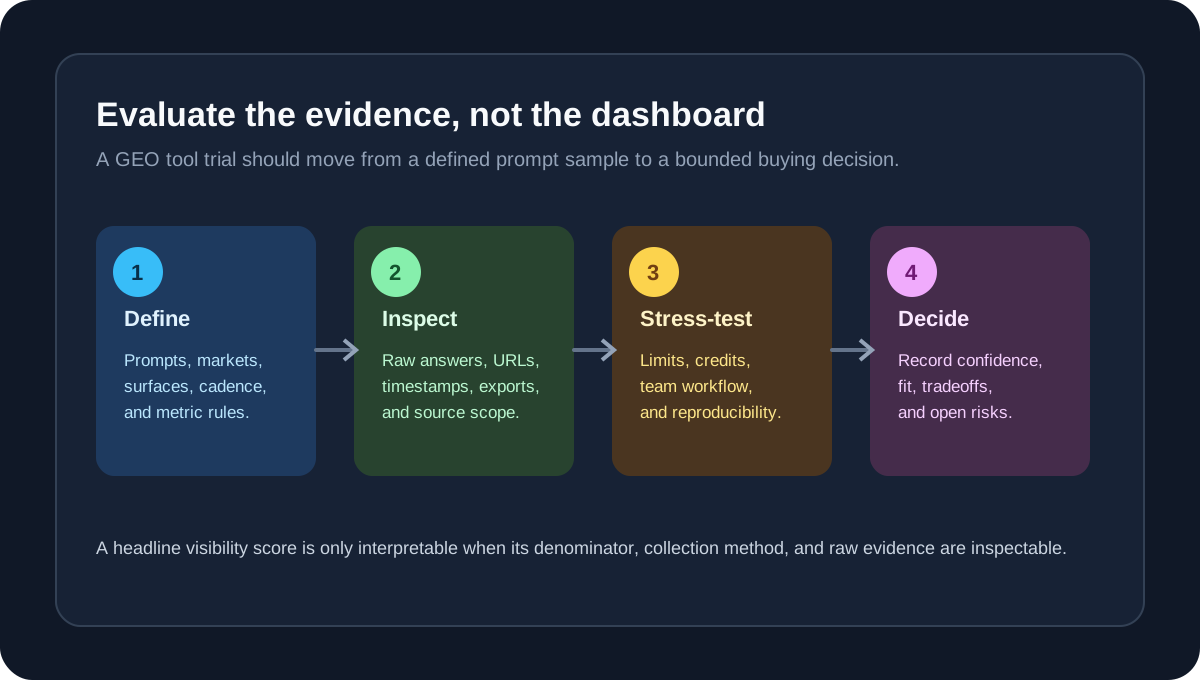
This guide addresses searches such as “how do I evaluate a GEO tool?”, “what should I test in an AI Search visibility trial?”, and “how do GEO monitoring tools measure citations?” It is a buying and measurement framework, not a promise of rankings, citations, traffic, leads, or revenue.
What a GEO tool trial can establish
A well-designed trial can help you determine whether a product can:
- Run the prompts, markets, languages, and AI surfaces relevant to your decision.
- Preserve enough of each observation to audit a mention, recommendation, or citation.
- Distinguish raw observations from derived scores and trend charts.
- Support the reporting, export, collaboration, and review cadence your team needs.
- Make important limits visible before you commit to a recurring workflow.
A trial cannot, by itself, prove that a vendor’s metric is a universal ranking, that an optimization caused an answer change, or that visibility produced traffic or revenue. Those are different evidence questions.
Google’s guidance for AI features and your website, checked October 29, 2026, describes links to supporting web resources and points site owners toward foundational Search practices. It does not define a universal GEO score or guarantee appearance in an AI answer.
The independent paper GEO: Generative Engine Optimization, checked October 29, 2026, provides research context for generative-engine visibility experiments. It does not validate a current commercial dashboard, a vendor’s collection method, or a business outcome.
First decide what you are buying
Different teams use “GEO tool” to mean different products. Write the decision before opening a trial.
| Decision | Evidence the trial should produce | Common mistake |
|---|---|---|
| Monitor branded prompts | Repeatable answers, mentions, sources, and timestamps | Calling one brand mention “visibility” without a denominator |
| Find citation opportunities | Source URLs, claim context, and competitor comparisons | Treating every cited page as a content recommendation |
| Audit product facts | Raw answer text and a way to check claims against first-party sources | Assuming a citation proves the whole answer is accurate |
| Report to clients | Exportable observations, definitions, and reproducible date ranges | Reporting a score without explaining its prompt set |
| Guide content work | Evidence that connects a proposed edit to a specific gap | Claiming that an edit caused a later answer change |
| Compare markets | Market, language, location, and surface fields | Blending different regional panels into one global number |
If the buyer’s real need is content production, a monitoring tool may not be enough. If the need is an auditable record of AI answers and citations, a content brief feature may not be enough. Compare the workflow, not just the category label.
The 14-point trial checklist
1. Can you define the prompt panel?
Start with 20–50 prompts that represent real customer questions, if the trial permits a sample of that size. The number is an editorial starting point, not a statistical rule. Split the panel into branded, category, comparison, problem, evaluation, and risk questions.
Record for every prompt:
- Exact wording and prompt-set version
- Intent group
- Brand or product entities included
- Market, language, and location assumptions
- AI surface, mode, and model label when exposed
- Collection date, time zone, and run number
Do not let a vendor’s prompt discovery feature silently replace your own business questions. Discovery can expand the panel; it should not define the denominator without review.
2. Which AI surfaces are actually included?
Ask for the precise surface and mode, not just a list of brand names. “ChatGPT,” “Google,” or “Perplexity” can describe multiple experiences with different retrieval, citation, and export behavior.
Verify:
- Which surfaces are available on the trial and paid plan.
- Whether the product captures an answer, a search result, or a derived observation.
- Whether model or mode is disclosed.
- Whether web access, location, language, and account state are controlled or unknown.
- Whether collection is live, scheduled, sampled, or vendor-provided.
If a field is not exposed, record not disclosed. Do not infer a hidden model, retrieval query, or ranking reason from a brand label.
3. Can you inspect the raw answer?
A chart showing “brand visibility” is not the same as an answer record. Open several observations and look for the answer text, prompt, date, context, and status.
A useful record includes:
observation_id:
prompt_set_version:
prompt:
surface_and_mode:
model_label_or_not_disclosed:
market_and_language:
collected_at:
answer_capture_or_not_available:
mentioned_brands:
recommendation_order_if_explicit:
cited_urls:
collection_status:
Screenshots may preserve presentation, but they can be hard to search or export. If only an image is available, reduce confidence in later claim-level analysis.
4. Are citations links or just counts?
Ask whether each citation has a direct URL, source title, position, and relationship to the answer claim. A count such as “three citations” does not tell you which pages were shown or whether they support the statement.
Separate these observations:
- Mention: a brand or page was named.
- Recommendation: the answer proposed or preferred an option.
- Citation: a source URL was visibly attached.
- Support: the source actually covers the claim.
- Referral: analytics identifies a visit from an AI surface.
The tool may measure one of these and not the others. Never upgrade a mention or citation count into a supported recommendation.
5. What is the denominator?
For every percentage, ask:
- What is the numerator?
- What is the denominator?
- Are prompts, runs, answers, brands, citations, or domains being counted?
- Are failed, empty, gated, and no-source observations included?
- Are repeated URLs deduplicated?
- Are markets, surfaces, and prompt types blended?
For example, “40% visibility” could mean 40 of 100 prompt runs, 40 of 100 unique prompts, or a weighted vendor index. These are not interchangeable.
A score without a denominator is a navigation aid, not a complete measurement.
6. Can you reproduce an observation?
Run the same prompt twice, or use a documented repeat schedule, and check whether the product retains both observations. Do not expect identical AI answers. The test is whether the tool preserves the conditions and exposes the difference.
Record:
- Prompt and panel version
- Collection timestamps
- Surface and mode
- Market and language
- Answer or source capture
- Empty and failed states
- Any retry or sampling behavior
The result should be reported as observed volatility under declared conditions. It is not proof that the system is deterministic or that a content change caused a difference.
7. Are prompt, answer, and citation history exportable?
Test exports before you design a reporting workflow. Look for raw or row-level fields rather than only a polished PDF.
At minimum, ask whether exports preserve:
- Prompt text and IDs
- Answer text or permitted excerpts
- Direct source URLs
- Collection date and time zone
- Surface, market, language, and model fields
- Brand and competitor labels
- Metric definitions
- Failed or unavailable states
Also test whether an export made today can be understood six months later. A dashboard that changes its definitions without preserving historical context creates reporting risk.
8. What are the limits and credit rules?
Check the official pricing and documentation pages on the day of the trial. Verify prompt credits, refresh cadence, projects, domains, seats, exports, API access, retention, and add-ons. Limits may differ between a trial and paid plan.
Do not copy a price or limit from an old comparison article. A current official page is the primary source for commercial terms; an independent review can add workflow context but does not override the current plan page.
If the official pricing page is unavailable or ambiguous, mark the field unresolved and ask the vendor to confirm it in writing.
9. Does the tool preserve source scope?
A citation can be real and still be a poor fit for the claim. During the trial, select several answer claims and check:
- Entity: same company, product, and version?
- Scope: same plan, region, audience, and currency?
- Time: current for the decision?
- Text: does the passage support the complete wording?
Use the classification supported, partial, contradicted, or unresolved. The tool can help collect evidence; it does not remove the need to read the source.
10. Can you compare competitors without false precision?
A competitor report is useful when its prompt set, market, collection method, and definitions are visible. Ask whether the tool shows the complete answer or only a selected metric.
Do not call answer order a ranking unless the answer explicitly ranks the products. Do not describe a competitor as “preferred by AI” from one sampled answer. Compare recurring observations and label the sample.
AICiteKit’s AI Search Competitor Analysis and AI Search Recommendation Criteria provide related methods for separating observed recommendations from broader market claims.
11. Does the workflow support claim-level review?
A useful tool should fit a review loop:
answer → claim → cited source → scope check → confidence → actionAsk whether users can annotate an observation, attach a source, flag a stale fact, assign an owner, and preserve the review history. If not, budget for a separate evidence ledger.
12. Can different users reach the same record?
Invite the person who will actually use the product: an SEO lead, content editor, analyst, agency account manager, or client reviewer. Test permissions, saved views, comments, sharing, and report links.
A tool that looks efficient for one operator may be difficult to govern across a team. Record the workflow step where manual copying, spreadsheet cleanup, or screenshot collection begins.
13. Does it connect to your measurement system?
Integrations are useful only if the fields and definitions survive the handoff. Verify whether the product exports to the destinations your team uses and whether the integration carries raw evidence or only a summary metric.
Do not treat an analytics integration as proof of AI-attributed traffic. Google’s GA4 documentation on traffic-source dimensions, checked October 29, 2026, explains how Analytics identifies traffic-source information. That is measurement infrastructure context, not evidence that every AI referral is identifiable or that a citation caused a visit.
14. What remains unknown after the trial?
End the trial with an uncertainty register. Include:
| Open question | Why it matters | Trial status |
|---|---|---|
| Exact collection method | Affects interpretation of results | Confirmed / unresolved |
| Model or mode field | Affects repeatability | Confirmed / not disclosed |
| Failed-run handling | Affects denominator | Confirmed / unresolved |
| Raw answer retention | Affects auditability | Confirmed / unavailable |
| Credit consumption | Affects cost planning | Confirmed / unresolved |
| Historical definition changes | Affects trend reporting | Confirmed / unresolved |
A vendor does not need to expose every internal implementation detail. The buyer does need to know which fields are unavailable before turning the output into a business claim.
Evidence snapshot
| Source | Public signal | What it supports | Confidence |
|---|---|---|---|
| Google Search Central: AI features and your website | Official guidance on AI-feature links and foundational Search practices | Context for what Google documents; not a universal GEO score | High for the linked guidance |
| OpenAI Developer Docs: Web search | Official documentation for one web-search API implementation | Product-specific source and citation fields | High for that implementation; not every ChatGPT surface |
| Aggarwal et al., GEO: Generative Engine Optimization | Independent academic research paper | Research context for generative-engine visibility experiments | Medium; not validation of a commercial metric |
| Google Analytics: Traffic-source dimensions | Official analytics documentation | Context for source and medium reporting | High for documented GA4 behavior; not proof of AI causality |
| G2 AI SEO category | Third-party review marketplace category | A place to look for current user-feedback evidence | Low for this article: no rating or review count is used here |
| AICiteKit trial worksheet | Editorial checklist in this article | A bounded buying and evidence-review process | Editorial |
The G2 page is included as a research destination, not as proof of a product’s quality. Third-party review platforms can contain useful workflow observations, but ratings and review counts must be captured with their date, sample size, product scope, and access conditions. No rating, consensus, price, or user outcome is asserted here.
How to compare tools in a trial
A comparison table should describe tested capabilities, not repeat vendor adjectives.
| Dimension | Tool A record | Tool B record | Decision note |
|---|---|---|---|
| Prompt and market coverage | Does it match the actual program? | ||
| Raw answer access | Can a reviewer inspect the observation? | ||
| Citation URL and claim mapping | Are sources direct and auditable? | ||
| Denominator and metric definitions | Can a report be explained? | ||
| Repeat history | Can changes be compared under declared conditions? | ||
| Export and retention | Can the team preserve evidence? | ||
| Limits and cost model | What happens at production volume? | ||
| Collaboration | Can another reviewer reproduce the workflow? | ||
| Open risks | What remains unknown? |
For candidates already covered on AICiteKit, compare the actual pages rather than assuming that tools in one category are interchangeable: AI Search Console, Peec AI, Otterly.AI, PromptWatch, Profound, and Rankscale. Verify current pricing, limits, surfaces, retention, and trial terms on official sources before purchase.
Evidence boundaries
Keep these claims separate:
- A tool captured a URL: evidence of a captured URL under the tool’s stated method.
- A page supported a claim: evidence from reading the relevant passage at the right scope.
- A brand appeared in an answer: evidence of a mention in a defined observation.
- A score changed: evidence that two metric outputs differed.
- Traffic changed: analytics evidence under a declared attribution method.
- Revenue changed: a stronger business measurement design.
Neither a trial dashboard nor a vendor-selected customer story independently proves that an optimization caused more citations, rankings, clicks, leads, or revenue. A vendor case study is vendor-selected customer evidence and should be labeled that way.
The NIST AI Risk Management Framework, checked October 29, 2026, is a useful independent public framework for thinking about validity, reliability, transparency, and accountability. It is not a GEO ranking guide and does not validate any vendor’s score.
FAQ
How long should a GEO tool trial be?
Long enough to test the real prompt panel, export path, review workflow, and cost rules. A short trial can establish whether the interface works; it usually cannot establish a durable trend or causal business impact.
Should I choose the tool with the highest visibility score?
Not from the score alone. First check the prompt set, denominator, surfaces, collection method, source URLs, failed-run handling, and scope. A lower but inspectable metric may be more useful than a higher opaque one.
Are GEO monitoring tools the same as AI writing tools?
No. Monitoring tools generally focus on prompts, answers, mentions, citations, competitors, or derived visibility measures. Writing and optimization tools focus on creating or editing content. Some products combine workflows, but verify the actual feature and plan boundaries.
Can a GEO trial prove that content changes work?
It can document a before-and-after difference under declared conditions. It cannot prove causality from one comparison. Use a repeatable panel, preserve raw evidence, record other changes, and report the result as an observation unless the measurement design supports a stronger conclusion.
What if the tool will not show raw answers?
Ask what evidence is retained, what can be exported, and how the metric is calculated. If raw answers and source URLs are unavailable, limit the use case to directional monitoring and reduce confidence in claim-level or client-facing conclusions.
Trial worksheet
Copy this record for each candidate:
tool:
trial_dates:
decision_to_support:
prompt_set_version:
markets_and_languages:
surfaces_and_modes:
raw_answer_available:
direct_citations_available:
metric_denominator:
failed_run_handling:
export_fields:
retention:
credits_and_limits:
team_workflow_tested:
open_questions:
confidence: high | medium | low | unresolved
buying_decision:
Sources and verification
- Google Search Central: AI features and your website — official AI-feature context; checked October 29, 2026.
- OpenAI Developer Docs: Web search — source and citation fields documented for one API implementation; checked October 29, 2026.
- Aggarwal et al., GEO: Generative Engine Optimization — independent research context; checked October 29, 2026.
- Google Analytics: Traffic-source dimensions — official analytics context; checked October 29, 2026.
- NIST AI Risk Management Framework — public framework for validity, reliability, transparency, and accountability context; checked October 29, 2026.
- G2 AI SEO category — third-party review destination; no rating, review count, or consensus claim used because the page was not accessible in the research fetch.
Last reviewed: October 29, 2026
Data confidence: High for the linked official documentation and academic/public framework descriptions; medium for the operational checklist, which is AICiteKit editorial guidance; low for any claim about an engine’s hidden retrieval or ranking process. This article does not claim guaranteed visibility, citations, traffic, conversions, or revenue.