Field notes / ai-search
Can You Track AI Search Traffic in GA4? A Practical Attribution Audit
Learn what GA4 can show about detectable AI Search referrals, why citation visibility is not the same as traffic, and how to build an attribution audit without overclaiming.
The short answer
GA4 can record some AI Search visits, but it cannot automatically reveal every visit influenced by an AI answer. A detectable referral, a visible citation, an AI crawler request, and an eventual conversion are different evidence layers.
A defensible audit keeps them separate:
AI answer observation → visible source → detectable referral → engaged session → conversionGA4 can help with the later layers when a browser visit reaches the site and the analytics setup captures and classifies it. It cannot reconstruct an answer that was seen without a click, a copied URL, a mobile-app handoff that lost referrer data, or an AI-influenced journey that later returned through another channel.
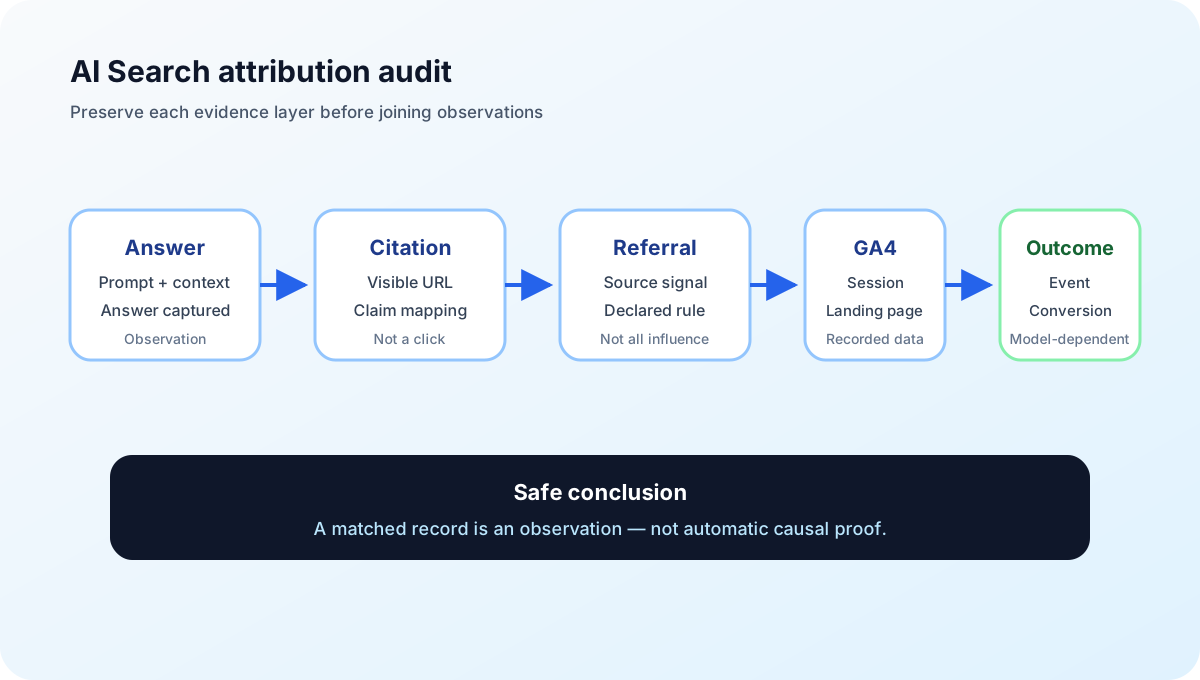
This guide addresses searches such as “can GA4 track ChatGPT traffic?”, “how do I see AI Search referrals in analytics?”, and “does an AI citation mean traffic?” It is an audit method, not a promise that AI-influenced visits or revenue can be fully observed.
What GA4 can and cannot answer
Google’s Traffic-source dimensions documentation, checked October 22, 2026, describes dimensions used to understand how users arrive at a site. Those dimensions are useful for analyzing captured sessions under a configured property. They are not a transcript of every AI answer or a complete record of every influence before a visit.
OpenAI’s ChatGPT search help documentation, checked October 22, 2026, describes links and sources in a web-search experience. A link being shown is evidence about that answer context; it is not proof that a user clicked, that analytics recorded the click, or that the link caused a later conversion.
The independent paper GEO: Generative Engine Optimization, checked October 22, 2026, studies visibility in generative-engine responses in an experimental setting. It provides research context for measuring generative-engine visibility, but it does not validate a GA4 channel grouping, a commercial dashboard score, or a causal revenue claim.
| Evidence layer | What it can support | What it does not prove by itself |
|---|---|---|
| Answer visibility | The brand appeared in a captured answer | A user saw that answer or visited the site |
| Citation | A source URL was visible beside an answer or claim | A click, session, or conversion |
| AI referral | Analytics recorded a visit classified under a chosen source rule | That the visit was influenced only by that answer |
| Engaged session | A captured session met the site’s engagement definition | That the session came from a specific citation |
| Conversion | Analytics recorded an event under the configured attribution model | That AI Search caused the conversion |
| AI crawler request | A bot requested a URL in server or CDN logs | A human saw, clicked, or cited the page |
The central rule is simple: a stronger downstream event does not retroactively prove every upstream step. A conversion with an AI-looking source is still a conversion observed under an analytics configuration, not automatic causal proof.
Why AI Search attribution is incomplete
AI Search can influence a journey in ways that are difficult to connect to one analytics session:
- A person reads an answer without clicking and later searches for the brand directly.
- A user clicks a visible source, but the browser or app does not pass a useful referrer.
- A link is copied into another browser, message, document, or device.
- A user visits once, returns through organic search, and converts later.
- A source URL is visible in an answer, but no one visits it.
- A crawler fetches a page while the user-facing answer is generated elsewhere.
- A platform or privacy setting limits the data available to the site.
These are not reasons to abandon analytics. They are reasons to state exactly what the report measures. “AI-attributed sessions” should mean sessions classified by a declared rule, not all demand that may have been influenced by an AI system.
The five-part attribution audit
1. Define the decision first
Do not begin with a channel label. Start with the decision the data must support:
- Are detectable AI referrals growing under the current tagging and classification rules?
- Which landing pages receive sessions that the team classifies as AI Search traffic?
- Do cited pages also receive measurable referrals?
- Which answer observations should be investigated against analytics?
- Is a reported conversion number reproducible from the raw event and attribution fields?
Different decisions require different evidence. A prompt monitor may answer whether a brand appeared in a sampled answer. GA4 may answer whether a session was recorded. Neither system alone answers whether the first observation caused the second.
2. Preserve the answer observation separately
For every sampled answer, retain the conditions before joining it to analytics:
- Exact prompt and prompt-set version
- Search surface and mode, when disclosed
- Model or version label, when exposed
- Country, language, location, and account context when relevant
- Collection date and time zone
- Full answer or permitted near-raw capture
- Visible source title and direct URL
- Mention, recommendation, citation, and position rules
- Empty, blocked, failed, and no-source states
A product such as AI Search Console or Peec AI may support recurring prompt observations, while PromptWatch may be relevant when teams also want crawler or referral context. Otterly.AI and Rankscale are additional comparison points for monitoring workflows. These products may expose different fields and counting rules; their scores should not be treated as interchangeable or as GA4 attribution.
A useful observation record might look like this:
Answer ID: CAT-004 / run 03
Prompt: Which tools help a small agency monitor AI citations?
Surface: named surface; web-search mode recorded when disclosed
Market: United States / English
Collected: 2026-10-22 UTC
Brand: mentioned; recommendation: unclear
Visible source URL: yes; exact URL retained
Analytics join: not attempted / attempted / matched
Boundary: answer observation only
If a model, referrer, or source field is not exposed, record not exposed. Do not infer it from a brand name, URL, or dashboard label.
3. Declare the analytics classification rule
GA4 reports are only reproducible when the classification rule is explicit. Document:
- Property and data stream scope
- Date range and time zone
- Channel, source, medium, campaign, landing page, and event dimensions used
- Custom channel-grouping rules, if any
- Referrer normalization and exclusion rules
- Treatment of direct, unassigned, unknown, and self-referral traffic
- Consent and data-retention limitations relevant to the report
- Whether conversions use data-driven, last-click, or another declared model
- Filters, sampling, thresholds, and reporting delays
Do not label a session “ChatGPT traffic” merely because its landing page was also cited in an answer. Use a source-based label only when the analytics record contains an attributable source signal under the documented rule.
4. Reconcile answer sources with analytics carefully
A source-level reconciliation can be useful, but it should start as a join of observations—not a claim of causality.
| Join field | Answer-side record | Analytics-side record | Safe conclusion |
|---|---|---|---|
| URL | Visible source URL | Landing page URL | The same URL occurred in both records |
| Time | Collection timestamp | Session timestamp | The records overlap in a declared window |
| Source | Named AI surface and capture context | Source or medium under the analytics rule | The session was classified under that rule |
| Campaign | Tagged link, if present | Campaign dimensions | The tag was observed in the session record |
| Outcome | Answer recommendation or mention | Event or conversion | Both observations exist; causal direction remains unresolved |
A URL match is not enough. A cited page may receive organic, direct, referral, or internal traffic unrelated to the captured answer. Conversely, an AI-influenced visit may land on a different URL after the user searches for the brand.
Report the join with denominators and unmatched records. For example:
In the declared October 22–29 panel, 12 answer captures contained a visible source URL from the site. Analytics recorded 4 sessions classified as AI referrals under the documented source rule during the same period. The records overlap in two landing URLs. This describes an observational match; it does not establish that the citations caused the sessions or any conversion.
Do not replace those counts with “AI Search drove 33% of citations” or “the citations generated four customers” unless the metric definitions and attribution design genuinely support those statements.
5. Test the implementation, not just the dashboard
Use a controlled test visit to verify whether the analytics implementation records the fields the report depends on. Keep the test separate from production findings.
- Open a known tagged or attributable URL under the intended test conditions.
- Confirm the landing page, source, medium, campaign, and session fields.
- Check whether redirects, consent choices, cross-domain navigation, or canonicalization change the recorded values.
- Verify the event and conversion definitions with a test action.
- Reconcile the raw event or export with the displayed report.
- Record delayed, missing, unassigned, or duplicated states.
This verifies the measurement path. It does not prove that every real AI Search visit will carry the same signal.
How to report AI Search traffic without overclaiming
Use labels that preserve scope:
| Better wording | Why it is safer |
|---|---|
| “Sessions classified as AI referrals under our source rule” | States the measurement rule |
| “Visible source URLs in the sampled answers” | Describes the answer sample |
| “Two cited URLs also appeared as analytics landing pages” | Reports an observed overlap |
| “Conversions recorded under the selected attribution model” | Avoids claiming a unique cause |
| “AI crawler requests in server logs” | Keeps bot activity separate from user activity |
Avoid these shortcuts:
- “Every AI-influenced visit is visible in GA4.”
- “A citation automatically creates traffic.”
- “AI crawler activity proves ChatGPT recommended the page.”
- “The increase in AI referrals proves the content change caused growth.”
- “A dashboard’s visibility score equals attributable revenue.”
A before-and-after comparison can identify an association under the recorded conditions. Stronger causal language needs a suitable design, stable measurement rules, repeated observations, and attention to concurrent campaigns and other explanations. Even then, AI Search visibility and analytics attribution remain different measurements.
What to verify in a GEO or AI-visibility tool
If a monitoring platform connects to analytics, ask for a demonstration of the raw evidence rather than only the blended dashboard:
- Can the exact prompt, answer capture, and visible source URLs be exported?
- Are answer citations distinguished from domains, mentions, and inferred sources?
- Can the tool show the surface, market, date, and model or mode when disclosed?
- Are empty, blocked, and failed captures retained?
- What is the precise definition of an AI referral or AI traffic session?
- Can the numerator and denominator be reconstructed?
- Are analytics joins based on observed fields or inferred relationships?
- Can unmatched records and ambiguous source states be inspected?
- Are conversions imported with the attribution model and date window attached?
- Can exports be reconciled with GA4, server logs, and CRM records without renaming one evidence layer as another?
A tool may be useful even when it cannot measure the full AI-influenced journey. The buying question is whether it preserves the evidence needed for the decision—not whether it produces the largest number.
Practical checklist
- Define whether the report concerns visibility, citations, referrals, sessions, or conversions.
- Freeze the prompt panel and record collection conditions.
- Preserve exact answer captures and source URLs where permitted.
- Document GA4 dimensions, channel rules, filters, and attribution model.
- Keep AI crawler requests in a separate technical dataset.
- Reconcile URLs and time windows without assuming causality.
- Report matched, unmatched, direct, unassigned, and unavailable states.
- Use denominators for every rate.
- Label vendor-selected case studies as vendor-selected customer evidence.
- State what the report does not prove: universal visibility, guaranteed citations, traffic causality, or revenue impact.
FAQ
Does GA4 show ChatGPT traffic automatically?
Not necessarily. GA4 can record a session when the site receives a visit and the analytics implementation captures it. Whether that session is identifiable as ChatGPT or another AI surface depends on the source signal, browser and app behavior, tagging, consent, redirects, and the classification rule used in the report.
Does an AI citation mean the page received a visit?
No. A citation is an answer-level observation. It may be visible without a click, and a click may not remain identifiable in analytics. Check the answer capture and analytics record separately.
Can I attribute a sale to an AI answer?
You can report a sale under a declared analytics attribution model when the conversion is recorded. Proving that a particular answer or citation caused the sale requires stronger evidence than a source URL, a dashboard score, or a same-period correlation.
Should AI crawler traffic be included in AI Search traffic?
No. A crawler request is a server or CDN observation. Keep it separate from human sessions, answer citations, and conversions. A crawler can request a page without a user seeing or clicking it.
What is the best AI Search traffic tool?
There is no universal best tool without a defined decision. Compare whether a product preserves raw answer evidence, exact source URLs, prompt and context fields, analytics joins, crawler logs, exports, and reproducible metric rules. Test the workflow against a small fixed panel before relying on a blended score.
Sources and evidence boundary
- Google Analytics Help: Traffic-source dimensions — official documentation for interpreting captured acquisition data; checked October 22, 2026.
- OpenAI Help: ChatGPT search — official documentation describing search results and source links in ChatGPT; checked October 22, 2026.
- Aggarwal et al., GEO: Generative Engine Optimization — independent academic research context for generative-engine visibility; checked October 22, 2026.
- AICiteKit: AI Visibility vs AI Citations vs AI Traffic — internal methodology companion for separating measurement layers.
- AICiteKit: How to Build an AI Search Measurement Baseline — internal workflow for defining panels, captures, and retests.
The official sources support documented analytics and search behaviors. The academic source provides research context. The attribution workflow and interpretations are AICiteKit editorial guidance. No source here proves that a citation, content change, monitoring tool, or analytics classification guarantees rankings, traffic, conversions, or revenue.
Last reviewed: October 22, 2026. Data confidence: High for the linked documentation and paper descriptions; medium for the implementation checklist; low for any inference about an unseen platform’s referral handling or source-selection process.