What Is GEO? Generative Engine Optimization Explained
A practical introduction to Generative Engine Optimization: how AI answer engines use sources, how GEO differs from SEO, what teams can measure, and where the evidence is still uncertain.
What GEO actually means
Generative Engine Optimization (GEO) is the practice of improving the chance that a brand, product, page, or source is represented accurately and usefully in AI-generated answers.
The term covers work across answer engines and AI search surfaces such as ChatGPT Search, Perplexity, Google AI Overviews, Gemini, Microsoft Copilot, and other systems that synthesize answers from retrieved or learned information.
GEO is not a single ranking factor or a guaranteed way to make an AI system recommend a company. It is a practical discipline built around three questions:
- Does the brand appear when relevant questions are asked?
- Which sources and pages shape the answer?
- Is the answer accurate, useful, and connected to a measurable business journey?
A team can work on GEO by improving its own pages, clarifying entities and facts, earning citations from relevant third-party sources, monitoring AI answers, and fixing inaccurate or outdated brand information.
How GEO differs from traditional SEO
Traditional SEO generally optimizes a website for crawling, indexing, and ranking in a search results page. GEO operates on a wider answer layer where an AI system may combine several sources into one response.
The two disciplines overlap, but they are not interchangeable.
| Traditional SEO | GEO / AI Search |
|---|---|
| Optimizes pages for ranked results | Improves representation in synthesized answers |
| Often focuses on keywords and search queries | Focuses on prompts, questions, entities, and context |
| Measures impressions, clicks, rankings, and organic sessions | Measures mentions, recommendations, citations, answer framing, and AI referrals |
| A page can rank without being quoted | A source can be cited without receiving a click |
| Technical SEO and links remain important | Technical SEO, clear facts, authority, and source consistency remain important |
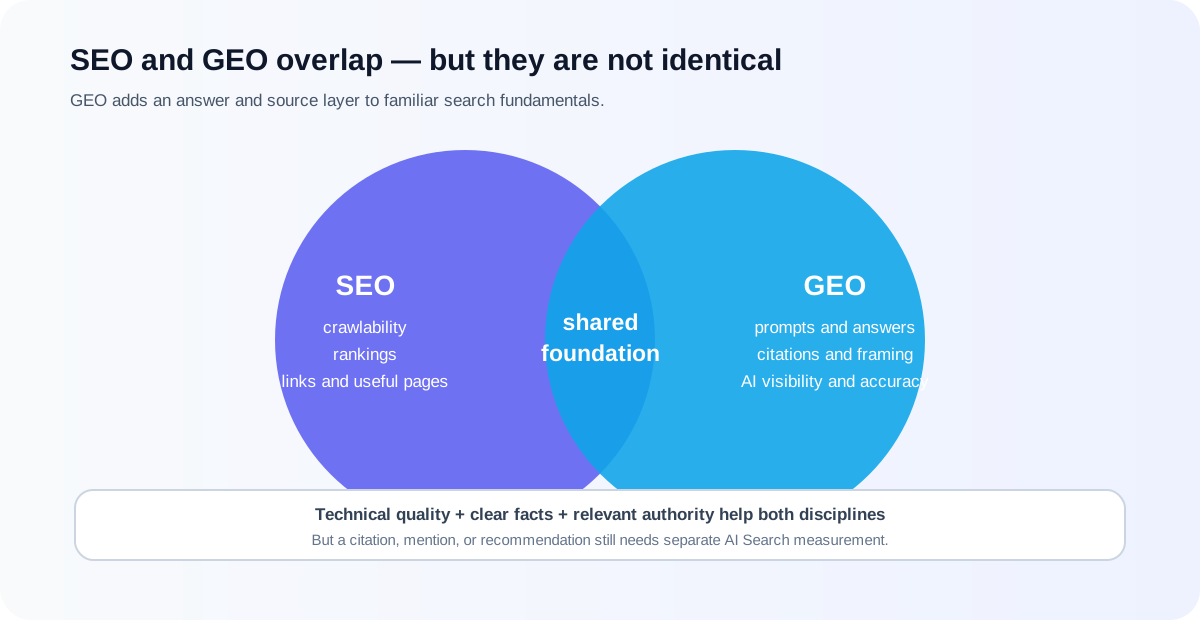
Google’s official guidance on AI features and your website makes an important point: the same fundamental SEO best practices continue to matter for pages that may appear in Google’s AI features. GEO should therefore be treated as an extension of search and content work, not as a replacement for crawlability, useful content, or technical quality.
For a more measurement-focused explanation, see AI Visibility vs AI Citations vs AI Traffic.
The main GEO signals teams work on
There is no public universal formula that explains every AI answer. Most practical GEO programs work across several signal groups instead.
1. Extractable answers
Can an AI system find and reuse a clear answer on the page?
A page is easier to interpret when it has:
- Descriptive headings
- Short answers near the relevant question
- Clear definitions
- Tables and lists where comparison is useful
- Unambiguous subject and object relationships
- Consistent terminology
- Specific claims supported by evidence
This does not mean every answer should be reduced to short fragments. Context, examples, original research, and helpful detail still matter. The goal is to make the important information understandable and verifiable, not to write for a fictional “AI word count.”
2. Structured facts and entities
AI systems need to distinguish a company from a product, a person from an organization, and a current price from an outdated reference.
Useful work can include:
- Clear organization and product descriptions
- Consistent names and relationships across the site
- Structured data where it accurately describes the page
- Author and publisher information
- Product, service, location, and policy facts
- Visible dates for material updates
- Links to authoritative supporting pages
Google’s structured data introduction is a useful technical reference. Structured data can make facts easier for systems to interpret, but it does not guarantee a citation, a rich result, or an AI recommendation.
3. Source credibility and consistency
AI answers often rely on multiple sources. A brand becomes easier to represent when important claims are consistent across:
- The company website
- Documentation
- Independent reviews
- Industry publications
- Partner pages
- Professional profiles
- Product directories
- Community discussions
A strong source profile is not the same as collecting as many links as possible. Relevance, accuracy, editorial quality, and consistency matter more than a large list of low-quality mentions.
4. Third-party evidence
A company can describe itself on its own site, but a buyer may also ask an AI system what independent customers, reviewers, or communities say.
For GEO, relevant third-party evidence may include:
- Product reviews with a named author and method
- Expert analysis
- Customer experiences on review platforms
- Industry comparisons
- Community discussions
- Original research and data
Third-party coverage should not be manufactured or manipulated. A vendor-selected customer case study can document a customer story, but it is not the same as independent proof of an outcome.
5. Technical access and page availability
A page cannot be used reliably if an AI retrieval system cannot access, discover, or understand it. Teams should still review:
- Robots directives
- Server responses
- Canonical URLs
- Internal links
- Sitemap coverage
- JavaScript rendering
- Duplicate or conflicting versions
- Structured data validity
Crawler activity and human AI traffic are different things. A request from an AI crawler indicates automated access, not that a person saw the page or that the page was cited.
What GEO is not
GEO is not:
- A guaranteed shortcut to the top of ChatGPT answers
- A replacement for traditional SEO
- A method for forcing an AI model to say a specific sentence
- A reason to add keywords unnaturally
- A license to publish large amounts of unreviewed AI text
- Proof that a visibility score represents all AI users
- Proof that a citation generated traffic or revenue
Be cautious with claims such as “guaranteed AI rankings,” “guaranteed citations,” or “proven revenue growth.” AI responses vary by model, prompt, user context, region, and time. A well-run GEO program measures trends and investigates sources; it does not turn an uncertain system into a deterministic one.
A practical GEO workflow
Step 1: Define the audience and buying questions
Start with real customer questions rather than a list of keywords. Include:
- Category questions
- Problem and solution questions
- Comparison questions
- Alternative questions
- Pricing and implementation questions
- Trust, risk, and compliance questions
- Location or language variants
A prompt set that contains only branded questions can make a brand look more visible than it is for category discovery.
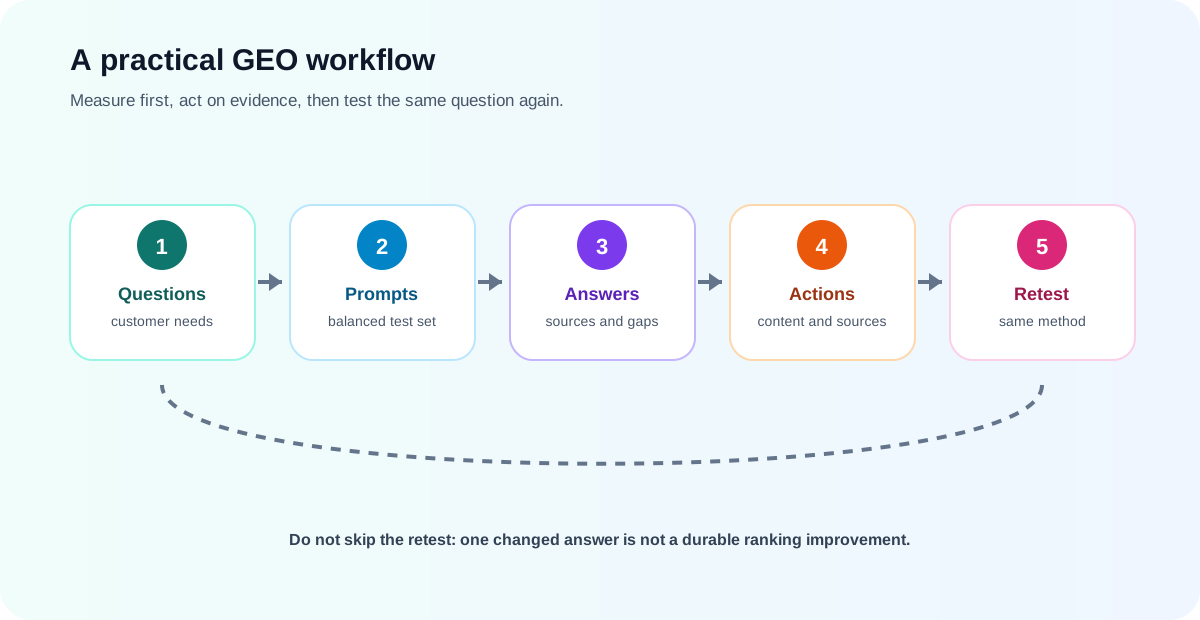
Step 2: Audit current answers
Run the prompt set across the AI surfaces relevant to the business. Record:
- Prompt wording
- Model or surface
- Country and language
- Date and time
- Complete answer
- Mentioned brands
- Cited domains and pages
- Sentiment or brand framing
- Incorrect or missing facts
Tools such as AI Search Console, Peec AI, Rankscale, and Otterly.AI can support different parts of this monitoring workflow. They do not all measure the same surfaces or use the same methodology, so their scores should not be compared without checking the underlying prompt and model assumptions.
Step 3: Find the source gap
When a brand is absent or described incorrectly, inspect the sources that appear in the answer.
Ask:
- Is the brand’s own page missing a clear fact?
- Is a third-party source outdated?
- Does a competitor have stronger comparison coverage?
- Is the information present but difficult to extract?
- Are different pages making inconsistent claims?
- Is the issue content, authority, technical access, or measurement noise?
Step 4: Improve the right page
Possible actions include:
- Rewrite an unclear explanation
- Add a direct answer and supporting context
- Publish a comparison or use-case page
- Update product, pricing, or policy facts
- Improve entity and structured-data clarity
- Add author, source, and update information
- Strengthen relevant internal links
- Earn accurate third-party coverage
Do not change every page after one AI answer. Use repeated observations and prioritize changes that help human readers as well as retrieval systems.
Step 5: Re-run a stable test
Keep the prompt set, model, region, and comparison period as consistent as possible. Compare the underlying answers, not just an aggregate score.
A change can produce:
- More mentions but worse accuracy
- More citations but no detectable traffic
- Better visibility for branded prompts but no improvement for category prompts
- A temporary response change that does not persist
GEO measurement should therefore include both the result and the evidence behind the result.
How to measure GEO progress
A practical measurement system separates:
AI visibility
Did the brand appear in the selected sample? Useful measures include mention rate, share of voice, recommendation position, and presence by prompt group.
AI citations
Which sources were linked, named, or used? Track source domains, pages, citation position, and whether the cited information is accurate.
AI traffic
Did a detectable visitor arrive from an AI surface? Use analytics and server evidence, but remember that many AI-influenced journeys are not fully attributable.
Business outcomes
Did a lead, sale, signup, or other outcome occur? Connect AI observations to analytics, CRM, and commerce data carefully. Correlation can inform an investigation, but it does not prove causation by itself.
How to Track Whether AI Engines Are Citing Your Brand explains how to build a repeatable prompt and citation-monitoring process.
Common GEO mistakes
Treating a single answer as a ranking
One answer is evidence of one observation. It is not a universal position.
Using only branded prompts
Branded prompts are useful for accuracy checks, but they do not measure category discovery by themselves.
Copying competitor language without evidence
A competitor’s wording may not be accurate or appropriate for another brand. Research the underlying customer question and source facts instead.
Adding schema without validating the page
Structured data should accurately describe visible page content. It is not a hidden instruction to an AI system.
Publishing unreviewed AI content
Generic, repetitive, or inaccurate content can make a brand less trustworthy. Human review remains essential for expertise, claims, legal requirements, and voice.
Claiming results too quickly
AI answer sampling is noisy. A before-and-after change should use a stable methodology and an appropriate observation window.
Who needs GEO?
GEO is especially relevant to businesses whose customers use AI systems for discovery, evaluation, or comparison:
- SaaS and software companies
- Ecommerce and product brands
- Agencies and professional services
- Healthcare and financial services
- Education and travel
- Local and multi-location businesses
- Publishers and research organizations
The appropriate investment depends on the buying journey. A small company may begin with a carefully designed prompt set and manual review. A multi-market enterprise may need model coverage, workspace permissions, API access, source analysis, crawler monitoring, and reporting integrations.
GEO tools by job to be done
AICiteKit’s directory groups tools by the workflow they support:
- AI visibility monitoring: Otterly.AI, AI Search Console, Peec AI, Rankscale
- Enterprise AI Search intelligence: Profound, AthenaHQ
- Prompt, crawler, and referral analysis: PromptWatch
- Answer capture and citation analysis: ZipTie
- Content optimization and GEO writing: Frase, Surfer AI Tracker, Writesonic GEO Suite
- Structured data and entities: Schema App
These categories overlap. The right choice depends on whether a team needs monitoring, source intelligence, technical access data, content execution, or enterprise reporting.
FAQ
Is GEO the same as AEO?
The terms overlap. AEO often emphasizes optimizing for answer engines, while GEO emphasizes generative engine and AI-generated answer visibility. Different vendors use the terms differently, so compare the actual workflow rather than the label.
Does GEO replace SEO?
No. Crawlability, useful content, internal links, authority, structured data, and technical quality remain important. GEO adds questions about answer representation, citations, prompt coverage, and AI-driven discovery.
Can I control what ChatGPT or Google says about my brand?
No. You can improve the clarity and consistency of your information and address inaccurate sources, but you cannot guarantee a specific answer across all models, prompts, users, or locations.
How long does GEO take to work?
There is no universal timeline. It depends on the model, source changes, content quality, authority, crawl and retrieval behavior, and the prompt set being monitored. Use repeatable measurements instead of promising a fixed result.
Does adding structured data guarantee AI citations?
No. Structured data can help machines interpret a page when it accurately describes visible content, but it does not guarantee a citation, recommendation, or ranking.
What should a small business do first?
Start with a clear source-of-truth page, a balanced prompt set, a manual baseline across relevant AI surfaces, and a review of the sources that competitors receive. Add a monitoring tool once recurring measurement becomes valuable.
Further reading and sources
- Google Search Central: AI features and your website — official guidance on AI features in Google Search.
- Google Search Central: Structured data — official technical guidance for structured data.
- OpenAI Help: ChatGPT Search — official context for ChatGPT Search and sources.
- Google Search Help: AI Overviews — official explanation of AI Overview experiences.
- Google Search Central: Creating helpful, reliable, people-first content — official content-quality guidance.
- AICiteKit: AI Visibility vs AI Citations vs AI Traffic — measurement distinctions and attribution limits.
- AICiteKit: How to Track Whether AI Engines Are Citing Your Brand — practical prompt and citation monitoring.
- AICiteKit GEO tool directory — evaluated tools for AI Search and GEO workflows.