Field notes / ai-search
AI Search Claim Coverage: How to Check Whether Important Facts Have Sources
A practical AI Search claim coverage framework for mapping answer claims to sources, separating supported facts from unsupported recommendations, and reporting evidence without overclaiming.
The short answer
AI Search claim coverage is a claim-level audit of whether the important statements in a captured answer have relevant, current, and visible supporting sources. It is more precise than counting citations because one URL may support one sentence while leaving the rest of an answer unverified.
Use this sequence:
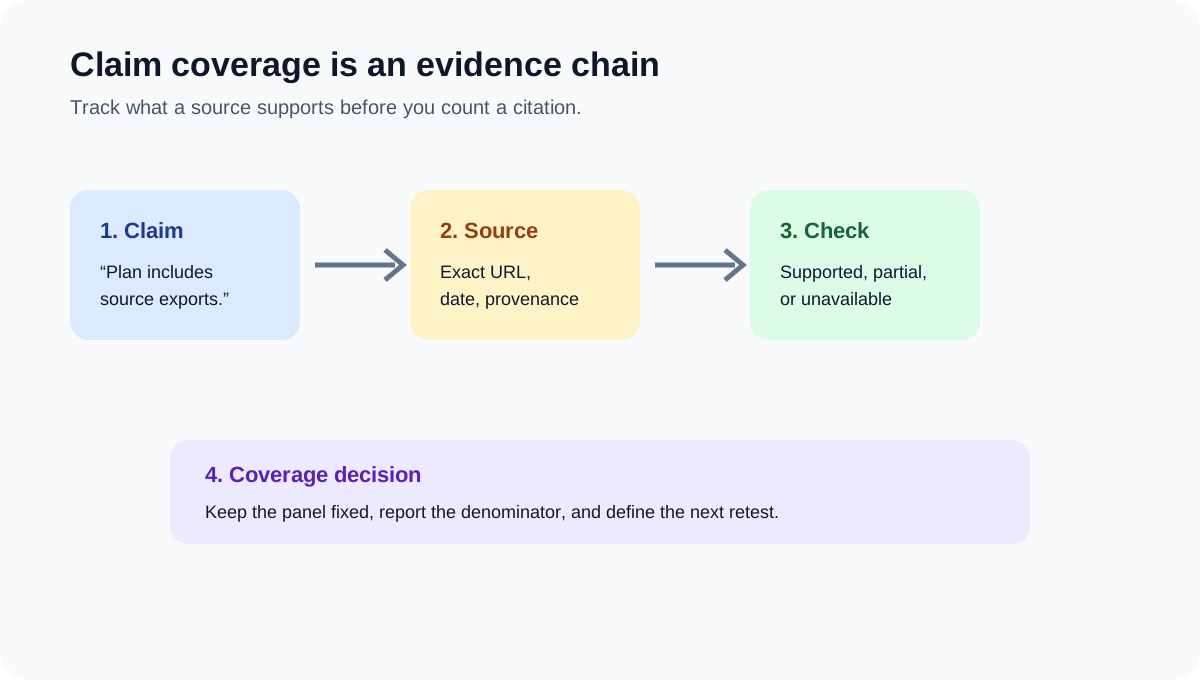
real question → answer capture → claim inventory → source mapping → support check → bounded reportA defensible result sounds like this:
We reviewed 24 product-fact answers. Of 68 claim-to-source relationships, 41 were supported for the recorded plan and date, 12 were partial, 9 were unavailable, and 6 were contradicted by the current primary source. The sample does not estimate every user’s answer or prove that a source caused selection.
That is more useful than “the page had a 60% citation score.”
This guide addresses searches such as “how do I check whether AI answers are accurate?”, “how do I measure AI citation quality?”, and “does a citation support the whole answer?” It is a methodology for reviewing observed answers, not a recipe for guaranteed citations, rankings, traffic, or revenue.
What claim coverage measures
A claim is a discrete statement that could be checked. Examples include:
- A product has a named feature.
- A plan has a stated price or usage limit.
- A provider serves a region.
- A comparison product is suitable for a particular buyer.
- A policy, date, specification, or availability condition applies.
Claim coverage asks whether the answer’s important claims have an observable source relationship and whether the source supports the wording used. It does not ask whether the answer contains a URL somewhere.
Google’s official guidance says AI features may show links to supporting web resources and directs site owners toward foundational Search practices (Google Search Central: AI features and your website, checked October 15, 2026). This supports the existence of supporting links in the documented Search context. It does not define a universal claim-coverage metric or guarantee that a page will be selected.
OpenAI’s web search documentation, checked October 15, 2026, describes citations and sources for a particular API tool. That is product-specific documentation, not evidence that every consumer AI surface exposes sources or maps them to claims in the same way.
The independent paper GEO: Generative Engine Optimization, checked October 15, 2026, provides research context for evaluating visibility in generative-engine responses. It does not validate a commercial dashboard’s claim score or establish a causal business effect.
Why citation counts are too coarse
A citation count can hide several different situations:
| Observation | What it supports | What it does not prove |
|---|---|---|
| A URL appears in an answer | The URL was visible in that capture | That it supports every sentence |
| A source appears beside a claim | The interface exposed a source relationship | That the claim is accurate or current |
| A brand is mentioned without a source | The answer contains a mention | That the brand was recommended or verified |
| A recommendation has a source | A source was visible near the recommendation | That the recommendation is independent or correct |
| A source supports an old price | It supported the checked historical wording | That the price is current today |
| A page was crawled | An automated access event occurred | That a person saw or clicked a citation |
The practical unit is therefore not “answer cited: yes.” It is:
claim → visible source → passage check → scope and freshness → statusFor the difference between mentions, recommendations, and citations, see AI Search Mentions vs Recommendations. For a broader evidence ledger, see AI Search Citation Log Template.
1. Define the question and claim scope
Start with a real decision, not a generic request to “check AI visibility.” Examples:
- Does the answer describe our current plan limits correctly?
- Which sources support recommendations for small agencies?
- Are regional service claims backed by current pages?
- Does the answer distinguish our product from a similarly named competitor?
- Which third-party sources shape a category comparison?
Version the prompt and write the expected claim scope before collecting answers. Do not add criteria after seeing which source was cited; that creates a moving test.
Record:
- Prompt ID and exact wording
- Intent: branded, category, comparison, product fact, local, or risk
- Buyer context and constraints
- Surface and mode
- Country, language, and location
- Collection date and time zone
- New conversation or prior-turn context
- Run number and retry status
If the surface does not expose a field, record not exposed or unavailable. Do not infer a hidden model, retrieval query, or source-selection reason.
2. Capture the complete answer
Save the answer before summarising it. Where permitted by the platform and applicable privacy rules, preserve:
- Exact prompt and prompt-set version.
- Full answer or an allowed near-raw capture.
- Mentioned brands, products, and competitors.
- Recommendations and stated criteria.
- Every visible source title and direct URL.
- Source position or answer section.
- The claim or sentence each source appears to support.
- Empty, failed, login-gated, and no-source states.
A source list at the end of a report is not enough if a reviewer cannot tell which claim each URL supports. Keep the raw observation separate from the editorial interpretation.
A minimal record might look like this:
Run: FACT-021 v3 / 05
Prompt: Which GEO tools export source URLs for agency reports?
Surface: named AI Search surface; mode recorded if disclosed
Market: United States / English
Collected: 2026-10-15 UTC
Claim set: export, agency workflow, plan scope
Answer status: qualifying capture
Visible sources: 4
3. Split the answer into claim units
Do not audit an answer as one block. Break compound statements into checkable units:
Answer: Tool A tracks daily prompts, supports agency reporting,
and includes source exports on the starter plan.

Claim 1: daily prompt tracking
Claim 2: agency reporting workflow
Claim 3: source exports
Claim 4: starter-plan availability
The source beside the sentence may support only Claim 1. Claim 4 may require a current pricing or plan document. Claim 2 may be editorial positioning rather than a fact supported by the cited passage.
Use smaller units when the answer combines:
- Feature plus plan
- Product fact plus recommendation
- Price plus billing interval
- Availability plus geographic scope
- Mention plus quality judgement
A good claim unit includes the subject, predicate, object, and relevant qualifiers. “Supports exports” is weaker than “the Standard plan documents CSV export for source URLs, checked on October 15, 2026.”
4. Map claims to sources
Create one row for each claim-to-source relationship. A single claim can have multiple sources, and one source can support several claims only when the relevant passages do so.
| Claim ID | Answer claim | Visible source | Source type | Scope |
|---|---|---|---|---|
| C-01 | Product documents source export | Direct documentation URL | Official | Feature, checked date |
| C-02 | Export is included in starter plan | Pricing or plan URL | Official | Plan and billing basis |
| C-03 | Best for agencies | Review or comparison | Independent or commercial | Audience judgement |
| C-04 | Product increased traffic | Case study | Vendor-selected evidence | Reported customer claim |
Classify provenance explicitly:
- Official: vendor documentation, pricing, or product page.
- Independent: user review, community discussion, research, or independent test.
- Commercial: agency, affiliate, competitor, or sponsored comparison.
- Vendor-selected evidence: a case study or testimonial selected by the vendor.
- Editorial: AICiteKit interpretation.
A commercial source can be useful for workflow observations while still carrying bias. A vendor-selected customer story can support the narrow statement that the vendor reports a named result; it is not independent proof of a general outcome.
5. Check support, scope, and freshness
Use a small status vocabulary:
| Status | Meaning |
|---|---|
| Supported | The checked passage supports the claim for the recorded scope and date. |
| Partial | The source supports only part of the claim, or a qualifier is missing. |
| Contradicted | The checked source conflicts with the answer claim. |
| Unverified | A relevant passage was not found or the relationship is unclear. |
| Unavailable | The answer or source could not be inspected under the collection rules. |
Check five dimensions:
- Relevance: Is this the same product, feature, and buyer question?
- Accuracy: Does the passage support the wording, not merely the topic?
- Scope: Does it match plan, edition, market, date, and currency?
- Freshness: Are dynamic facts current for the decision?
- Completeness: Does the source support the whole claim or one clause?
For a price, check billing interval, currency, taxes, annual versus monthly terms, usage limits, and the date checked. For model or platform coverage, check whether the claim applies to the base plan, an add-on, early access, or only a vendor roadmap.
Do not silently turn “not found” into “false.” Use unverified or unavailable when the evidence does not justify a stronger conclusion.
6. Calculate claim coverage with a visible denominator
Choose the denominator before reporting the result. For example:
supported claim coverage
= supported claim-source relationships ÷ reviewed claim-source relationships
You may also report:
answer claim coverage
= answer claims with at least one supported source ÷ answer claims reviewed
These are different. A single claim with five supporting URLs should not outweigh five unsupported claims unless that weighting is declared.
A report should show counts, not only a percentage:
We reviewed 80 answer claims from 20 qualifying captures. Forty-eight claims had at least one source that supported the stated scope; 14 were partial, 10 unverified, 5 contradicted, and 3 unavailable.
Keep these measures separate from:
- Mention rate
- Recommendation rate
- Citation visibility
- Source position
- Crawler requests
- AI-referred sessions
- Leads, orders, or revenue
A higher claim-coverage rate in one prompt panel is not proof of a universal quality improvement. It is evidence about the defined sample and checking rule.
7. Handle recommendations separately
Recommendations combine factual predicates with judgement. An answer may correctly state a feature and still make an unsupported claim that a product is “best for agencies.”
Audit a recommendation in layers:
| Layer | Example question | Evidence needed |
|---|---|---|
| Product fact | Does the tool export source URLs? | Current official documentation |
| Buyer criterion | Does the agency need source-level exports? | Prompt and buyer context |
| Fit judgement | Is this product suitable for the agency? | Explicit criteria and comparative evidence |
| Outcome claim | Will it improve client retention? | Strong independent business evidence; often unavailable |
Do not use a product rating, case study, or citation count as proof of traffic, revenue, guaranteed visibility, or customer success. A recommendation can be a useful observed answer while remaining an unverified judgement.
For more on auditing recommendations, see AI Search Recommendation Evidence and AI Search Recommendation Criteria.
8. Turn a gap into one bounded action
A claim gap should lead to the smallest action supported by the evidence:
- Missing primary fact: clarify the official product, pricing, or policy page.
- Stale fact: update the date-sensitive claim and define a retest.
- Partial comparison: add the missing criterion with direct sources.
- Third-party contradiction: investigate which source is current; do not erase inconvenient evidence.
- Entity confusion: add distinctive names, relationships, and official references.
- Measurement gap: repair the prompt, capture, or source-recording rule before editing content.
- Noisy answer change: continue the fixed-panel observation rather than making a large rewrite.
After a material update, rerun the same versioned prompts under comparable conditions. Report a before-and-after association as an observation. Do not claim the edit caused the change without a stronger design.
Where tools fit
Monitoring products can reduce collection and comparison work, but their claim, citation, and source fields are not automatically equivalent.
- AI Search Console is relevant when the workflow needs prompt, answer, source, and visibility records.
- PromptWatch is a comparison point for prompt monitoring alongside crawler or referral context.
- Otterly.AI represents a recurring prompt and citation-monitoring workflow.
- ZipTie is relevant when answer capture and source-impact analysis are central.
- Profound is an enterprise-oriented comparison for broader AI Search intelligence and reporting.
These internal pages describe different products, not interchangeable measurements. During a trial, verify whether the export preserves exact prompts, full answers, source URLs, claim context, timestamps, failed runs, plan scope, and the tool’s citation definition. Recreate one reported coverage figure manually when possible.
A practical claim-coverage worksheet
Run ID:
Prompt ID and version:
Exact prompt:
Surface / mode / model label:
Market / language / location:
Collected at (UTC):
Answer status:

Claim ID:
Exact answer claim:
Claim type: fact / comparison / recommendation / outcome
Visible source title:
Visible source URL:
Source position or section:
Source type: official / independent / commercial / vendor-selected
Relevant passage:
Scope: plan / edition / market / date / currency
Support: supported / partial / contradicted / unverified / unavailable
Freshness checked at:
Action and retest date:
Reviewer notes:
This format keeps the answer, source, support decision, and next action connected. It also makes later disagreement inspectable instead of hiding it inside a score.
What claim coverage can and cannot prove
| Finding | Reasonable interpretation | Boundary |
|---|---|---|
| A source supports one answer claim | The checked passage supports that claim for the recorded scope | Not support for the whole answer |
| Several claims have supporting URLs | The sample has a documented source relationship | Not a universal accuracy rate |
| Coverage rises after a content edit | The measured sample changed afterward | Not causal proof without controls |
| A vendor reports high coverage | The vendor calculated a metric under its method | Not a standardized cross-tool score |
| A cited page receives a referral | A visit was observed if analytics captured it | Not proof the citation caused the visit |
| Coverage and conversions move together | The measurements co-occurred | Not proof of revenue causation |
The evidence boundary is part of the result. A useful audit may conclude that an important claim is unsupported or stale while leaving the reason for source selection unresolved.
FAQ
Is a citation enough to mark a claim as supported?
No. Open the source and check the passage, scope, date, and qualifiers. A URL can be relevant to the topic while failing to support the exact wording.
Should every sentence have a citation?
Not necessarily. Prioritize claims that affect a buyer’s decision: prices, limits, availability, safety, performance, comparisons, and recommendations. Define the audit scope before collecting the answer.
Is claim coverage the same as citation rate?
No. Citation rate counts a source relationship under a chosen rule. Claim coverage checks whether important claims have sources that support them. Report the two separately because one cited URL may leave several claims unsupported.
Can claim coverage measure AI answer quality?
It can provide a bounded evidence signal for the checked claims and sources. It cannot fully measure helpfulness, user trust, hidden retrieval, or every answer a person may receive.
Can better claim coverage increase traffic or revenue?
This method does not establish that. Pair answer records with separately defined referral, analytics, CRM, and revenue evidence when available, and do not treat co-occurrence as causation.
How many answers should be audited?
There is no universal threshold that makes a sample representative. Start with a stable panel large enough to expose failed runs and variation, preserve the denominator, and expand it when the decision is important. Report the actual sample and context.
Sources and verification
- Google Search Central: AI features and your website — official guidance on AI features and supporting web resources; checked October 15, 2026.
- OpenAI: Web search — official documentation for citations and sources in a specific web-search tool; checked October 15, 2026.
- Google: Creating helpful, reliable, people-first content — official guidance on useful, reliable content; checked October 15, 2026.
- Aggarwal et al., “GEO: Generative Engine Optimization” — independent academic research context for generative-engine visibility; checked October 15, 2026.
- Google Analytics campaign URL guidance — official context for tagged campaign measurement; checked October 15, 2026.
The official pages and independent paper above support the documented platform and research context. They do not establish a universal claim-coverage standard, validate any vendor’s score, or prove that a source, content change, citation, or recommendation causes traffic, leads, or revenue.
Evidence confidence: Medium. The workflow is grounded in public documentation and independent research context, while answer interfaces, source exposure, sampling, and parser behavior differ by surface and can change.
Last reviewed: October 15, 2026.