Field notes / ai-search
AI Search Regression Testing: How to Detect Answer Changes After a Website Release
A practical AI Search regression-testing workflow for comparing prompts, answers, citations, and source claims after a website change—without mistaking volatility for causation.
The short answer
AI Search regression testing is a controlled comparison of saved prompts before and after a website, content, access-policy, or product change. The test asks whether the captured answer, visible sources, or checked claims changed under the same recorded conditions.
Use this chain:
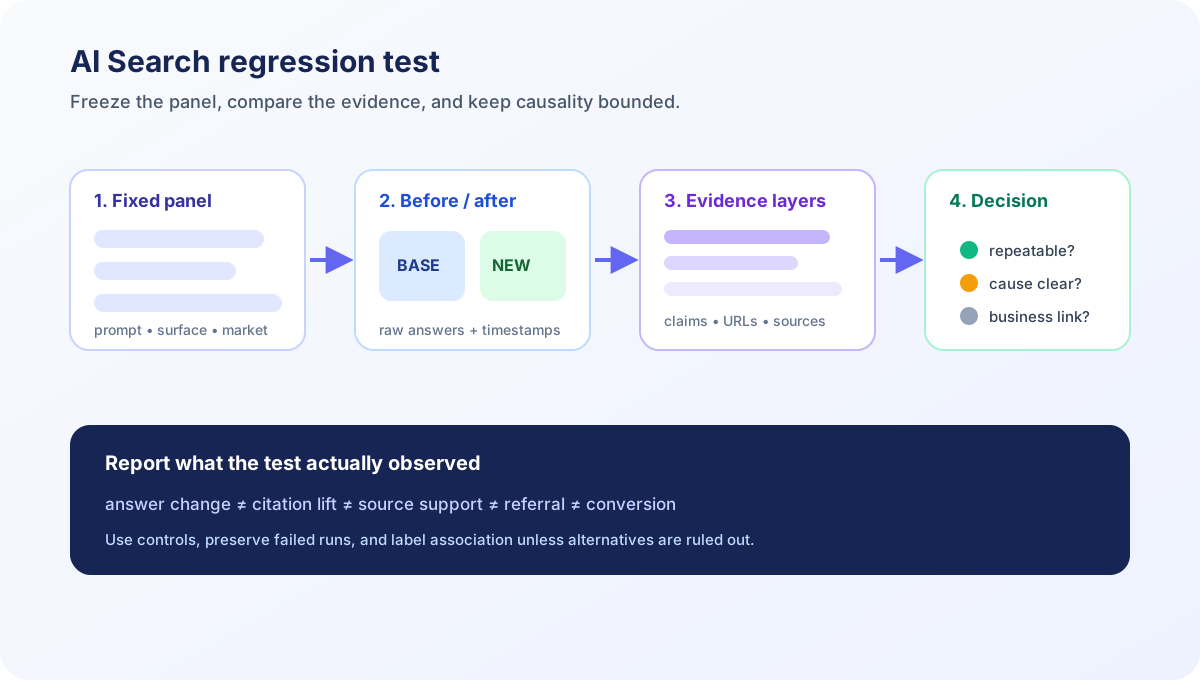
release → fixed prompt panel → answer capture → claim/source comparison → bounded decisionA changed answer is an observation. It is not, by itself, proof that your release caused the change, improved visibility, increased citations, or generated revenue. AI Search outputs can also vary because of retrieval state, surface behavior, model routing, source updates, location, language, account context, or changes in the prompt panel.
This guide addresses searches such as “how do I test whether a website change affects ChatGPT answers?”, “how can I monitor AI citations after a content update?”, and “how do I run an AI search regression test?” It complements AI Search Answer Volatility, AI Search Prompt Drift, and AI Search Experiment Backlog.
What a regression test can—and cannot—show
Google’s AI features documentation, checked October 11, 2026, says AI features may show links to supporting web resources and recommends foundational Search practices. It does not define a universal test for whether a site change will produce an answer or citation.
OpenAI’s web search documentation, checked October 11, 2026, documents source and citation fields for a particular API tool. This supports inspecting exposed source data when that tool supplies it; it does not establish that every ChatGPT surface, model, or other answer engine exposes identical fields.
| Observation | Safe interpretation | Do not claim from it alone |
|---|---|---|
| Answer text differs after a release | The sampled output differs under the recorded conditions | The release caused the difference |
| An owned URL appears in more answers | The URL appeared more often in that sample | Market-wide citation growth or ranking improvement |
| A product fact is corrected | The captured answer is closer to the checked source | Higher traffic, trust, or revenue |
| A crawler requested the changed page | A request was recorded for that user agent | The page was used in a user-facing answer |
| An AI referral is recorded | Analytics recorded a referral signal | The citation caused a conversion |
| The result repeats across runs | Repetition occurred in the defined cohort | Permanent behavior or a universal ranking |
Keep answer change, mention, recommendation, visible citation, source support, referral, and conversion as separate fields.
1. Define the release and the decision
A test needs a release boundary and a decision. “We changed the site” is too broad for an auditable comparison.
Record:
- Release ID, deployment timestamp, and time zone
- URLs, templates, components, policy files, or data affected
- Intended change and the claim it was meant to clarify
- Control URLs or pages that should not have changed
- Prompt-panel version and owner
- Surfaces, modes, markets, languages, and account assumptions
- The outcome that would justify follow-up
| Decision | Useful test | Weak conclusion |
|---|---|---|
| Did a pricing-page rewrite fix a factual answer? | Product-fact prompts mapped to the pricing page, with claim checks | “The page is now ranked higher” |
| Did a documentation release change citations? | Stable technical prompts and exact source URLs | “The release caused citation growth” |
| Did an access-policy change alter answer presence? | Policy snapshot plus page response and answer capture | “Allowing the bot guarantees inclusion” |
| Did a category page help discovery prompts? | Unbranded and comparison prompts, split from branded prompts | “The brand now owns the category” |
The narrower the intended claim, the easier it is to choose an appropriate panel and evidence boundary.
2. Freeze the prompt panel before the release
Do not create the baseline after the change. Save the exact prompts before deployment and version them. A prompt panel should represent the decision rather than merely generate a large number of convenient questions.
A useful panel may include:
- Branded prompts: what the company or product does
- Category prompts: which options are considered for a need
- Comparison prompts: how named alternatives differ
- Product-fact prompts: pricing, limits, integrations, and availability
- Source prompts: which pages or sources support a claim
- Regional prompts: questions where market or language could matter
Keep cohorts separate. “What does Brand X do?” tests identity; “Which tools solve problem Y?” tests discovery. Combining them can hide a regression in one intent class.
For each prompt, preserve:
Prompt ID and exact wording
Panel version and intent class
Surface, mode, and model label when disclosed
Country, language, device, and account context when relevant
Collection timestamp and run number
Prior conversation state
Expected source or claim under test
If a field is not exposed, record not disclosed or not available. Do not fill it with an assumed model, hidden query, or inferred retrieval order.
3. Capture a baseline, not just a screenshot
A screenshot preserves appearance but is a weak comparison record on its own. Capture the complete answer or an allowed near-raw representation, every visible URL, and the conditions needed to interpret it.
A minimum baseline record looks like this:
Release: DOCS-2026-10-11
Prompt: PRICE-003 v2
Surface: named AI Search surface; mode recorded
Market: US / English
Run: 2 of 5
Model: not disclosed
Answer: preserved according to the collection policy
Visible URLs: exact URLs and link positions
Target claim: current plan availability
Baseline status: supported / partial / contradicted / unavailable
Record failed, empty, blocked, and unavailable runs. Removing them after collection makes the post-release result look more stable than it was.
Tools such as AI Search Console, PromptWatch, Peec AI, Otterly.AI, Profound, and Rankscale may support different combinations of prompt scheduling, answer capture, source analysis, and reporting. Their “visibility” or “citation” metrics are not interchangeable until you verify the prompt set, surface coverage, refresh method, counting rules, retention, and raw evidence available for export.
4. Compare claims, not only strings
A text diff is useful, but it is not the same as a factual regression. Compare the answer at three levels:
Answer-level changes
Record whether the answer:
- Appeared, disappeared, or returned an error
- Changed its recommendation set
- Added or removed a brand mention
- Added, removed, or changed visible source URLs
- Changed its qualification, date, or confidence language
Claim-level changes
Split material statements into units whose truth conditions differ:
| Claim unit | Baseline check | Post-release check |
|---|---|---|
| Capability | Does the source document the capability? | Did the wording remain accurate? |
| Limit | Is the plan, market, or edition specified? | Did the answer preserve the condition? |
| Recommendation | Is the option suggested for the stated need? | Did the recommendation change? |
| Comparison | Are the alternatives compared on a defined criterion? | Did the criterion or facts change? |
| Qualification | Is the date, region, or exception visible? | Was a relevant caveat lost? |
A source URL appearing beside a paragraph does not prove that it supports every sentence in that paragraph. Map a source to the narrowest claim it can support and mark the relationship supported, partial, contradicted, unavailable, or not applicable.
Source-level changes
Canonicalize URLs without erasing useful distinctions. A product page, pricing page, help article, review, and redirected URL may belong to the same domain but provide different evidence.
Compare:
- Exact URL and canonical target
- Domain and source type
- First-party versus third-party status
- Source passage supporting the claim
- Source publication or update date when available
- Whether the source was accessible at both checkpoints
The independent paper GEO: Generative Engine Optimization by Aggarwal et al., checked October 11, 2026, provides research context for generative-engine visibility experiments. It does not validate a production dashboard’s regression score or prove that a website release causes a commercial result.
5. Use controls and repeated runs
A single before-and-after pair is a weak design. Add controls where practical:
- A stable page that was not part of the release
- Prompts whose expected answer should not change
- A second collection run before deployment
- Repeated post-release runs at defined intervals
- A comparison of branded and unbranded cohorts
A simple observation table can separate the evidence:
| Cohort | Baseline | Post-release | What it says |
|---|---|---|---|
| Product-fact prompts with target URL | 4/10 cited | 6/10 cited | URL presence changed in this sample |
| Unbranded category prompts | 2/10 mentioned | 3/10 mentioned | Mention count changed in this sample |
| Unchanged control prompts | 5/10 cited | 4/10 cited | Background variation may be present |
| Failed or unavailable runs | 1 | 2 | Collection quality also changed |
These numbers are an illustrative reporting shape, not a result from an AICiteKit experiment. Use your own raw captures and denominator.
If controls move in the same direction as the treatment prompts, the release is a weaker explanation. Other causes may include source-page edits, retrieval changes, surface updates, changed account state, or ordinary answer volatility.
6. Classify the result conservatively
Use labels that describe what was observed:
- No observed change: no material difference in the defined fields.
- Answer change, cause unclear: the output changed, but competing explanations remain.
- Source change: visible URLs or source passages changed.
- Claim correction: the answer moved closer to or farther from a checked authoritative source.
- Access change: policy, response, redirect, or delivered-content behavior changed.
- Collection change: the panel, surface, parser, account, or availability changed.
- Follow-up experiment needed: the observation is useful but not sufficient for the decision.
Avoid “successful” unless success is defined as a measured condition, such as “the answer stated the current trial term and cited the intended documentation URL in the fixed panel.” Do not use a higher citation count as a proxy for accuracy.
7. Separate regression testing from analytics
A regression test can be joined to analytics only when the systems preserve compatible identifiers and dates. Even then, the layers answer different questions:
| Layer | Question | Evidence |
|---|---|---|
| Answer | What changed in the captured output? | Raw answer and timestamp |
| Citation | Which visible URLs changed? | Exact URLs and positions |
| Source support | Do those pages support the claims? | Checked passages and scope |
| Referral | Was a visit recorded? | Referrer, campaign, or analytics event |
| Conversion | Was a business event recorded? | Defined CRM or transaction event |
| Causality | Did the release cause it? | Stronger experimental design and alternatives |
An answer change with no analytics event remains an answer observation. A referral with no preserved answer identifier remains an adjacent analytics observation. Do not join them into a causal story because their dates are close.
For a fuller claim-to-source method, see AI Search Citation Attribution Audit. For separating visibility, citations, and traffic, see AI Visibility vs AI Citations vs AI Traffic.
A practical regression checklist
- Write the decision and the exact release boundary.
- Freeze the prompt panel, cohorts, surface, market, language, and run rules.
- Capture at least one baseline with raw answers, URLs, timestamps, and unavailable states.
- Snapshot the changed pages, canonical URLs, access policy, and relevant source passages.
- Deploy one bounded change where possible.
- Run the same panel under the same conditions, preserving failures.
- Compare answer, claim, and source fields separately.
- Review controls and repeated runs for background variation.
- Report denominators and evidence boundaries.
- Choose one follow-up action, then version the next test.
Who should use this workflow?
This method is useful for SEO and content teams releasing documentation or pricing changes, product marketers checking AI-generated product facts, agencies reporting client changes, and engineers who need an answer-level regression signal alongside conventional tests.
It is not a substitute for unit tests, web analytics, search-engine diagnostics, a vendor’s hidden retrieval trace, or a representative study of all AI Search users. A small panel can reveal a useful regression to investigate; it cannot become a universal ranking or traffic forecast.
FAQ
Does a changed AI answer prove that my content update caused it?
No. It proves that the sampled output differed under the recorded conditions. Hold the panel steady, use controls and repeated runs, and report association unless the design rules out credible alternatives.
How many prompts should an AI Search regression panel contain?
There is no universal number. Start with the smallest panel that covers the decision, separate intent cohorts, preserve the baseline, and expand when the result needs broader coverage. More prompts do not automatically make an unbalanced panel representative.
Should I compare exact answer text or citations?
Both, but for different purposes. Text comparison can reveal changed claims and qualifications; URL comparison can reveal changed source exposure. Neither alone establishes that the new answer is more accurate or that the release caused the change.
What if the model or surface changes between runs?
Create a new cohort or mark the comparison as compromised. A result collected under a different surface, mode, model label, market, or account state may still be useful, but it is not a clean regression comparison.
Can a crawler log serve as the regression test?
No. A log can show that a request matching a user-agent rule occurred. It does not show that the page was used in a user-facing answer or that a citation changed. Keep access evidence and answer captures separate.
Should I roll back a release after citation loss?
Not from citation loss alone. First check whether the loss is repeatable, whether controls moved, whether the source is accessible and accurate, and whether the change affected the intended claim. A rollback is a product decision, not an automatic response to one volatile answer.
Evidence snapshot
| Source | Public signal | What it supports | Confidence |
|---|---|---|---|
| Google Search Central: AI features and your website | Official guidance that AI features may show supporting links | AI-feature link behavior and the boundary around guaranteed appearance | High for Google documentation; not a universal test protocol |
| OpenAI Developer Docs: Web search | Official API documentation for source and citation fields | Product-specific source inspection context | High for the documented API; not every ChatGPT surface |
| Aggarwal et al., “GEO: Generative Engine Optimization” | Independent academic paper | Research context for generative-engine visibility experiments | Medium; not validation of production causality |
| AI Search Answer Volatility | AICiteKit editorial method | Companion guidance for repeated-run variation | Editorial |
| AI Search Prompt Drift | AICiteKit editorial method | Companion guidance for panel and wording changes | Editorial |
Sources and verification
- Google Search Central: AI features and your website — checked October 11, 2026; supporting links and foundational Search guidance.
- OpenAI Developer Docs: Web search — checked October 11, 2026; source and citation fields for a documented API tool.
- Aggarwal et al., “GEO: Generative Engine Optimization” — checked October 11, 2026; independent research context, not evidence of a commercial or causal outcome.
- AI Search Answer Volatility — internal companion for repeated-run interpretation.
- AI Search Prompt Drift — internal companion for preserving prompt definitions.
The evidence boundary is deliberate: official documentation supports documented platform behavior; independent research supports methodological context; the comparison framework and recommendations are AICiteKit editorial judgment. No source cited here proves a universal AI ranking, guaranteed citation, traffic increase, conversion lift, or causal effect from a website release.