Field notes / ai-search
AI Search Answer Volatility: How to Measure Changes Without Calling Them Trends
A practical framework for measuring changing AI Search answers, separating normal variation from meaningful movement, and reporting evidence without inventing rankings or causal results.
The short answer
AI Search answers can change between runs because the prompt, conversation context, search surface, model, market, index, cited sources, and answer-generation conditions may differ. A single changed answer is therefore an observation—not automatically a trend, ranking movement, or result of your last content edit.
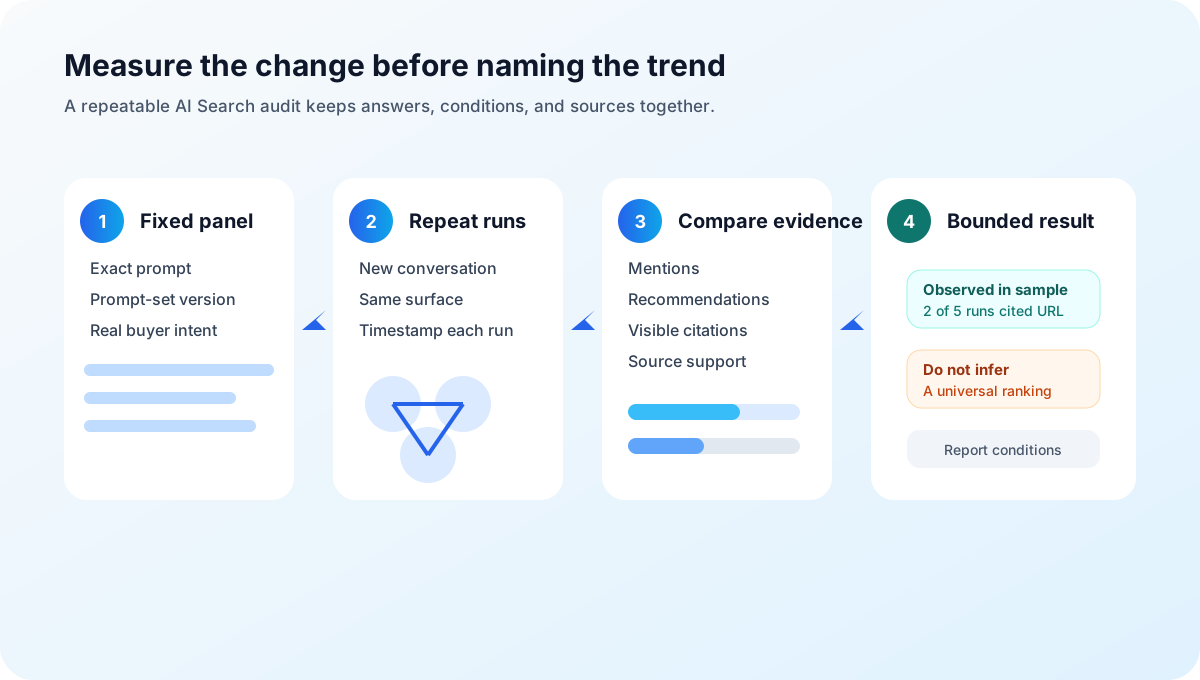
A defensible volatility audit uses this sequence:
fixed prompt panel → repeated captures → condition log → claim/source comparison → bounded conclusionGoogle says its AI features may show links to supporting web resources and recommends foundational Search practices, but its public guidance does not define a universal stability rate or guarantee that a page will appear (Google Search Central, “AI features and your website”, checked September 20, 2026). OpenAI’s web-search documentation describes citation fields for a particular API tool, not a universal behavior across every ChatGPT surface or other answer engine (OpenAI Developer Docs, “Web search”, checked September 20, 2026).
This guide addresses practical searches such as “why do AI search results change?”, “how often should I rerun AI visibility prompts?”, and “how do I know whether a citation change is meaningful?” It complements AI Search Prompt Drift, AI Search Measurement Baseline, and AI Search Benchmarks.
What answer volatility means
For this article, answer volatility means a change in the observed output for a materially equivalent test condition. The output can change in several ways:
- The answer mentions a different brand or set of brands.
- A recommendation changes while the prompt remains the same.
- A cited URL disappears, is replaced, or moves to a different claim.
- The answer’s factual wording changes.
- The answer becomes unavailable, shorter, or differently qualified.
These are not interchangeable events. A changed citation is not necessarily a changed recommendation. A changed recommendation is not proof of a ranking change. A new URL may reflect source freshness, retrieval variation, or a different answer composition.
| Observation | Safe interpretation | Do not claim from it alone |
|---|---|---|
| One rerun cites a different URL | The captured source set differed | A durable visibility loss |
| A brand appears in 3 of 10 runs | The brand was observed in 30% of this defined sample | A 30% probability for all users |
| A recommendation changes after a follow-up | Conversation context may have affected the answer | That one page edit caused the change |
| Several answers use the same source | Source repetition occurred in the sample | That the source is authoritative or universally preferred |
| A crawler request is logged | An automated request reached the site | That a user-facing answer cited or trusted the page |
The independent paper GEO: Generative Engine Optimization studies generative-engine visibility in an academic setting (Aggarwal et al., arXiv, checked September 20, 2026). It provides research context for evaluating visibility, but it does not establish a production volatility benchmark for a particular commercial platform.
Why the same prompt can produce a different answer
A comparison is only meaningful when its conditions are comparable. Log these variables before interpreting movement:
- Exact prompt: preserve punctuation, qualifiers, spelling, and requested market.
- Conversation state: record whether the run started in a new conversation or followed earlier turns.
- Surface and mode: distinguish a search-enabled answer, a consumer chat surface, an API call, and a browser experience.
- Model or version: record it when the product discloses it; otherwise write
not disclosed. - Location and language: note country, language, device, and account state when relevant.
- Collection time: use a timestamp and timezone, not only a calendar date.
- Source state: preserve visible URLs, answer text, and whether a source was unavailable.
- Prompt-set version: do not silently add or remove prompts from the denominator.
If a field is not exposed, say so. Filling an unknown model, hidden query, or retrieval order with a guess creates false precision.
A minimum run record can look like this:
Prompt ID: GEO-021 v2
Prompt: Which AI visibility tools fit a small agency with weekly reporting?
Surface: search-enabled AI answer; exact product surface recorded
Market: United States / English
Run: 04 of 10
Collected: 2026-09-20 14:35 UTC
Model: not disclosed
Visible sources: 6
Recommendation: Tool A and Tool B
Target URL cited: no
Hidden retrieval trace: not exposed
1. Define the unit you are measuring
Before choosing a cadence, decide what counts as a change. A useful audit separates at least five units:
- Mention: the brand name appears.
- Recommendation: the answer presents the brand as a fit under stated criteria.
- Citation: a visible URL appears in the response.
- Claim support: the cited source supports the particular statement.
- Referral: separately defined analytics record a visit from a measured source.
A single answer can contain all five, but they require different checks. A brand may be mentioned without being recommended. A recommendation may cite a third-party page rather than the brand’s own URL. A citation may be visible without proving that a person clicked it.
AI Search Mentions vs Recommendations explains this distinction in more detail, while AI Search Answer Provenance provides a claim-to-source review workflow.
2. Build a repeatable prompt panel
Use a versioned panel representing real decisions rather than a list designed only to produce favorable mentions. A practical starter panel might include:
- Category discovery questions
- Branded accuracy questions
- Comparison and alternative questions
- Recommendation questions with explicit constraints
- Pricing, limits, availability, or implementation questions
- Regional or language variants where the business actually operates
The exact size is editorial judgment. What matters is that the panel is stable enough to compare and broad enough to represent the decision. Keep diagnostic prompts separate from the baseline when they answer a different question.
A sample panel record:
| Cohort | Example intent | Keep stable? | Evidence output |
|---|---|---|---|
| Category | “What tools help a small agency monitor AI visibility?” | Yes | Mentions, recommendations, sources |
| Comparison | “Compare Tool A and Tool B for weekly client reporting” | Yes | Criteria and source support |
| Accuracy | “What is Tool A’s current prompt limit?” | Yes | Claim-level fact check |
| Regional | “Which local providers serve buyers in Toronto?” | Separate cohort | Market-specific observations |
| Diagnostic | “Why was our documentation not cited?” | No, investigate only | Hypothesis and source review |
Do not call the panel representative of all AI Search users unless you have evidence for that broader claim. It is a sample of the questions and conditions you chose.
3. Repeat captures before changing the page
A single baseline run is useful for discovery but weak for interpreting movement. Repeat the same panel under the same declared conditions before making a content change. The number of runs is a design choice, not a universal industry standard; state it plainly.
For each run, preserve:
- Full answer text or a permitted near-raw export
- Every visible citation URL
- The claim or answer section associated with each URL
- Mentioned and recommended brands
- Failed, empty, or unavailable responses
- Prompt, surface, market, model disclosure, timestamp, and run number
A basic comparison table can be maintained manually:
| Prompt | Run 1 | Run 2 | Run 3 | Stable finding |
|---|---|---|---|---|
| GEO-021 | Tool A recommended; 5 URLs | Tool A recommended; 6 URLs | Tool B added; 4 URLs | Recommendation not stable across runs |
| GEO-022 | Target URL cited | Target URL absent | Target URL cited | Citation observed in 2 of 3 runs |
| GEO-023 | Pricing claim supported | Pricing claim stale | Pricing claim unsupported | Verify first-party fact before trend analysis |
The table reports the sample. It does not identify the hidden retrieval cause.
4. Use explicit sample measures
Simple measures are useful when their denominator and scope are visible:
mention rate = runs with a target mention ÷ qualifying runs
recommendation rate = runs with a target recommendation ÷ qualifying runs
citation rate = runs with the target URL visible ÷ qualifying runs
support rate = supported cited claims ÷ cited claims reviewed
Report the prompt cohort, platform or surface, market, date range, run count, unavailable runs, and definition of “qualifying.” If one platform returns two answers for one prompt, define whether the unit is the run, answer, or prompt-platform pair.
These rates are descriptive sample statistics. They are not rankings, probabilities for every user, or evidence that a page edit caused a change. AI Search Visibility Scores covers the additional safeguards needed before using a composite score.
5. Distinguish volatility from a measurement change
Many apparent movements are caused by the measurement design itself. Before calling a result “more volatile,” check:
- Did the prompt wording change?
- Did the tool switch from a consumer surface to an API or modeled result?
- Did the plan change the number of available platforms or refreshes?
- Did the market, language, account, or browsing state change?
- Did the tool deduplicate answers or change its citation parser?
- Did a source URL redirect, expire, move behind a login, or become unavailable?
- Did the answer include a different number of generated responses?
Products such as AI Search Console, Peec AI, Otterly.AI, PromptWatch, and Profound may expose different combinations of prompts, answers, citations, sources, and reporting. During evaluation, ask whether exports preserve raw answers, exact URLs, timestamps, condition labels, failed runs, and prompt history. Do not compare a vendor’s composite “visibility” metric with another vendor’s metric without documenting how each is calculated.
6. Run a bounded before-and-after test
If a page edit is necessary, write the hypothesis before publishing it:
If the product documentation states the verified integration limit in a clearer, current section, then the proportion of sampled answers that correctly describe that limit may change in the fixed accuracy cohort.
Then:
- Freeze the prompt panel and test conditions.
- Capture a baseline and save the source ledger.
- Change one material variable where practical.
- Wait for the relevant page and source conditions to be observable.
- Repeat the same panel, including failed runs.
- Compare claims, sources, mentions, and recommendations separately.
- Report an association unless the design isolates causality.
A changed answer after an edit is compatible with many explanations: the edit, a source update, index changes, model changes, or ordinary variation. Do not write “the update increased citations” unless the study actually supports that causal conclusion.
Google’s people-first guidance recommends content created to help people rather than content made primarily to manipulate rankings (Creating helpful, reliable, people-first content, checked September 20, 2026). In practice, the safest optimization target is a real information gap: accurate facts, clear scope, usable evidence, and a source that readers can inspect.
Who should use this framework?
This workflow is useful for:
- SEO and content teams investigating inconsistent AI answers
- Agencies reporting prompt-level observations to clients
- Product marketers checking whether current facts are represented accurately
- Technical teams joining answer captures to source and access logs
- Buyers evaluating whether a monitoring product preserves enough evidence to audit its metrics
It is not a substitute for:
- A platform’s private retrieval trace
- A representative study of every AI Search user
- A guaranteed citation or recommendation strategy
- Conversion or incrementality testing
- Independent verification of every page cited in every answer
Evidence snapshot
| Source | Public signal | What it supports | Confidence |
|---|---|---|---|
| Google Search Central: AI features and your website | Official guidance on AI features, supporting links, and foundational Search practices | Platform-level context and the absence of a universal appearance guarantee | High for the documented guidance |
| OpenAI Developer Docs: Web search | Official API documentation describing web-search source and citation fields | Product-specific context for exposed citations; not every ChatGPT surface | High for the API documentation |
| OpenAI: Overview of OpenAI Crawlers | Official crawler purposes and user-agent documentation | Access-log context; a crawler request is not answer-level citation evidence | Medium-high for the narrow claim |
| Aggarwal et al., GEO | Independent academic research on generative-engine visibility | Research context for evaluation; not a current commercial volatility benchmark | Medium |
| Google: People-first content | Official content-quality guidance | Editorial boundary against unsupported manipulation claims | High for the guidance |
| AICiteKit editorial framework | Repeated-capture worksheet and interpretation model in this article | Practical method for bounded measurement | Editorial |
Evidence boundaries
The official sources document particular products and guidance. The academic source provides research context. None of these sources proves that a specific AICiteKit tool, page edit, citation, recommendation, traffic event, or revenue outcome will behave in a particular way. Tool capabilities and plan limits are dynamic and must be verified on their own current pages.
FAQ
How many times should I run the same AI Search prompt?
There is no universal number that makes a result representative. Choose a repeat count that fits the decision, state it, and preserve every run. A small repeated sample can show that an answer is not stable; it cannot explain every cause of variation.
Is a changed citation a ranking drop?
Not by itself. It shows that the visible source set differed under the recorded conditions. Treat it as a citation observation unless the platform exposes a defined ranking construct and your test preserves comparable conditions.
Should I average visibility across different AI platforms?
Only with a clearly documented aggregation rule and a reason the platforms belong in the same decision. A consumer answer, API response, and modeled estimate may represent different products and evidence. Often, separate platform cohorts are easier to interpret.
Can monitoring tools remove answer volatility?
No. A tool may standardize collection, retain history, or report repeated observations, but it cannot make an underlying answer engine deterministic. Verify what the tool actually captures and how it handles failed or changed runs.
Does lower volatility mean the answer is more accurate?
No. A stable answer can repeat an unsupported or stale claim. Measure stability and source support separately.
Can a crawler log explain why an answer changed?
Usually not. Logs can show automated access under the conditions recorded by the site, but they do not reconstruct a complete retrieval trace or prove that a human-facing answer cited the page. Keep crawler analytics and answer captures in separate evidence ledgers.
Practical checklist
- The exact prompt and prompt-set version are recorded.
- Surface, mode, market, language, account context, and timestamp are captured.
- Model or version is recorded when disclosed, and otherwise marked unknown.
- New-conversation and follow-up runs are separated.
- Full answers, visible URLs, and failed runs are retained.
- Mentions, recommendations, citations, support, and referrals are measured separately.
- The denominator and qualifying-run rule are explicit.
- Tool parser or plan changes are logged as measurement changes.
- Baseline and retest use the same fixed cohort where possible.
- The conclusion states what the sample cannot prove.
Sources and verification
The following sources were checked on September 20, 2026:
- Google Search Central: AI features and your website — official guidance on AI-feature links and foundational Search practices.
- OpenAI Developer Docs: Web search — official documentation for an OpenAI API web-search tool and its citation fields.
- OpenAI: Overview of OpenAI Crawlers — official crawler-purpose and user-agent context.
- Aggarwal et al., “GEO: Generative Engine Optimization,” arXiv — independent academic research context.
- Google Search Central: Creating helpful, reliable, people-first content — official content-quality guidance.
Last reviewed: September 20, 2026
Data confidence: High for the linked official documentation; medium for the academic context; editorial for the measurement framework. The article does not guarantee citations, recommendations, rankings, traffic, or revenue.