Field notes / ai-search
AI Search Content Brief: How to Turn a Real Question Into a Sourceable Page
A practical AI Search content brief template for mapping buyer questions to claims, sources, page structure, and measurable evidence without promising citations or rankings.
The short answer
An AI Search content brief is a research record that connects a real user question to the claims a page needs to answer, the sources that support those claims, the page structure that makes the answer inspectable, and the checks you will run after publication.
Use this sequence:
question → intent → claim map → source map → page outline → verification planA content brief can improve editorial clarity. It cannot guarantee that an AI surface will cite the page, recommend the brand, send traffic, or produce revenue. Those are separate observations that need separate measurement.
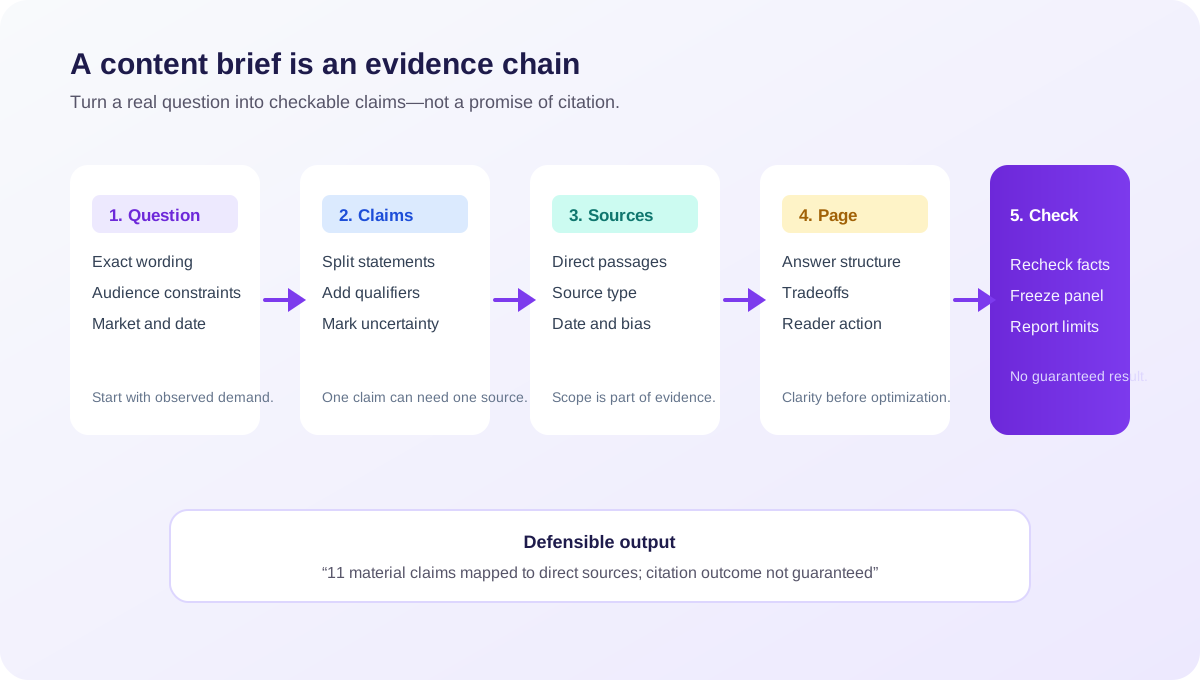
This guide addresses searches such as “how do I create content for AI Search?”, “what should a GEO content brief include?”, and “how do I make a page easier for AI engines to cite?” It is an editorial workflow, not a ranking recipe.
What a content brief can—and cannot—show
Google’s SEO Starter Guide, checked October 31, 2026, describes ways to help search engines understand content and users find and use a site. Google’s AI features guidance, checked the same day, says AI features may show links to supporting web resources and points site owners toward foundational Search practices. Neither page defines a universal AI-citation score or guarantees inclusion.
OpenAI’s web search documentation, checked October 31, 2026, documents citations and source fields for a particular API tool. That is useful when the tested implementation exposes those fields; it does not establish identical selection or display behavior across every AI surface.
The independent GEO paper by Aggarwal et al., checked October 31, 2026, provides research context for optimizing visibility in generative-engine responses. It does not prove that a commercial brief template, content edit, or tool score causes citations or business outcomes.
| Brief output | Safe interpretation | Do not claim from it alone |
|---|---|---|
| A page answers a defined question | The editorial scope is clear | The page will rank or be cited |
| A claim has a direct source | The claim is easier to verify under that source’s scope | The source will be selected by an answer engine |
| A page uses headings and explicit qualifiers | Readers and systems have clearer document structure | Structure is a citation switch |
| A monitoring tool reports a change | A metric changed under that tool’s method | The edit caused the change |
| A cited page receives visits | A citation and visit were separately observed | The citation caused the visit or conversion |
Keep intent, claim support, citation presence, traffic, and business outcomes as separate fields in the brief and the report.
1. Start with a real question, not a keyword list
A keyword can describe a topic without describing the decision a reader is trying to make. Begin with the wording a buyer, operator, or reviewer would actually use.
Useful inputs include:
- Customer-support tickets and sales-call questions
- Search Console queries and internal site search
- Product documentation gaps and recurring objections
- Comparison prompts that name constraints such as budget, team size, or region
- Questions seen in public forums, with privacy and attribution handled appropriately
- Existing AI Search captures where the answer was incomplete or factually wrong
Record the source of the question and its date. A brief based on one invented prompt is a hypothesis, not evidence of broad demand.
A minimal question record looks like this:
Question ID: GEO-CB-014
Question: Which AI visibility workflow fits a small agency that needs source URLs?
Intent: comparison and workflow selection
Audience: small agency; constraints stated in the prompt
Market/language: United States / English
Observed from: customer question and comparison prompt panel
Collected: 2026-10-31 UTC
Do not broaden “Which tool supports source exports?” into “What is the best AI visibility tool?” The larger question requires different evidence and a different comparison design.
2. Classify the intent and the decision
A page can answer several related questions, but the brief should name the primary decision. Use a small, stable vocabulary:
| Intent | Reader decision | Typical page job |
|---|---|---|
| Definition | Understand a term | Explain the concept and boundaries |
| How-to | Complete a task | Give ordered steps and checks |
| Product fact | Verify a current detail | State plan, feature, date, and scope |
| Comparison | Choose among options | Compare the same criteria and tradeoffs |
| Risk or accuracy | Avoid an error | Identify failure modes and verification steps |
| Regional or local | Understand a market-specific result | Preserve country, language, and location qualifiers |
Then write the decision in one sentence:
After reading this page, the audience should be able to decide whether to run a source audit, update a fact, create a comparison page, or keep observing.
This keeps the page from becoming a collection of loosely related subtopics. If the question changes from “how” to “which product,” create a separate brief or explicitly split the page into an instructional section and a sourced comparison section.
3. Build a claim map before an outline
The most important part of an AI Search content brief is not a list of headings. It is a list of claims that can be checked independently.
Split compound statements into smaller units:
Weak brief claim: Tool A tracks prompts, supports agencies, and has source exports on its starter plan.

Claim 1: Tool A tracks prompts.
Claim 2: The product documents an agency reporting workflow.
Claim 3: Source exports exist.
Claim 4: Source exports are included on the starter plan.
Claims 1 and 3 may need product documentation. Claim 4 needs a current plan source and a billing qualifier. Claim 2 may be an editorial interpretation unless the product describes the workflow directly.
Use this table while researching:
| Claim ID | Claim to publish | Claim type | Required qualifier | Evidence status |
|---|---|---|---|---|
| C-01 | The workflow records visible source URLs | Method | Surface and export scope | To verify |
| C-02 | The plan includes a named export | Product fact | Plan, billing, date, region | To verify |
| C-03 | The workflow fits a small agency | Editorial interpretation | Buyer constraints | Interpretive |
| C-04 | A page was cited in a fixed sample | Observation | Prompt panel, denominator, date | Capture required |
Use supported, partial, contradicted, unverified, and unavailable rather than forcing every claim into true or false. “Unavailable” is important when a plan page is login-gated, a platform does not expose a field, or the original answer cannot be preserved.
For a deeper review method, see AI Search answer evaluation and AI Search claim coverage.
4. Match each claim to the right source
A source is useful only when it supports the wording and scope of the claim. A general article about a product category does not prove a current plan limit. A vendor case study can document what the vendor selected to publish, but it is not independent proof of a general outcome.
Build a source map:
| Claim | Best source | Source type | What to record | Boundary |
|---|---|---|---|---|
| Definition or search behavior | Official documentation or primary technical source | Official | Exact passage and checked date | Scope of the documented surface |
| Current feature or plan | Product docs or pricing page | Official | Plan, billing, currency, limit | May change; recheck before publication |
| Recurring user experience | G2, Capterra, TrustRadius, Reddit, or independent review | Independent | Sample, date, positive and negative themes | Broader product may not validate a new GEO module |
| Research context | Paper or independent study | Independent | Method, sample, applicable construct | May not describe a current product |
| Buyer recommendation | Your comparison and interpretation | Editorial | Criteria and tradeoffs | Not an objective universal ranking |
For every dynamic fact, record the URL, source type, date checked, exact scope, and confidence. If a source is commercial, affiliate, competitor-authored, or vendor-selected, label that relationship in the brief.
Do not treat a product’s documentation as evidence of customer satisfaction. Do not apply reviews of a traditional SEO feature to a newer AI-visibility feature without stating the evidence boundary.
5. Design the page around answerable sections
Once claims and sources are mapped, make the outline serve the reader’s decision. A practical structure is:
- Short answer: the bounded conclusion in two or three sentences.
- Definition and scope: what the page is evaluating and what it is not.
- Workflow: ordered steps a reader can perform.
- Evidence table: direct sources mapped to the material claims.
- Examples: one transparent record, with unavailable fields preserved.
- Tradeoffs: what can fail, vary, or remain unknown.
- Related tools or methods: only where a real workflow connection exists.
- Checklist and FAQ: practical next actions and narrowly worded answers.
- Sources and verification: URLs, dates, source types, and confidence.
Use headings that describe the question rather than repeating a target phrase. Put the material qualifier beside the claim it limits. A pricing caveat hidden at the bottom is easy for a reader—or an answer summarizer—to miss.
A clear page is not necessarily a short page. Remove repetition, not necessary conditions. If a recommendation depends on plan, region, date, or model coverage, keep that condition in the sentence and the source table.
6. Write for verification, not for a citation trick
Good page structure supports human inspection first:
- State the subject and scope near the relevant claim.
- Use specific nouns instead of ambiguous pronouns.
- Separate observed results from editorial interpretation.
- Put dates on dynamic facts.
- Link directly to the supporting source.
- Explain what a source does not establish.
- Keep examples labeled as examples rather than results.
Avoid writing a paragraph that combines a feature, a price, an audience claim, and a business outcome. Those require different sources and different evidence levels.
A safer sentence is:
The product documentation describes source export for the checked plan page on October 31, 2026. Buyers should verify the current billing interval and export format during a trial; this fact does not show that exports improve citation frequency.
A weaker sentence is:
Tool A gives agencies the exports they need to win more AI citations.
The second sentence combines an unsupported audience judgement with an unproven causal outcome.
7. Add a verification plan before publication
A brief is incomplete if it ends at the outline. Define how the page will be checked after it is published.
Editorial checks
- Does every material product fact have a current direct source?
- Does each comparison use the same criteria for every option?
- Are prices, limits, models, regions, and billing intervals dated?
- Are vendor-selected case studies labeled as vendor-selected evidence?
- Are independent reviews clearly separated from official claims?
- Does every internal tool link map to an existing AICiteKit detail page?
AI Search observation checks
If you are measuring visibility, freeze the conditions before the first run:
- Exact prompt and panel version
- Surface and mode, with model label only when disclosed
- Country, language, and location settings
- Collection date, time zone, and run number
- Full answer or permitted near-raw capture
- Visible source URLs and the claim each source appears to support
- Empty, failed, login-gated, and no-source states
Tools such as AI Search Console, Peec AI, Otterly.AI, PromptWatch, and Profound may expose different combinations of prompts, answers, citations, and derived metrics. During a trial, verify whether the export preserves the raw answer, exact URL, timestamp, prompt conditions, and failed runs. Do not compare headline scores until their denominators and collection methods match.
A post-publication change is still an observation. To make a stronger causal claim, the study needs a design that rules out prompt drift, answer volatility, source changes, interface changes, and other competing explanations. See AI Search regression testing for a controlled comparison workflow.
8. Report what the brief produced
A useful content report separates production from outcome:
Briefs completed: 12
Pages published: 8
Claims with checked direct sources: 41 of 47
Claims marked partial or unavailable: 6
AI Search captures collected: 30
Answers with a visible target source: 9
Citation-to-click relationship: not available
Business outcome: measured separately; not attributed here
The figures above are a reporting template, not an AICiteKit result. Replace them with observed values or leave the field unavailable.
Do not report “the brief increased citations” because a page changed after a brief was used. Prefer:
The page was published from a brief that mapped 11 material claims to direct sources. In the fixed sample collected afterward, the target URL appeared in 3 of 10 qualifying answers. The sample does not establish that the brief caused selection or traffic.
The denominator, surface, date, and source definition make the statement auditable.
Common content-brief mistakes
| Mistake | Why it fails | Better practice |
|---|---|---|
| Starting with a keyword and no decision | The page answers a topic, not a user problem | Record the exact question and desired decision |
| One source for every claim | Source scope rarely covers every sentence | Build claim-level source relationships |
| Mixing facts and recommendations | Editorial judgement looks like product evidence | Label interpretation and show criteria |
| Optimizing for a “citation word count” | Citation systems are not documented as a simple density formula | Improve clarity, source support, and user usefulness |
| Removing failed answer runs | The denominator becomes artificially clean | Keep unavailable and no-source states |
| Using a vendor case study as independent proof | The sample is selected by the vendor | Label it vendor-selected customer evidence |
| Updating a page from one volatile answer | One capture is not a stable trend | Repeat a fixed panel and preserve context |
Practical AI Search content brief template
Copy this as a starting record:
Question:
Question source and date:
Primary intent:
Audience and constraints:
Market and language:
Decision the page should support:

Material claims:
- Claim / qualifier / source / status
- Claim / qualifier / source / status

Required sections:
- Short answer
- Definition and scope
- Workflow or comparison criteria
- Evidence table
- Limitations
- Verification checklist

Dynamic facts to recheck before publication:
- Price and billing interval
- Plan and usage limits
- Model or platform coverage
- Availability and region

Post-publication observation plan:
- Prompt panel and version
- Surface and mode
- Collection window
- Citation or mention definition
- Denominator
- Unavailable states
- Separate traffic and business measurement

Evidence confidence:
Last reviewed:
FAQ
Does an AI Search content brief make a page more likely to be cited?
It can make the page’s scope, claims, and source relationships clearer. That is an editorial quality judgment, not evidence of a guaranteed citation or ranking change. Test a defined panel if you need an observation about a named surface.
Should every claim have an external link?
Every material factual claim should have an appropriate source or be explicitly marked as interpretation, example, unavailable, or unverified. A link is not automatically support; inspect whether the source covers the claim’s scope.
How many sources should a content brief include?
There is no universal number. Use enough sources to support the material claims and represent meaningful tradeoffs. More links do not compensate for weak claim-to-source matching or outdated facts.
Can I use a GEO tool to generate the brief?
A tool may help collect prompts, answers, sources, or derived observations. The editor still needs to check the claim scope, source quality, plan conditions, and evidence boundary. Verify what the tool actually exports before treating a dashboard field as raw evidence.
Does a cited page necessarily deserve a content update?
No. A citation can be relevant and accurate, or it can support only part of an answer. Check the exact claim, source passage, freshness, and user intent before changing the page.
Sources and verification
- Google Search Central: SEO Starter Guide — official guidance on helping search engines understand and users use site content; checked October 31, 2026.
- Google Search Central: AI features and your website — official guidance on AI features and supporting web resources; checked October 31, 2026.
- OpenAI: Web search — official documentation for citations and sources in an OpenAI API web-search tool; checked October 31, 2026.
- Aggarwal et al., “GEO: Generative Engine Optimization” — independent academic research context; checked October 31, 2026.
- AI Search answer evaluation — AICiteKit methodology for checking claims and sources in captured answers.
- AI Search regression testing — AICiteKit methodology for comparing answer changes under fixed conditions.
Evidence confidence
Medium. The workflow is grounded in public official documentation and independent academic research context. The evidence is weaker for any universal relationship between page structure and AI citation selection because surfaces, prompts, models, and retrieval behavior differ and are not governed by one public standard.
Last reviewed: October 31, 2026.