Field notes / ai-search
AI Search Content Pruning Audit: When to Keep, Update, Merge, or Retire a Page
A practical AI Search content pruning audit for deciding what to do with pages that are rarely cited, while separating content maintenance from rankings, traffic, and revenue claims.
The short answer
An AI Search content pruning audit decides whether a page should be kept, updated, consolidated, or retired after reviewing its purpose, evidence, overlap, accessibility, and observed answer behavior. A page that is rarely cited is not automatically low quality, and a page that is cited is not automatically current or useful.
Use this sequence:
content inventory → evidence review → decision rule → controlled retestThe objective is a clearer, more maintainable source library—not a promise that deleting pages will increase AI citations. A citation, mention, referral, ranking, and conversion are different observations and should not be blended into one pruning score.
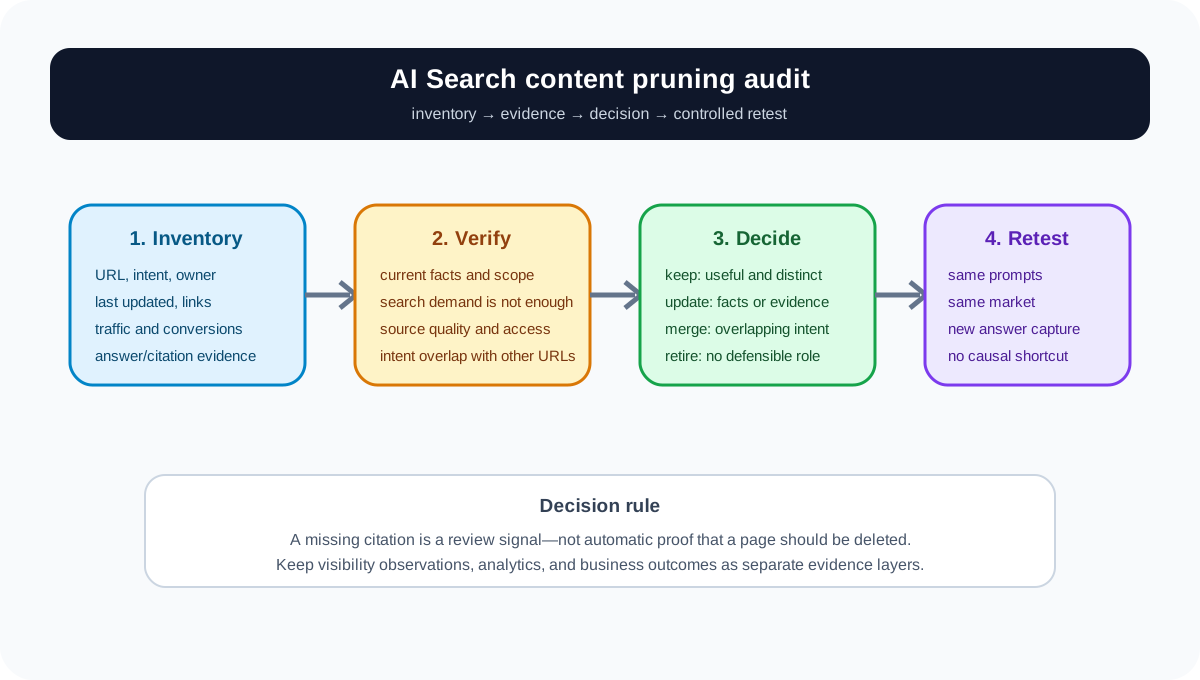
This guide targets practical searches such as “should I delete old content for AI Search?”, “why is my page not cited by ChatGPT?”, and “how do I consolidate overlapping SEO pages for GEO?” It is an evidence and governance workflow. No source cited here supports guaranteed citations, rankings, traffic, or revenue from pruning.
Why AI Search makes pruning harder
Traditional content audits often start with traffic, rankings, conversions, or links. AI Search adds answer-level observations: a page may be cited for one claim, omitted for another, or replaced by a third-party source. Those observations are useful, but they are not a complete quality verdict.
Google says its AI features may show links to supporting web resources and recommends foundational Search practices (Google Search Central: AI features and your website, checked October 4, 2026). That is official guidance about Search features and site practices. It is not a published rule that more pages, fewer pages, or a particular pruning action will produce citations.
Google’s people-first guidance asks whether content is created to help people and whether a site has a primary purpose (Creating helpful, reliable, people-first content, checked October 4, 2026). This supports reviewing purpose, originality, accuracy, and user value. It does not provide an AI-answer pruning threshold.
The academic paper GEO: Generative Engine Optimization studies visibility in a defined experimental setting (Aggarwal et al., arXiv, checked October 4, 2026). It provides independent research context for generative-engine visibility, not validation for a commercial “citation score” or proof that deleting a URL causes a business result.
The four decisions
Do not force every page into “keep” or “delete.” Use four decisions with explicit reasons.
| Decision | Appropriate when | First action | Main risk |
|---|---|---|---|
| Keep | The page has a distinct audience, intent, or evidence role | Maintain facts and links | Leaving a stale page untouched |
| Update | The intent is sound but facts, examples, sources, or scope are weak | Repair the smallest material gap | Mistaking a citation change for a content defect |
| Merge | Several URLs substantially overlap and one canonical page can serve the intent better | Map claims and redirects carefully | Losing unique evidence or creating a broader, less useful page |
| Retire | The page has no defensible current purpose and no retention or legal need | Redirect, archive, or return an appropriate status | Removing a useful niche source because it lacks traffic |
A page can be valuable without being frequently cited. It may support existing customers, answer a narrow compliance question, document a product history, or provide evidence for a human reader. Record that role before using answer visibility as a reason to change it.
1. Build a page-level inventory
Start with URLs, not a dashboard score. For every candidate page, record:
| Field | What to capture | Why it matters |
|---|---|---|
| URL and title | Canonical URL, title, owner | Prevents decisions about duplicate or redirected URLs |
| Primary intent | The question or job the page serves | Separates genuine overlap from different audiences |
| Current scope | Market, product edition, date, eligibility | Makes factual review possible |
| First-party facts | Prices, limits, features, policies | High-risk facts need direct verification |
| Independent evidence | Reviews, research, community, expert sources | Distinguishes owned claims from corroboration |
| Search data | Impressions, clicks, queries, conversions where available | Useful context, not a complete AI visibility record |
| Answer evidence | Prompt, surface, date, answer, cited URL | Defines exactly what was observed |
| Links and dependencies | Inlinks, outlinks, referenced assets | Reveals costs of removal or consolidation |
| Decision owner | Editorial, product, legal, or SEO owner | Makes the action accountable |
Use Google Search Console as adjacent Search performance evidence, not as a transcript of every AI answer (Search Console performance report, checked October 4, 2026). Search clicks and impressions can inform a decision, but zero clicks do not prove that a page has no human value or no role in an answer system.
2. Separate four evidence layers
A pruning decision becomes unreliable when all signals are put into one spreadsheet column called “performance.” Keep these layers separate:
| Layer | Example observation | What it supports | What it does not prove |
|---|---|---|---|
| Content quality | Page has current, specific, readable evidence | A review of usefulness and accuracy | That an engine will cite it |
| Search performance | Impressions, clicks, or conversions in a defined report | Observable Search or analytics activity | Every AI answer or source-selection reason |
| Answer visibility | URL appeared beside a claim in a captured answer | Citation under recorded conditions | A universal ranking or endorsement |
| Business outcome | A separately measured referral, lead, or order | An analytics observation under its attribution rules | That pruning caused the outcome |
OpenAI’s web-search documentation describes a tool that can return citations and source information (OpenAI Developer Docs: Web search, checked October 4, 2026). That documents one technical implementation. It does not make API results interchangeable with consumer ChatGPT, Google Search, or another answer surface.
3. Classify the page’s evidence role
A page may be worth keeping for different reasons. Label its strongest role before judging its visibility.
- Canonical fact page: current product, pricing, policy, location, or service information.
- Explanatory page: teaches a concept or workflow that supports a broader journey.
- Independent evidence page: reports research, testing, user experience, or comparison evidence.
- Use-case page: serves a distinct audience, industry, integration, or constraint.
- Navigation page: routes users to more specific content.
- Historical or legal record: retained for context, disclosure, compliance, or contractual reasons.
- Speculative or obsolete page: no current audience, evidence role, or defensible fact scope.
A canonical page can be cited for a product fact even when an independent review is cited for a comparison. Those sources serve different evidence roles. Consolidating them merely because one has more visibility can remove the distinction a buyer needs.
4. Find real overlap instead of topic similarity
Two pages overlap when they answer substantially the same question for substantially the same audience and neither has a clear unique role. Similar keywords are not enough.
Compare pages across five dimensions:
| Test | Question | Warning sign |
|---|---|---|
| Intent | Would a reader ask the same question? | Titles differ but the decision is identical |
| Audience | Do both pages serve the same user and market? | One is local, regulated, or enterprise-specific |
| Claims | Do they make the same material claims? | One contains unique evidence or limitations |
| Source role | Would the same source support both? | One is first-party and the other independent |
| Action | Would one canonical page make the task easier? | The merged page would become vague or oversized |
Create a claim map before merging:
Page A: entry-plan limits → current first-party pricing source
Page A: agency workflow → independent review or documented workflow
Page B: enterprise limits → separate contract scope; do not generalize
Page B: regional availability → market-specific source
Decision: merge shared explanation only; retain distinct scope pages
Do not copy competitor structures as a shortcut. A competitor citation can identify a buyer question, but it does not prove that your site should publish the same page or that the competitor’s claim is current.
5. Review answer evidence without overreading it
For pages that are being evaluated partly because they are rarely cited, use a fixed prompt panel. Preserve, where the surface permits:
- Exact prompt and prompt-set version
- Surface, mode, and model/version when disclosed
- Country, language, location, and account context
- Collection date and time zone
- Full answer or permitted capture
- Every visible citation URL and the associated claim
- Mention, recommendation, omission, or uncertainty
- Whether the page was accessible, redirected, or changed
A small panel might include category, fact, comparison, risk, and regional prompts. The sample should match the decision. Branded prompts test recognition and accuracy; unbranded prompts test discovery. Do not combine them into one unexplained rate.
Tools such as AI Search Console, Peec AI, Otterly.AI, and PromptWatch represent different monitoring workflows. During a trial, verify whether each preserves raw answers, exact URLs, prompt context, timestamps, failed runs, and source history. A vendor’s “visibility” or “citation” label is not automatically comparable with another vendor’s metric.
6. Use a decision matrix
Score the evidence qualitatively before making a destructive change. A simple matrix keeps a missing citation from dominating every other signal.
| Question | Keep or update | Merge candidate | Retire candidate |
|---|---|---|---|
| Distinct current intent? | Yes | Partly overlaps | No |
| Accurate and scoped facts? | Yes or repairable | Repair during merge | No defensible facts |
| Unique evidence or audience? | Yes | Preserve explicitly | No |
| Human use or business dependency? | Present | Can be mapped | None found after review |
| Search/answer evidence? | Any result, interpreted narrowly | Duplicated or fragmented | No evidence after defined checks |
| Safe technical action? | No change or edit | Canonical + redirect plan | Archive/redirect/status review |
The last row matters. A content decision is not complete until the team knows what will happen to canonical tags, redirects, internal links, structured data, feeds, translations, and analytics annotations. “Delete it” is not a technical implementation plan.
7. Choose the smallest defensible action
Prefer reversible or inspectable changes when the evidence is uncertain:
- Keep: annotate the review date and owner; schedule the next fact check.
- Update: repair stale facts, unclear scope, missing sources, or weak explanations.
- Merge: preserve unique claims, choose a canonical URL, redirect only after mapping dependencies, and record the change date.
- Retire: check legal, customer-support, historical, and link dependencies before redirecting, archiving, or removing.
If a page has a stale price, correct the price. If it has overlapping intent, consolidate the explanation. If it has no current purpose, retire it. Do not rewrite every page merely to insert keywords, schema, or a claim that an AI engine will cite it.
8. Define a controlled retest
A retest can show whether the observation changed after an edit. It cannot isolate causation unless the design controls other meaningful changes.
Record before and after:
page version:
prompt-set version:
surface and mode:
market and language:
collection dates:
answer capture:
cited URLs and claim mapping:
Search/analytics context:
other known changes:
conclusion:
Use bounded language:
After consolidating two overlapping pages, the canonical URL appeared in 3 of 10 matched answer captures, compared with 1 of 10 before the change. Prompt, surface, market, and scoring rules were held constant where recorded. This is an observed association; it does not establish that consolidation caused the change or that traffic or revenue increased.
That statement is more useful than “pruning improved GEO” because another reviewer can inspect the denominator and the evidence boundary.
What an AI Search pruning audit cannot prove
Even a careful audit cannot establish:
- That every AI user sees the same answer or source set
- That a page with no observed citation is low quality
- That a cited page is current, authoritative, or preferred universally
- That deleting or merging pages improves rankings or citations
- That a changed answer was caused by the edit rather than retrieval, prompt, index, or measurement changes
- That a citation generated a click, lead, order, or revenue
- That a commercial tool’s score is a universal AI Search standard
The strongest conclusion may be narrow: “The page duplicated the current explanation, had no distinct audience after dependency review, and was replaced by a canonical page; answer observations will be monitored separately.”
Trial and implementation checklist
Before pruning a page because of AI Search evidence, verify:
- Is the exact prompt, surface, market, and collection date recorded?
- Is the page’s current intent distinct from nearby URLs?
- Are prices, limits, availability, and product claims current and scoped?
- Does the page contain independent or first-party evidence that should be preserved?
- Do Search Console, analytics, CRM, support, or legal records show a human dependency?
- Are inlinks, redirects, canonical tags, feeds, translations, and structured data mapped?
- Can the action be reversed or audited?
- Is the retest prompt panel frozen before the change?
- Are visibility, citations, referrals, and conversions reported separately?
FAQ
Should I delete pages that AI Search never cites?
No. First determine whether the page has a distinct audience, useful evidence, current facts, support value, or legal and historical role. Lack of citation in a defined sample is a reason to investigate, not a deletion rule.
Is content consolidation the same as GEO optimization?
No. Consolidation can improve editorial clarity and reduce duplication, but no source here establishes that it will produce a citation or ranking improvement. Treat any answer change as an observation under the stated conditions.
How many pages should be pruned at once?
There is no universal safe number. Smaller, documented batches make dependencies and retests easier to inspect. Keep the batch aligned to one decision or content family rather than deleting unrelated URLs to create a favorable aggregate metric.
Can a page with no traffic still matter?
Yes. It may answer a narrow question, support customers, carry independent evidence, serve a regional audience, or be needed for compliance. Review the page’s role and dependencies before treating traffic as a veto.
Sources and verification
- Google Search Central: AI features and your website — official guidance on AI features and foundational Search practices; checked October 4, 2026.
- Google Search Central: Creating helpful, reliable, people-first content — official guidance on purpose, usefulness, and reliability; checked October 4, 2026.
- Google Search Console performance report — official Search performance context; checked October 4, 2026.
- OpenAI Developer Docs: Web search — official documentation for one web-search tool implementation and its source information; checked October 4, 2026.
- Bing Webmaster Guidelines — independent platform context on discoverability and quality; checked October 4, 2026.
- Aggarwal et al., GEO: Generative Engine Optimization — academic research context; checked October 4, 2026.
- AICiteKit: AI Search Source Decay — adjacent framework for reviewing missing citations over time.
- AICiteKit: AI Search Content Optimization Workflow — adjacent framework for content changes and bounded retests.
This article uses official documentation and academic research for platform and research context. The keep/update/merge/retire framework and all recommendations are AICiteKit editorial interpretation, not a published platform rule.