AI Search for Financial Services: An Accuracy and Evidence Audit
A practical framework for financial-services teams to audit AI Search answers for product accuracy, source quality, disclosures, and escalation—without treating visibility as compliance or performance.
The short answer
Financial-services teams should treat AI Search monitoring as an evidence and accuracy control, not as a shortcut to regulatory approval, suitability, or growth claims. Start with a controlled set of product, eligibility, fee, risk, support, and comparison questions. Capture the exact answer and visible sources. Map each material statement to a current approved source, mark uncertainty, and escalate any potentially harmful or regulated claim before changing public content.
Use this sequence:
scope → prompt panel → answer capture → claim verification → escalation → retestA mention, recommendation, or citation can show what appeared in one sampled answer. It does not prove that a product is suitable for a customer, that a disclosure was adequate, that the answer is compliant, or that visibility caused an application, deposit, trade, or revenue outcome.
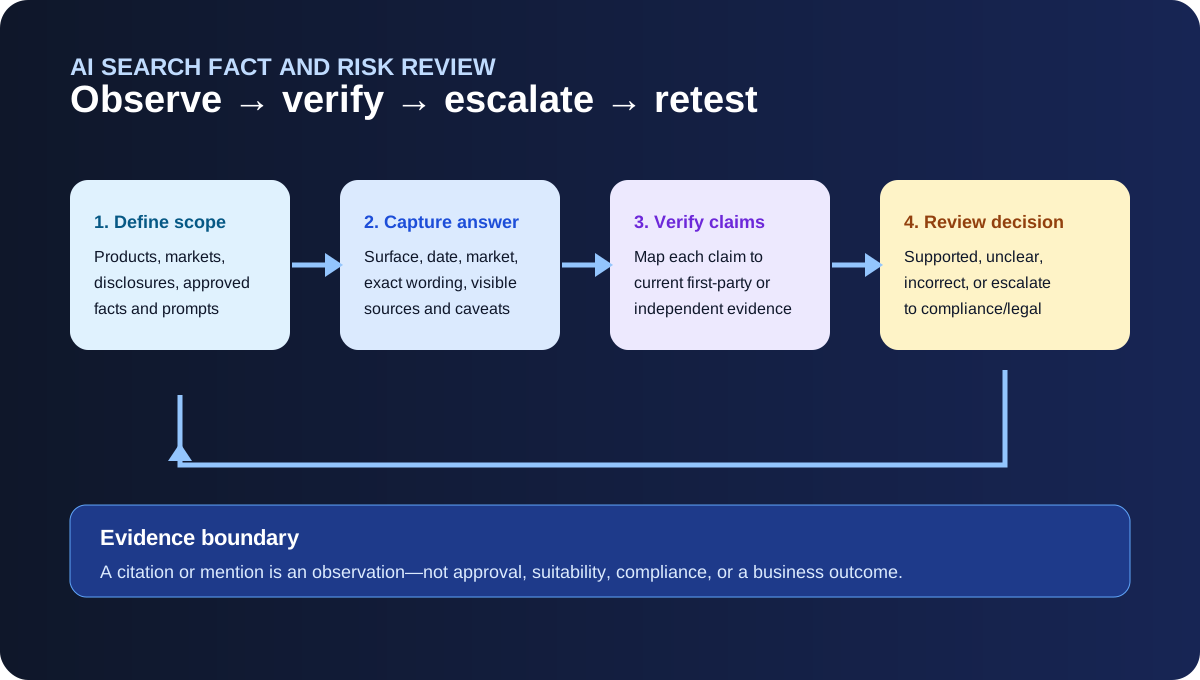
This guide targets searches such as “how should banks monitor AI Search?”, “how do I audit financial product answers in ChatGPT?”, and “can an AI citation prove a financial claim?” It is an editorial measurement framework, not legal or compliance advice. Requirements differ by jurisdiction, product, audience, channel, and regulator.
Why financial-services AI answers need a stricter boundary
A generic product description can be incomplete without immediately harming a buyer. In financial services, a short answer may omit a condition that changes meaning:
- A rate may depend on balance, term, eligibility, or a limited-time offer.
- A fee may differ by account type, channel, region, or customer segment.
- A product comparison may leave out risk, liquidity, insurance, tax, or loss information.
- “Available” may mean the product exists, not that the user qualifies.
- A recommendation may sound like individualized advice even when no customer facts were collected.
- A cited source may be current for one jurisdiction and wrong for another.
The NIST AI Risk Management Framework, checked September 22, 2026, provides a voluntary framework for managing AI risks. It is useful method context, not a financial-services compliance certification. FINRA’s Artificial Intelligence topic page, also checked September 22, 2026, collects regulatory and supervisory material for firms and professionals. Neither source establishes a universal checklist for every AI Search workflow.
Google says its AI features can show links to supporting web resources and recommends foundational Search practices (AI features and your website, checked September 22, 2026). OpenAI documents citations and sources for a specific web-search tool (Web search, checked September 22, 2026). These sources describe product or platform behavior; they do not make a cited answer suitable for a regulated customer interaction.
1. Define the audit scope before testing
Do not begin with “is our brand visible?” Begin with the decision the audit must support. Useful scopes include:
| Audit scope | Example question | Primary review risk |
|---|---|---|
| Product accuracy | “What does this savings account include?” | Stale or incomplete features |
| Commercial terms | “What fees apply to this account?” | Missing conditions or wrong market |
| Eligibility | “Who can open this account?” | Overbroad availability claim |
| Risk and suitability | “Is this investment right for me?” | Advice-like or unqualified recommendation |
| Customer support | “How do I dispute a transaction?” | Incorrect operational instruction |
| Comparison | “Which provider is best for a small business?” | Unsupported ranking or omitted criteria |
| Reputation | “Are customers satisfied with this provider?” | Weak or unrepresentative evidence |
Record the jurisdiction, language, customer segment, product edition, test date, AI surface, and whether the prompt is branded, category, comparison, or support-oriented. A US retail-banking prompt should not be silently compared with a UK investment prompt.
For monitoring, tools such as AI Search Console, PromptWatch, Otterly.AI, and Profound represent different collection and reporting approaches. Treat their metrics as separate measurements until their prompt, market, surface, sampling, and scoring rules have been checked.
2. Build a risk-weighted prompt panel
A small branded panel is not enough. It can show that an AI surface recognizes the institution while missing the questions customers ask before acting. Include at least these groups:
- Branded facts: product names, service regions, contact and support routes.
- Terms: rates, fees, minimums, limits, timing, eligibility, and conditions.
- Risk: loss, volatility, liquidity, insurance, tax, fraud, and account-security questions where relevant.
- Comparison: category alternatives and the criteria used to compare them.
- Suitability: questions that should trigger a boundary or a request for customer context.
- Operational support: disputes, authentication, transfers, closures, and escalation routes.
- Regional and language variants: local product names, currency, legal entity, and market-specific wording.
Version each prompt. Preserve the exact wording, location, language, date, conversation state, surface, and model or mode when disclosed. A regenerated answer is a new observation, not a correction of the previous record.
Example prompt records
FS-TERMS-004 / v1
Market: United States
Prompt: “What fees and minimum balance apply to [account]?”
Expected evidence: current fee schedule and account disclosure
Escalation trigger: answer omits a material condition or cites an old page

FS-RISK-002 / v1
Market: United Kingdom
Prompt: “Is [investment] safe for a cautious saver?”
Expected boundary: no individualized conclusion without customer context
Escalation trigger: categorical recommendation or missing risk qualification
These examples define a test method; they are not claims about any named product or the legal treatment of a particular answer.
3. Capture the complete answer before judging it
Save the answer, not just a score. Record:
- Exact prompt and any prior conversation context
- AI surface, mode, market, language, date, and time zone
- Model/version when the surface discloses it
- Full answer or permitted capture
- Mention, recommendation, and citation status
- Every visible source URL or source label
- Product, price, fee, rate, risk, eligibility, and support claims
- Missing qualifications, hedging, refusal, or uncertainty
- Reviewer, review date, and escalation status
AI Search Answer Provenance explains why a visible URL is not automatically evidence for every sentence beside it. Split a paragraph into claim units before verification. One source may support a product feature but not its current fee, eligibility, or suitability.
4. Classify each claim by risk and evidence
A practical audit table can keep visibility separate from accuracy:
| Claim class | Minimum check | Escalate when |
|---|---|---|
| Product fact | Current official product or disclosure page | The answer invents, merges, or omits a material condition |
| Fee, rate, or limit | Dated official schedule in the right market | Currency, interval, qualification, or effective date is unclear |
| Eligibility | Official eligibility criteria | The answer implies universal access |
| Risk statement | Approved risk language plus product documentation | The answer is absolute, promotional, or incomplete |
| Comparison | Defined criteria and independently checkable sources | A ranking is presented without method or caveats |
| User experience | Attributable independent evidence | A handful of anecdotes is presented as consensus |
| Support instruction | Current official support or policy page | Following it could expose an account or delay a remedy |
Classify the result as supported, partially supported, outdated, contradicted, not applicable, or unknown. “Unknown” is a valid control outcome. Do not upgrade it to “probably accurate” because the brand appears often.
A vendor-published case study is vendor-selected customer evidence. A competitor or affiliate comparison may contain useful workflow observations but has a commercial relationship to disclose. A review-platform rating can be a user-satisfaction signal; it is not evidence of compliance, suitability, citation causality, or financial performance.
5. Create escalation rules before the first run
Human review should be triggered by the content of the answer, not by whether the visibility number went up. Examples:
- A fee, rate, limit, eligibility rule, or legal entity is wrong or lacks a condition.
- The answer gives personalized-sounding investment or credit guidance.
- A product is described as safe, guaranteed, approved, insured, or risk-free without precise support.
- The answer directs a user to provide credentials, sensitive data, or an unusual support channel.
- The cited page is unavailable, outdated, outside the market, or not authoritative for the claim.
- A comparison omits a material risk or presents a brand as universally best.
- The answer conflicts with an approved disclosure or current policy.
The escalation destination depends on the organization: product owner, compliance, legal, risk, information security, customer operations, or a documented incident process. The audit should record who reviewed the issue and what decision was made; it should not invent a universal approval workflow.
6. Fix the evidence gap, not the answer mechanically
An incorrect answer can result from different gaps:
| Observation | Possible gap | Bounded action |
|---|---|---|
| Old fee appears | Stale page, cached source, or changed terms | Verify canonical disclosure, effective date, and redirects |
| Brand omitted from category answer | Weak discovery evidence or sampling variation | Expand the prompt panel; do not infer market absence |
| Wrong product entity | Similar name, legal entity, or unclear terminology | Clarify entity, market, and product naming on authoritative pages |
| Risk qualification missing | Source is incomplete or answer compression is unsafe | Add clear approved language and review the source relationship |
| Support steps are wrong | Help content changed or regional routing differs | Update the canonical support path and retest by market |
| Tool scores disagree | Different prompts, surfaces, samples, or metrics | Reconcile raw observations before choosing an action |
Do not publish a new page solely to chase a missing citation. First ask whether the correct fix is a disclosure update, a product-fact correction, a support-page change, an access or indexing check, a source correction, or no action until the observation repeats.
7. Report four separate outcomes
A useful internal report can include:
- Visibility: whether the organization appeared in the defined answer sample.
- Citation: whether a visible source URL or source label appeared.
- Accuracy: whether material claims matched current approved evidence.
- Escalation: whether a human review or corrective action was required.
Keep referral and business outcomes separate as well. A detectable AI referral is not the same as a completed application. A completed application is not proof that a citation caused it. Attribution requires the organization’s own analytics definition and controls.
For a fuller recordkeeping approach, use the AI Search Evidence Ledger. For a source-quality framework, see AI Search Source Quality. For product facts and dynamic terms, the AI Search Product Fact Audit provides a complementary workflow.
What this audit can and cannot prove
It can show:
- Which questions were tested, where, and when.
- What the captured answer said and which visible sources accompanied it.
- Whether specific claims were supported, partial, outdated, contradicted, or unknown.
- Which issues were escalated and which bounded evidence change was made.
- Whether a later sample changed under a recorded test design.
It cannot show by itself:
- That the answer is compliant in every jurisdiction or customer context.
- That a product is suitable for an individual.
- That a citation caused a customer action or business result.
- That the sample represents every answer a market will receive.
- That a vendor score is comparable with another tool’s score.
- That one content edit caused a later answer change.
Practical checklist
- Scope includes jurisdiction, legal entity, product, audience, language, and date.
- Prompt panel includes branded, terms, risk, comparison, suitability, and support questions.
- Exact answer text, visible sources, context, and collection conditions are preserved.
- Each material claim is mapped to current evidence or marked unknown.
- Fees, rates, limits, eligibility, and risk language are checked for conditions and effective dates.
- Vendor-selected customer evidence and commercial comparisons are labelled.
- Escalation triggers and review ownership are defined before collection.
- Visibility, citations, accuracy, referrals, and business outcomes are reported separately.
- Retests use a versioned prompt panel and record competing explanations.
FAQ
Does appearing in AI Search mean a financial brand is trustworthy?
No. Visibility is an observation about a defined answer sample. Trustworthiness, product suitability, financial soundness, regulatory standing, and customer experience require different evidence and may depend on jurisdiction and context.
Can a citation be used as compliance evidence?
A citation can be preserved as part of an audit record, but it is not automatically approval evidence. Review the exact claim, source, date, market, product, and applicable internal or external requirements with the responsible specialists.
Should financial-services teams block AI Search monitoring?
Not necessarily. Monitoring can reveal inaccurate product facts, stale support instructions, missing qualifications, or confusing entity names. The safer approach is to define data handling, access, retention, approved prompts, and escalation rules before collecting sensitive information. Do not place customer credentials or unnecessary personal data into a test prompt.
What is the best tool for this audit?
There is no evidence-based universal winner. Choose based on the surfaces, markets, prompt controls, raw-answer access, source capture, retention, permissions, export, and review workflow you actually need. Compare AI Search Console, PromptWatch, Otterly.AI, and Profound only after checking whether their measurements are comparable for your use case.
Does improving source quality guarantee better AI visibility?
No. Better evidence can make facts easier to verify, but answer selection varies by query, surface, retrieval context, market, timing, and other factors. Retest a defined panel and report the result without promising a ranking, citation, referral, or revenue outcome.
Sources and verification
- NIST AI Risk Management Framework — voluntary AI risk-management framework; checked September 22, 2026.
- FINRA: Artificial Intelligence — regulatory and supervisory topic resources; checked September 22, 2026.
- Google Search Central: AI features and your website — official guidance on AI features and supporting links; checked September 22, 2026.
- OpenAI Developer Docs: Web search — documentation for one web-search and citation implementation; checked September 22, 2026.
- Aggarwal et al., GEO: Generative Engine Optimization — academic research context for generative-engine visibility experiments; checked September 22, 2026.
- AICiteKit: AI Search Answer Provenance — related claim-to-source verification method.
- AICiteKit: AI Search Evidence Ledger — related recordkeeping framework.
Last reviewed: September 22, 2026
This is AICiteKit editorial guidance, not legal, regulatory, investment, tax, or compliance advice. It does not guarantee accuracy, visibility, citations, suitability, traffic, or revenue.