AI Search Query Fan-Out Audit: How to Measure Multi-Query Answers
A practical audit for AI Search query fan-out: map subqueries, inspect source evidence, preserve answer context, and retest without turning one answer into a ranking or revenue claim.
The short answer
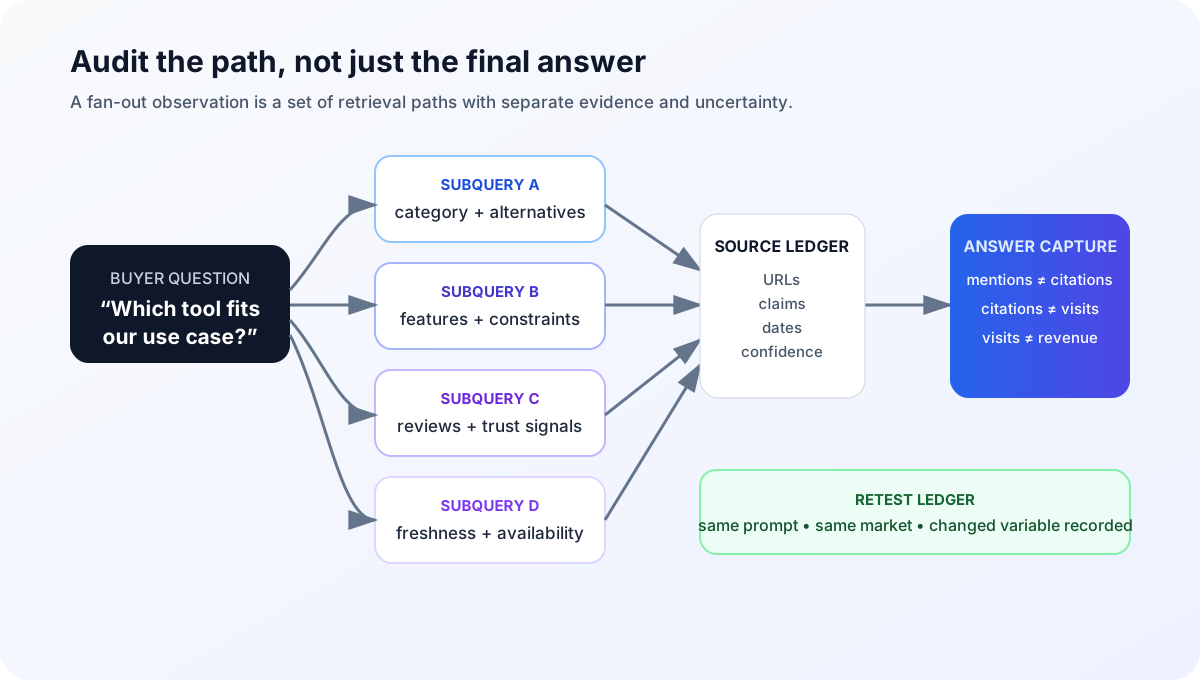
A query fan-out audit treats a complex AI Search answer as a set of retrieval questions rather than as one ordinary keyword query. You map the buyer question, document the subtopics you can observe, preserve the cited sources and answer context, and compare the result against a fixed retest design.
The safe measurement chain is:
buyer question → subquery map → source ledger → answer capture → bounded retestGoogle describes AI Mode’s “query fan-out technique” as breaking a question into subtopics and issuing multiple queries. Google also says Deep Search uses the same approach at a larger scale, with hundreds of searches in some research tasks (Google, “AI Mode in Google Search: Updates from Google I/O 2025”, checked September 6, 2026). That is a description of one product’s stated behavior, not a universal specification for every AI answer engine.
This guide addresses practical searches such as “what is query fan-out in AI search?”, “how do I audit AI Mode citations?”, and “why does an AI answer cite different sources for the same question?” It complements AI Search Prompt Set: How to Build a Reproducible GEO Test Panel, AI Search Retrieval Audit, and How to Track Whether AI Engines Are Citing Your Brand.
What query fan-out changes—and what it does not
In a traditional search workflow, a user may submit one query and inspect a ranked result page. In a fan-out workflow, the system may decompose a broad question into related searches, retrieve different documents for different subtopics, and synthesize an answer. The system may not expose every internal query, its retrieval order, its candidate set, or its selection rule.
That creates a useful audit distinction:
| Observation | What it supports | What it does not prove |
|---|---|---|
| The platform describes query fan-out | A product-level description of its stated retrieval approach | That every answer uses the same number or type of subqueries |
| A complex answer cites several URLs | The captured answer displayed those sources | Which hidden subquery selected each URL |
| Your page is cited for one aspect | The page supported a claim in that sample | That the page ranked first or caused the full answer |
| A follow-up changes the sources | Context or conditions changed the observed answer | A durable visibility trend |
| A crawler or fetch request is logged | A request occurred under recorded conditions | A human saw, trusted, clicked, or converted from the answer |
The independent paper GEO: Generative Engine Optimization studies ways of improving visibility in generative-engine responses in an academic setting (Aggarwal et al., arXiv, checked September 6, 2026). It is useful research context, but it does not validate Google’s implementation, establish a universal fan-out metric, or prove a production business outcome from a page edit.
1. Start with the decision, not the platform feature
“Does AI Search know our brand?” is too broad to audit. Define the decision that the answer should support:
- Which tools should a five-person agency compare?
- Which implementation approach fits a site with a JavaScript-rendered catalog?
- Which provider meets a documented integration or compliance requirement?
- Which sources should a buyer trust for current pricing or availability?
Then write the question exactly as a real buyer would ask it. Preserve qualifiers such as market, budget, team size, platform, date range, and job to be done. The qualifiers often become the subtopics that need separate evidence.
A useful issue record is:
Question ID: COMP-007 v1
Prompt: Which GEO monitoring tools support raw answer exports for a small agency?
Surface: AI Search surface and mode recorded
Market: United States / English
Collection date: 2026-09-06 UTC
Observed: answer listed four tools and cited seven URLs
Not established: hidden subqueries, universal rank, traffic, or revenue impact
Do not call the answer a “ranking” unless the platform exposes a ranking construct you can define and reproduce. In a synthesized answer, mention order can reflect answer composition, not a stable search position.
2. Build a subquery hypothesis map
You may not be able to see the engine’s internal fan-out. You can still build a transparent hypothesis map for review. Label it as your audit model, not as a claim about hidden system behavior.
| Buyer intent | Audit subtopic | Evidence to collect |
|---|---|---|
| Category discovery | Which options are considered? | Product names, category definitions, inclusion rule |
| Fit | Who is each option for? | Audience, workflow, prerequisites, use-case wording |
| Capability | Does it support the required job? | Official docs, observed product behavior, limitations |
| Trust | Why should the buyer believe the claim? | Independent reviews, documentation, third-party context |
| Freshness | Could the answer be stale? | Publication or update dates, current pricing, availability |
| Comparison | What is the material tradeoff? | Like-for-like criteria and clearly scoped differences |
This map gives you a way to review source coverage without pretending to know the hidden query list. If the answer contains a recommendation, also record the criteria the answer used and whether those criteria were supported by the cited sources.
For measurement workflows, AI Search Console, Peec AI, Otterly.AI, PromptWatch, and Profound represent monitoring products with different coverage and evidence models. Do not assume that a dashboard’s “visibility” or “share of voice” metric exposes fan-out queries. During evaluation, ask whether the product preserves raw answers, exact URLs, prompt context, timestamps, and failed runs.
3. Create a source ledger for every answer claim
A fan-out answer can combine first-party documentation, independent reviews, directories, forums, and outdated pages. Record the source at the claim level instead of only saving a screenshot.
| Field | Example | Why it matters |
|---|---|---|
| Answer claim | “Tool A supports CSV export” | Defines what must be checked |
| Source URL | Exact URL displayed in the answer | Makes the citation inspectable |
| Source type | Official docs, independent review, directory | Establishes evidence boundary |
| Source date | Page date or collection date | Flags freshness risk |
| Supported wording | The specific passage that supports the claim | Separates support from proximity |
| Conflict | Current first-party page disagrees | Prevents silent acceptance of stale facts |
| Confidence | High, medium, low, or unverified | Makes uncertainty visible |
An exact URL is stronger evidence than a domain name mentioned without a link. A citation can still be a poor source for the particular claim if the page is outdated, promotional, or discussing a different product edition.
For official product facts, use the current vendor documentation or pricing page and record the date checked. For user experience, look for independent sources such as G2, Capterra, TrustRadius, Product Hunt, Reddit, or independent reviews when they contain relevant evidence. Do not turn a rating into proof of traffic growth, revenue growth, guaranteed citations, or guaranteed recommendations. Vendor-selected customer stories are vendor-selected customer evidence, not independent validation.
4. Capture the answer as a test condition
The same prompt can produce different source sets after a model update, index change, location change, account change, or follow-up turn. Preserve the conditions that a reader would need to interpret the observation:
- Exact prompt text and prompt-set version
- New conversation or follow-up context
- Platform, surface, and mode
- Model or version when disclosed
- Country, language, device, and account context when relevant
- Collection date, time zone, and run number
- Full answer or permitted export
- All visible cited URLs and the claims they appear to support
- Whether the answer used a search or browse mode
If a system hides the internal fan-out, write “not exposed” rather than filling in a presumed query list. A reproducible audit does not require impossible visibility; it requires clear boundaries around what was observed.
A safe answer ledger might look like:
Prompt: COMP-007 v1
Run: 2 of 5
Context: new conversation; US English; search mode recorded
Mentioned brands: 4
Visible citations: 7
Citations checked: 5 of 7; 2 URLs unavailable at review time
Fan-out queries: not exposed by the platform
Conclusion: source set observed in this run; no universal rank or cause inferred
5. Separate mention, citation, source quality, and referral
A fan-out audit becomes misleading when all answer activity is collapsed into one score.
| Layer | Safe statement |
|---|---|
| Mention | “The brand appeared in 3 of 10 sampled answers.” |
| Recommendation | “The answer recommended the brand under the recorded criteria.” |
| Citation | “The exact URL appeared beside a claim in 2 of 10 answers.” |
| Source support | “The cited passage supported the claim under the checked date and scope.” |
| Referral | “Analytics recorded a separately defined visit from the measured source.” |
| Conversion | “The attribution system recorded an event under its documented rules.” |
Google’s AI features guidance, checked September 6, 2026, says AI features may show links to supporting web resources and that appearance in AI features is not guaranteed. That supports measuring displayed links when they are observable; it does not provide a universal citation rate or a method for attributing a business result to a hidden subquery.
OpenAI’s Overview of OpenAI Crawlers, checked September 6, 2026, documents crawler purposes and user agents. A logged bot request is still an access observation, not proof that a page was cited in a user-facing response. Keep crawler analytics and answer citations in separate ledgers.
6. Check source quality before changing content
If a competitor appears in an answer and your page does not, do not immediately add the competitor’s wording to your page. First ask:
- Is the answer’s inclusion criterion explicit?
- Does the competitor source actually support the claim made about it?
- Is your page accessible and canonical under the tested conditions?
- Does your page clearly publish the fact the buyer needs?
- Is the fact current, scoped, and independently corroborated where appropriate?
- Did the answer rely on a third-party source that describes your category differently?
Google’s people-first guidance encourages content created to help people rather than content made primarily to manipulate rankings (Creating helpful, reliable, people-first content, checked September 6, 2026). For a fan-out audit, that means clarifying a real buyer question, correcting a real factual gap, and documenting evidence—not repeating a term because an answer happened to use it.
If structured data is part of the proposed fix, treat it as a description and validation layer. Google’s structured data introduction, checked September 6, 2026, explains that markup can help Search understand page content but does not guarantee a display outcome. It cannot reveal an engine’s hidden subqueries or guarantee a citation.
7. Retest one bounded hypothesis
A useful retest changes one material variable while keeping the test panel stable. Examples:
| Hypothesis | Bounded action | Retest |
|---|---|---|
| The page does not state the integration limit clearly | Publish the verified limit and scope in visible copy | Same comparison and capability prompts |
| A cited directory contains a stale plan name | Correct the first-party source and document outreach | Same branded and category prompts |
| The prompt omits the actual buyer constraint | Add a separate constrained prompt cohort | Compare only within the new cohort |
| The answer depends on region | Run matched language and market panels | Report cohorts separately |
| The monitoring tool hides source evidence | Export raw answers and URLs or mark unavailable | Trial review, not a visibility claim |
Do not use a new prompt set after the edit and call the difference a trend. Keep baseline captures, failed runs, model changes, platform changes, and major source changes. If the answer changes, report an association unless the design can isolate the cause.
A minimal comparison can report:
citation rate = qualifying answers with the exact target URL ÷ qualifying answers reviewed
support rate = cited claims supported by the checked source ÷ cited claims reviewed
State the numerator, denominator, prompt cohort, market, surface, date range, and unavailable runs. These are sample statistics, not probabilities for every AI Search user.
Who should use this audit?
This workflow is a good fit for:
- SEO and content teams investigating why complex questions produce inconsistent sources
- Product marketers reviewing comparison, capability, pricing, or availability claims
- Agencies that need to show clients raw answer evidence rather than a black-box score
- Technical teams connecting source checks, access observations, and answer captures
It is not a substitute for:
- A vendor’s undocumented internal retrieval trace
- A representative study of every AI Search user or model
- A guaranteed citation or recommendation strategy
- Conversion attribution or incrementality testing
- Independent verification of every claim in every source
Evidence snapshot
| Source | Public signal | What it supports | Confidence |
|---|---|---|---|
| Google: AI Mode in Google Search | Google describes query fan-out and Deep Search’s larger-scale use of it | Product-level context for Google’s stated AI Mode behavior | High for the statement; not a universal specification |
| Google: AI features and your website | Official guidance on AI features, links, and foundational Search requirements | Search-feature context and the absence of a guaranteed appearance claim | High |
| Google: People-first content | Official content-quality guidance | Editorial standard for useful, non-manipulative content | High |
| Google: Structured data introduction | Official structured-data guidance | Markup as a description and eligibility aid, not a citation guarantee | High |
| OpenAI: Overview of OpenAI Crawlers | Official crawler documentation | Narrow access and user-agent context; not answer-level citation evidence | Medium-high |
| GEO: Generative Engine Optimization | Independent academic paper | Research context for generative-engine visibility and evaluation | Medium; not evidence for a vendor metric or causal outcome |
| AICiteKit editorial framework | Audit model and worksheets in this article | A bounded way to record subquery hypotheses, sources, and retests | Editorial |
What this audit cannot prove
Even a detailed query fan-out audit cannot establish:
- The complete hidden query decomposition used by an AI system
- A universal ranking position or share of voice
- That one page was selected because of one specific edit
- That a citation caused a click, lead, purchase, or revenue
- That a visible citation means the source was read or trusted by a human
- That a crawler request was part of a user-facing answer
- That a vendor’s composite metric is comparable with another vendor’s metric
- That a result observed in one market, account, date, or model generalizes everywhere
The useful output is narrower: a versioned question, an explicit subquery hypothesis map, a claim-level source ledger, answer captures with conditions, and a retest whose evidence boundary is visible.
Practical checklist
- The buyer decision and exact prompt are recorded.
- Market, language, surface, mode, account, and date conditions are captured.
- Subquery groups are labeled as audit hypotheses unless the platform exposes them.
- Every visible citation is stored as an exact URL with the supported claim.
- Official facts and independent user or market evidence are separated.
- Stale, unavailable, promotional, and conflicting sources are labeled.
- Mentions, recommendations, citations, source support, referrals, and conversions are reported separately.
- Failed and unavailable runs remain in the denominator or are explained.
- One material variable is changed for the retest where possible.
- The conclusion states what the sample cannot prove.
FAQ
Does query fan-out mean AI Search runs the same subqueries every time?
No. Google describes query fan-out for AI Mode, but the exact internal decomposition, retrieval order, candidate set, and answer-selection process may vary. Do not infer a fixed universal query list from one answer.
Can I see the hidden fan-out queries?
Only if the product exposes them. If it does not, record the internal queries as “not exposed” and use a transparent hypothesis map for your audit. Do not present inferred subtopics as a platform trace.
Should I optimize a page for every possible subquery?
No. Start with the buyer’s real decision and publish clear, accurate, well-scoped evidence. Expand the prompt panel when it represents a real use case, not to create artificial coverage.
Is a cited page automatically a high-quality source?
No. Check whether the page is current, relevant, accurate, and strong enough for the particular claim. A citation is an answer observation; source quality requires review.
Do query fan-out citations drive traffic?
A citation may be followed by a visit, but the citation alone does not prove a click or business outcome. Use separately defined analytics and attribution evidence, and state the platform and time window.
Sources and verification
- Google, “AI Mode in Google Search: Updates from Google I/O 2025” — checked September 6, 2026 for Google’s description of query fan-out and Deep Search.
- Google Search Central, “AI features and your website” — checked September 6, 2026 for AI-feature guidance and non-guarantee boundaries.
- Google Search Central, “Creating helpful, reliable, people-first content” — checked September 6, 2026 for editorial guidance.
- Google Search Central, “Introduction to structured data markup” — checked September 6, 2026 for structured-data limits.
- OpenAI, “Overview of OpenAI Crawlers” — checked September 6, 2026 for crawler context.
- Aggarwal et al., “GEO: Generative Engine Optimization” — checked September 6, 2026 for independent academic context.
Last reviewed: September 6, 2026
Data confidence: High for the cited official descriptions; medium for broader generative-search interpretation; editorial for the audit workflow. Internal fan-out behavior is not claimed where the platform does not expose it.