Field notes / ai-search
AI Search Query Fan-Out Audit: How to Trace Expanded Questions and Sources
A practical audit for tracing how one AI Search question becomes related queries, retrieved sources, answer claims, and bounded actions without treating fan-out as a universal ranking signal.
The short answer
An AI Search query fan-out audit traces the path from an original user question to the related searches, source pages, answer claims, and recommendations that can be observed in a defined AI Search workflow. It helps a team investigate why an answer included a source—or failed to include one—without pretending that an opaque retrieval process has been fully reconstructed.
Use this chain:
original question → related query or intent → retrieved sources → answer claims → bounded findingThe important word is observed. Some products and APIs expose query, search, or citation information; other surfaces expose only a final answer and links. A fan-out audit should preserve what the system actually reported and label any inferred step as an inference.
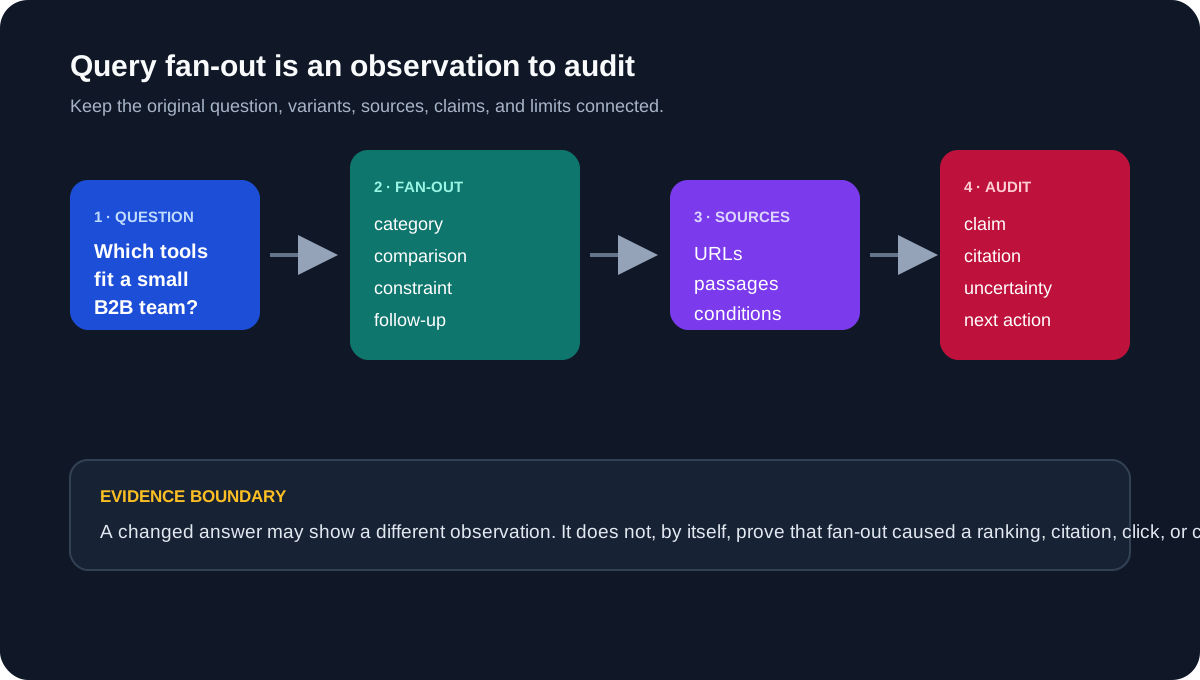
This guide addresses searches such as “what is query fan-out in AI Search?”, “how do I audit AI answer sources?”, and “why does an AI answer cite a competitor instead of my page?” The practical answer is not to optimize for an assumed hidden query. It is to capture the question, conditions, visible sources, claim support, and uncertainty consistently.
What query fan-out can—and cannot—show
Google describes AI features as Search experiences that may show links to supporting web resources and says that appearing in an AI feature is not guaranteed (AI features and your website, checked October 6, 2026). OpenAI’s web-search documentation describes a particular tool that can return citations and source information (Web search, checked October 6, 2026). These sources establish documented product behavior for their respective contexts; they do not publish one universal fan-out algorithm for every consumer or API surface.
The independent paper GEO: Generative Engine Optimization studies visibility in a defined experimental setting (Aggarwal et al., arXiv, checked October 6, 2026). It is useful research context, not proof of a current production retrieval path, commercial dashboard score, traffic effect, or revenue effect.
Keep the layers separate:
| Observation | What it supports | What it does not prove |
|---|---|---|
| A system exposes related searches or queries | Those queries were reported in that captured workflow | That they are the only queries used internally |
| A source URL appears in an answer | The URL was visible in the captured answer | That the URL caused the answer or a click |
| A page contains a phrase similar to the question | The page is textually relevant under that check | That relevance caused retrieval or citation |
| A brand appears after a question is reworded | An observed answer changed under a new input | A stable ranking or market preference |
| A tool reports query expansion or citations | The tool calculated or displayed a metric under its method | That different tools measure the same event |
| An answer changes after a page edit | Two observations differ under recorded conditions | That the edit caused the difference |
The audit is valuable even when the hidden retrieval chain remains unavailable: it can reveal mismatched intent, unsupported claims, stale source pages, or a measurement panel that silently changed.
1. Define the original question and conditions
Start with the exact question, not a post-hoc paraphrase. Record qualifiers that can alter the answer:
- Market, language, and location
- Audience, company size, or use case
- Budget, plan, platform, or integration requirement
- Surface and mode
- Model or product configuration when disclosed
- Collection date, time zone, and repeat number
A useful capture record is:
Question ID: FAN-014-v1
Exact question: Which AI Search monitoring tools fit a five-person B2B marketing team?
Audience: in-house B2B marketing team
Market/language: United States / English
Surface and mode: recorded at collection time
Collected: 2026-10-06 UTC
Output fields: related query, mention, recommendation, source URL, claim support, unavailable state
Do not compare a consumer answer with an API response as if they were the same surface. A result from one market and language should not silently become a global claim. The AI Search prompt sampling framework explains why panel design needs declared cohorts and denominators.
2. Separate declared fan-out from inferred fan-out
Use three labels in your evidence ledger:
| Label | Meaning | Example wording |
|---|---|---|
| Reported | The product or surface explicitly exposed the query, source, or field | “The captured response listed these related searches.” |
| Observed | A repeatable output was visible, even if the internal step was not exposed | “The answer included these three URLs.” |
| Inferred | The team hypothesizes a retrieval or intent relationship | “The wording suggests a comparison intent; the internal query is unconfirmed.” |
This distinction prevents a common reporting error: taking a set of related terms from a dashboard or a search result and describing them as the exact hidden queries used by a model. If a workflow does not expose fan-out, report the original prompt, answer, visible sources, and your inference separately.
A source such as OpenAI’s web-search documentation can support what that documented tool returns. It cannot be used to claim that every ChatGPT mode, Google AI feature, or third-party monitoring product follows the same sequence. Product pages for AI Search Console, Peec AI, Otterly.AI, PromptWatch, Profound, and Rankscale should be compared by the fields they preserve, not by assuming their metrics are interchangeable.
3. Build an intent map before collecting variants
A fan-out audit is easier to interpret when every variant has an explicit job. Start with customer language from search data, sales calls, support conversations, review questions, and editorial research. Generated variants can identify gaps, but they are not independent demand evidence by themselves.
| Intent branch | Example variant | Evidence to capture |
|---|---|---|
| Category discovery | Which tools monitor AI citations? | Mentioned brands, criteria, visible URLs |
| Comparison | Which AI citation tools are alternatives to Product A? | Alternatives, comparison claims, source support |
| Constraint | Which tool fits a small team with a limited query budget? | Budget or limit claims, plan sources, caveats |
| Workflow | How do I verify whether an AI answer cited my page? | Steps, documentation sources, unsupported assumptions |
| Follow-up | Which source supports the claim about exports? | Atomic claim, exact passage, URL and date |
Do not merge variants that change the buyer, market, constraint, or requested action. “Best AI Search tool” and “best AI Search tool for a five-person agency” may produce different evidence. That difference is useful; hiding it inside one average is not.
4. Capture sources at the claim level
A source list is not enough. Split the answer into atomic claims and map each claim to the visible URL and the relevant source passage. The AI Search answer claim audit provides a fuller ledger model.
| Claim ID | Answer claim | Visible source | Source supports wording? | Boundary |
|---|---|---|---|---|
| C-01 | Product A monitors the named surfaces | URL-01 | Yes, if current documentation says so | Does not establish quality or preference |
| C-02 | Product A fits a small team | URL-02 | Maybe; requires declared criteria | Fit is an editorial judgment |
| C-03 | Product A costs the stated amount | URL-03 | Verify current official pricing | Price and limits are time-sensitive |
| C-04 | Product A is more accurate than Product B | None or unclear | No conclusion | Needs a matched method and evidence |
A citation may support one narrow fact while the surrounding recommendation remains unsupported. Check whether the source is first-party, independent, commercial, or vendor-selected. A vendor case study can document what the vendor says happened; it is not independent proof of the outcome.
5. Test fan-out with a fixed panel and controlled changes
Use a small, versioned panel before expanding it. Freeze the exact wording, audience, market, surface, and collection window. Then vary one condition at a time:
- Baseline: run the original question and preserve the full answer.
- Intent variant: change only the requested job, such as discovery to comparison.
- Constraint variant: add one buyer constraint, such as team size or integration.
- Follow-up: ask for the source or evidence behind one claim.
- Repeat: collect again under the same declared conditions.
Record unavailable responses, retries, and partially captured answers in the denominator. If the system does not expose query fan-out, do not fill that field with a guessed query. Mark it unavailable and retain the observable answer evidence.
Tools can make collection easier, but a dashboard does not remove the need for a research design. Confirm whether a product stores the exact prompt, answer text, source URL, query variant, model or surface, timestamp, and failure state. Also verify how it counts credits or refreshes; AI Search credit budgeting covers why commercial limits are not research standards.
6. Diagnose common fan-out findings
The answer uses a different intent than the original question
A broad question may yield category sources while the buyer expected implementation guidance. First check the wording and constraints. Do not call the result a retrieval failure until the intended task is explicit and the same task has been tested repeatedly.
A competitor is cited for a comparison claim
Check whether the competitor has a more direct, current, or independently corroborated page for the requested criterion. This supports an evidence gap hypothesis, not a conclusion that a single page edit will displace the competitor.
A source is relevant but the answer overstates it
Map each sentence to the passage it appears to use. If a page supports a feature but not a performance or outcome claim, preserve the narrower finding. The correct action may be to correct the answer, improve the source, or document that the claim is unverified.
Related queries vary between runs
Variation may reflect the surface, retrieval state, model configuration, timing, or wording. Repeat the same record before changing content. A changed variant set is an observation about reproducibility, not evidence of a trend in market visibility.
A page is never cited
Check access, canonical URLs, clarity, source quality, and prompt fit—but keep them as separate hypotheses. A crawlable page can still be omitted, and a page can be cited without proving that it is authoritative. The AI Search retrieval audit covers this separation.
7. Report fan-out without inventing a ranking
Use counts and conditions:
In 8 of 12 captured US-English runs of the fixed panel, the answer exposed at least one comparison-oriented source. The observation describes this panel, surface, and collection window. It does not estimate universal AI Search visibility, source preference, traffic, or revenue.
Report:
- Number of original questions and variants
- Intent and constraint composition
- Surface, mode, model label, market, and language when disclosed
- Collection dates, time zone, repeats, and unavailable runs
- Which query and source fields were reported versus inferred
- Mention, recommendation, and citation rules
- Exact URLs and atomic claims
- Prompt, plan, credit, and sampling limits
Do not turn “the source appeared after a variant” into “the variant improved rankings.” Do not turn a citation into a referral, and do not turn a referral into revenue without separately collected outcome evidence.
A practical weekly workflow
- Choose one decision. For example, verify whether product facts are represented for a defined buyer question.
- Freeze the original prompts. Give each question an ID, owner, cohort, and version.
- Add controlled variants. Change intent or one constraint at a time.
- Capture raw evidence. Preserve answer text, visible URLs, related queries, timestamps, and unavailable states.
- Audit claims. Mark each claim as supported, partially supported, unsupported, or not checked.
- Check the source. Verify current first-party facts and identify independent corroboration or its absence.
- Choose one bounded action. Fix a factual conflict, improve a canonical source, or change the measurement design.
- Retest without changing the denominator silently. Create a new panel version when wording or membership changes.
The useful output is not a larger list of speculative hidden queries. It is a reproducible record of what was asked, what was exposed, what the cited sources support, and what remains unknown.
FAQ
Is query fan-out the same as keyword expansion?
No. Keyword expansion is a research technique for generating related language. Query fan-out may describe a system’s internal or reported decomposition of a question into related searches or retrieval steps. Unless the surface exposes that process, the relationship is an inference, not a confirmed implementation detail.
Can I optimize a page for the hidden queries an AI system uses?
You can improve clarity around real customer intents and make important claims easier to verify. You cannot reliably optimize for an undisclosed, changing internal query set. Record the original question, test explicit variants, and avoid claiming that a phrase caused a citation.
How many fan-out queries should I track?
There is no universal count. Track enough variants to cover the decision, important buyer constraints, high-risk facts, and the surfaces you actually compare. Keep a fixed core and a separately labeled exploratory set rather than presenting a generated maximum as representative demand.
Should every related query be treated as a separate prompt?
Only when it changes the intent, audience, market, constraint, or requested action in a way that matters to the decision. Near-duplicates can be grouped with a documented rule; materially different questions should remain separate.
What should I do when a source is cited but does not support the claim?
Record the mismatch at the claim level. Check the source’s current wording, correct your own page if it is ambiguous, and report the answer as partially supported or unsupported. A visible citation does not make every surrounding sentence true.
Can a fan-out audit prove that a content change improved AI visibility?
No. It can document a before-and-after difference under declared conditions. Causal attribution requires a stronger design and still needs separate evidence for clicks, leads, or revenue. Treat the audit as an evidence and diagnosis workflow.
Sources and verification
- Google Search Central: AI features and your website — checked October 6, 2026; used for the boundary around AI-feature links and non-guaranteed appearance.
- OpenAI Developer Docs: Web search — checked October 6, 2026; used for the documented distinction between a web-search tool, citations, and source information.
- Aggarwal et al., “GEO: Generative Engine Optimization” — checked October 6, 2026; used as independent research context, not as proof of current commercial platform behavior.
- AI Search Prompt Sampling — internal methodology companion for panel design and denominators.
- AI Search Answer Claim Audit — internal methodology companion for claim-to-source verification.
The evidence boundary for this article is deliberate: official documentation supports documented features and guidance; the academic paper supports research context; AICiteKit editorial judgment turns those inputs into a conditional workflow. No source cited here proves a universal fan-out algorithm, guaranteed citation, ranking improvement, traffic increase, or revenue outcome.