How to Build an AI Search Report That Clients Can Audit
A practical framework for reporting AI visibility, citations, referrals, and outcomes without turning a sampled answer into a revenue claim.
The short answer
An auditable AI Search report separates four things: visibility in a sampled answer, source or citation evidence, observed AI-referred visits, and business outcomes. It records the prompt, model, market, language, date, response, and scoring rule instead of presenting one blended “AI score” as proof of revenue.
A useful chain is:
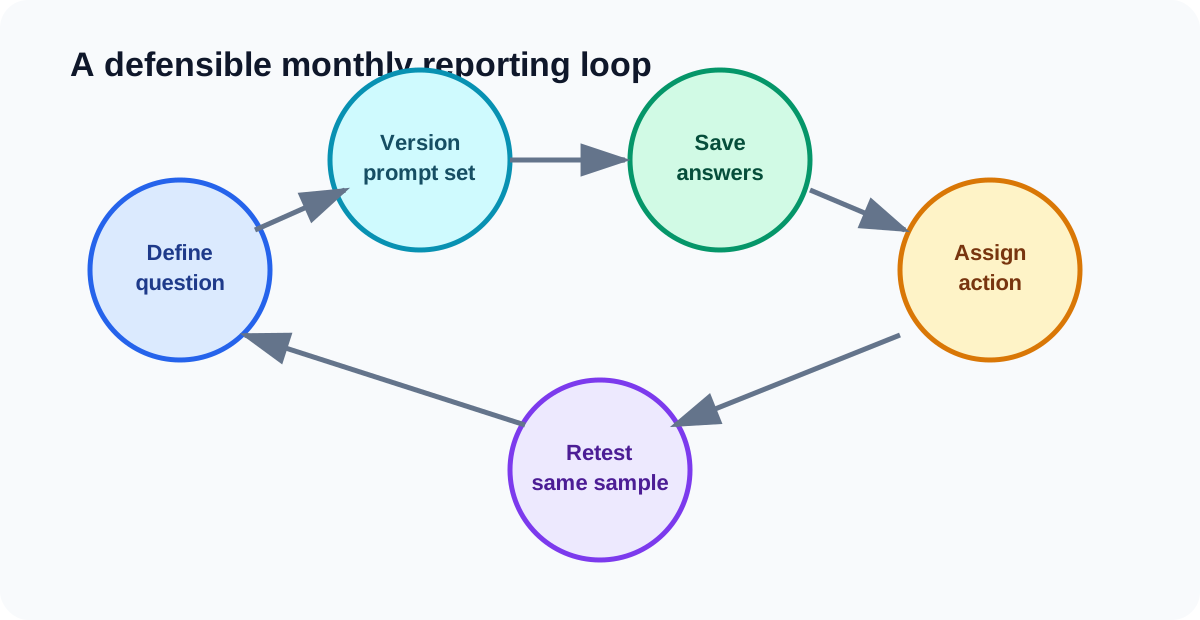
question → prompt sample → answer evidence → action → retest → analytics reconciliation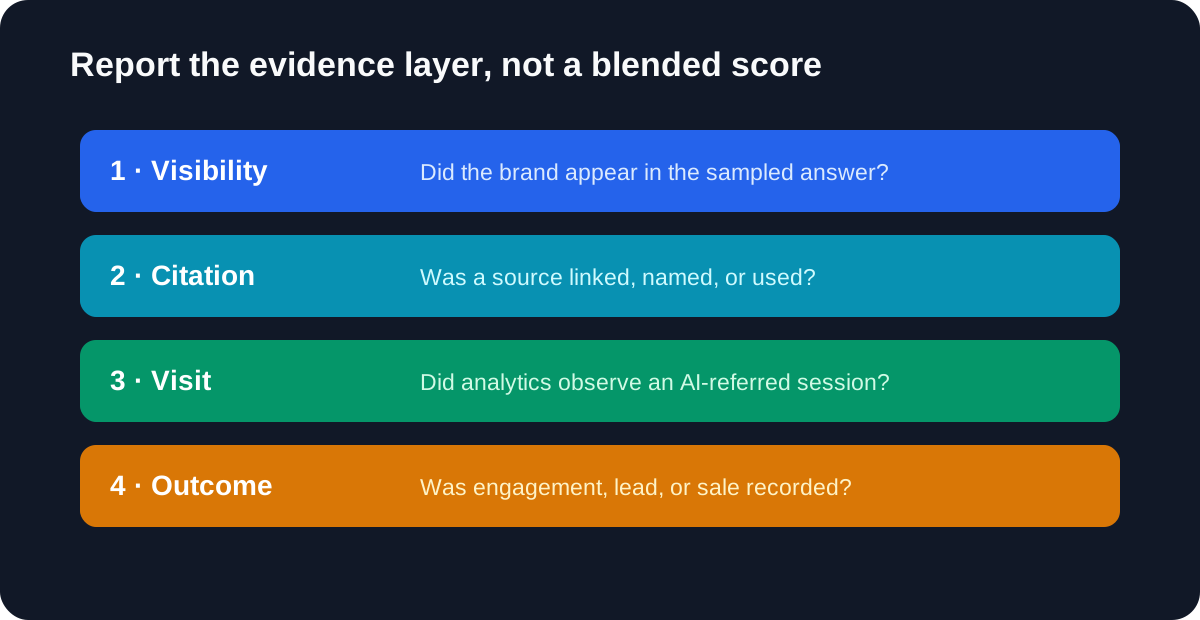
This framework is for agencies, in-house teams, and enterprise reporting groups. It complements AI Visibility vs AI Citations vs AI Traffic, which explains the measurement boundaries in more detail.
Why client reports often overclaim
AI answers are sampled, volatile, and dependent on context. A report can change because the prompt changed, a model updated its retrieval system, a location changed, or a competitor list was edited. A high mention rate may be useful, but it is not the same as market-wide visibility.
The common reporting errors are:
- Counting branded prompts as if they represented category demand
- Comparing scores from different prompt sets or model mixes
- Treating a cited page as a clicked page
- Mixing AI crawler requests with human referrals
- Presenting vendor-selected customer stories as independent proof
- Calling attributed revenue causal when the original AI interaction was not observable
Google Analytics campaign parameters can help identify tagged referrals, but Google’s campaign URL guidance does not make every AI-influenced visit observable. A report should show what was measured and what remains unknown.
1. Start with the client decision
Do not begin with “What is the AI score?” Begin with a decision:
| Decision | Evidence to collect |
|---|---|
| Are we visible for category discovery? | Category and problem prompts, brand presence, competitor set |
| Are competitors cited instead? | Full answers, source URLs, source type, citation position |
| Is the brand described accurately? | Accuracy prompts, source-of-truth claims, answer excerpts |
| Which content or PR gap should we address? | Repeated cited sources, missing topics, owner, proposed action |
| Are detectable AI referrals valuable? | Referrer or UTM, landing page, engagement, CRM/ecommerce event |
The decision controls the denominator. A reputation audit and a product-recommendation report should not share a single undifferentiated prompt pool.
2. Version a balanced prompt set
A credible client panel normally includes:
- Branded questions
- Category and problem questions
- Comparison and alternative questions
- Recommendation and evaluation questions
- Pricing, feature, and integration questions
- Reputation or risk questions
- Regional and multilingual variants when relevant
Keep a version number. If ten prompts are replaced with ten easier prompts, the next month is not a clean trend comparison. AI Search Console and Peec AI are examples of tools that can support prompt and answer analysis; their plan limits and methodologies should still be checked before a client contract.
For each run, store:
prompt_id, prompt_text, model_or_surface, country, language,
run_date, response_text, source_urls, mentioned_brands,
position_rule, sentiment_rule, prompt_set_version
3. Show answer evidence behind every metric
A dashboard number should link to the underlying examples. For each headline metric, show:
- Numerator and denominator
- Prompt-set version
- Models and regions included
- Sampling date and frequency
- Definition of mention, recommendation, citation, and position
- At least a few representative complete answers
- Source domains and URLs, not only domain names
- Whether the source is owned, earned, community, review, or vendor-selected
A citation is not automatically an endorsement or a click. A page can be cited while an answer contains an old price. A brand can be mentioned without its own domain being linked. Otterly.AI and Profound illustrate different product approaches to monitoring and answer intelligence; the report should disclose the chosen tool’s sampling assumptions rather than hide them.
4. Use a source ledger, not a source list
For each repeated source, maintain a small ledger:
| Field | Example question |
|---|---|
| Source URL | Which exact page was cited? |
| Claim supported | What sentence did it appear to support? |
| Freshness | Is the page current and dated? |
| Ownership | Owned, publisher, community, review, or vendor-selected? |
| Accuracy | Does the page support the answer as written? |
| Action | Refresh, clarify, earn coverage, or monitor? |
| Owner and retest | Who acts, and when is it rerun? |
This prevents the report from turning “a competitor was cited” into an unbounded content mandate. A source may be relevant for one prompt and irrelevant for another.
5. Separate observed traffic from influence
Create a distinct analytics section. It can include:
- Sessions with a detectable AI referrer
- Tagged links and campaign parameters
- Landing pages
- Engagement events
- Leads, purchases, or other recorded conversions
- CRM or ecommerce reconciliation
Label the result observed AI-referred traffic or attributed traffic, depending on the implementation. Do not call it total AI influence. Copy-pasted URLs, mobile apps, privacy settings, direct returns, AI Overviews, and later branded searches can hide the original interaction.
AI crawler logs belong in a separate technical section. A crawler request means an automated system accessed a resource; it does not mean a person saw the page or converted. PromptWatch is relevant when a team wants to discuss crawler and referral data, but crawler activity and human traffic remain different observations.
6. Write the executive summary in two layers
Use an observation paragraph followed by an interpretation paragraph.
Observation:
In the fixed Q3 category panel, the brand appeared in 31 of 100 sampled responses. Twenty-one included a source from the brand’s domain. Observed AI-referred sessions increased from 140 to 176 month over month.
Interpretation:
The brand has measurable presence in this defined sample, and its own domain was present in a subset of answers. The sample does not establish total AI visibility. The referral increase is an analytics observation and does not prove the visibility change caused additional revenue.
This language is less dramatic than a single score, but it is more useful for client decisions and renewal conversations.
7. Add a controlled action and retest
Every recommended action should include:
- The prompt or answer showing the issue
- The source or claim that explains the diagnosis
- The proposed change
- The owner and publication date
- The unchanged prompt-set version
- The retest date and success criterion
- The result, including no change or worse framing
For brand accuracy, an action might be updating a pricing page, clarifying an integration, or correcting inconsistent facts across authoritative sources. For citation gaps, it might be improving a page’s direct answer or pursuing relevant third-party coverage. None guarantees a future citation.
Brandlight is an example of an enterprise product positioned around visibility, source influence, and brand framing. Its public pricing and methodology are limited, so a buyer should ask for answer exports and a pilot. Product positioning is not evidence that a recommended action will improve a score.
8. A report template agencies can reuse
Executive summary
- Decision being supported
- Prompt-set version and coverage
- Three observed changes
- Three uncertainties or caveats
- Actions requiring approval
Visibility
- Mention rate and denominator
- Share of voice definition
- Position or recommendation rule
- Model, region, and prompt breakdown
Answer and citation evidence
- Representative full answers
- Cited URLs and source types
- Accuracy and freshness notes
- Competitor source comparison
Analytics
- Detectable AI referrals
- Landing pages and engagement
- Conversion events and attribution model
- Crawler activity kept separate
Action register
- Finding, source, owner, due date, test, and status
Methodology appendix
- Tool, plan, credits, schedule, prompt version, and exclusions
What the report does not prove
Even a careful report does not prove:
- Universal AI rankings across all users
- That a visibility increase caused a citation increase
- That a citation caused a click
- That AI traffic represents all AI-influenced visits
- That an attributed conversion was caused by one AI answer
- That a vendor-selected case study generalizes to the client
For a broader evidence framework, see AI Search source quality and Why two GEO tools can rank differently.
Client-report checklist
Before delivery, confirm:
- Prompt set includes branded and non-branded questions.
- Prompt, model, region, language, date, and version are visible.
- Every metric shows numerator and denominator.
- Answer excerpts and direct source URLs are available.
- Owned citations, third-party citations, and vendor-selected evidence are distinguished.
- Crawler requests are not counted as human visits.
- AI-referred traffic is labeled observed or attributed.
- Recommendations have an owner and a retest date.
- No visibility, citation, or traffic metric is presented as guaranteed revenue.
FAQ
How many prompts should a client report use?
There is no universal number. Use enough prompts to cover the client’s buying journey and markets, then publish the denominator. A small stable panel is more useful for a trend than a large changing panel.
Should agencies report one AI visibility score?
A summary score can be a navigation aid if its formula and denominator are visible. It should be accompanied by model, prompt, region, answer, and citation breakdowns rather than used as a universal rank.
Are AI citations the same as AI traffic?
No. A citation is answer-level source evidence. AI traffic is an observed or attributed website visit. The same answer may cite a page without a click, and a visit may lose its original AI context.
Can a client claim AI-attributed revenue?
A client can report revenue associated with a defined attribution model, but should not automatically call it causal AI-generated revenue. Explain the model, missing referrals, delayed journeys, and alternative explanations.
Sources and verification
- Google Analytics campaign URL guidance — campaign parameters and referral measurement; checked August 22, 2026.
- Google guidance on AI features and websites — AI features remain connected to core search fundamentals; checked August 22, 2026.
- AICiteKit: AI Visibility vs AI Citations vs AI Traffic — related measurement framework.
- AICiteKit: AI Search source quality — source ledger and evidence quality workflow.
- AICiteKit: Agency AI visibility reporting — agency reporting context.
Verification date: August 22, 2026. This article describes a methodology; tool prices, plans, model coverage, and integrations should be rechecked before procurement.