Field notes / ai-search
AI Search Source Conflict Audit: How to Resolve Contradictory Facts Before Citation
A practical workflow for finding conflicting product facts across first-party and independent sources, checking what an AI answer can support, and choosing bounded GEO actions.
The short answer
An AI Search source conflict audit investigates what to do when public pages disagree about a product fact, company identity, price, feature, policy, or service area. The aim is not to guess which page an answer engine “trusts.” It is to identify the exact conflicting claim, verify the scope and date of each source, and publish the narrowest fact that the evidence supports.
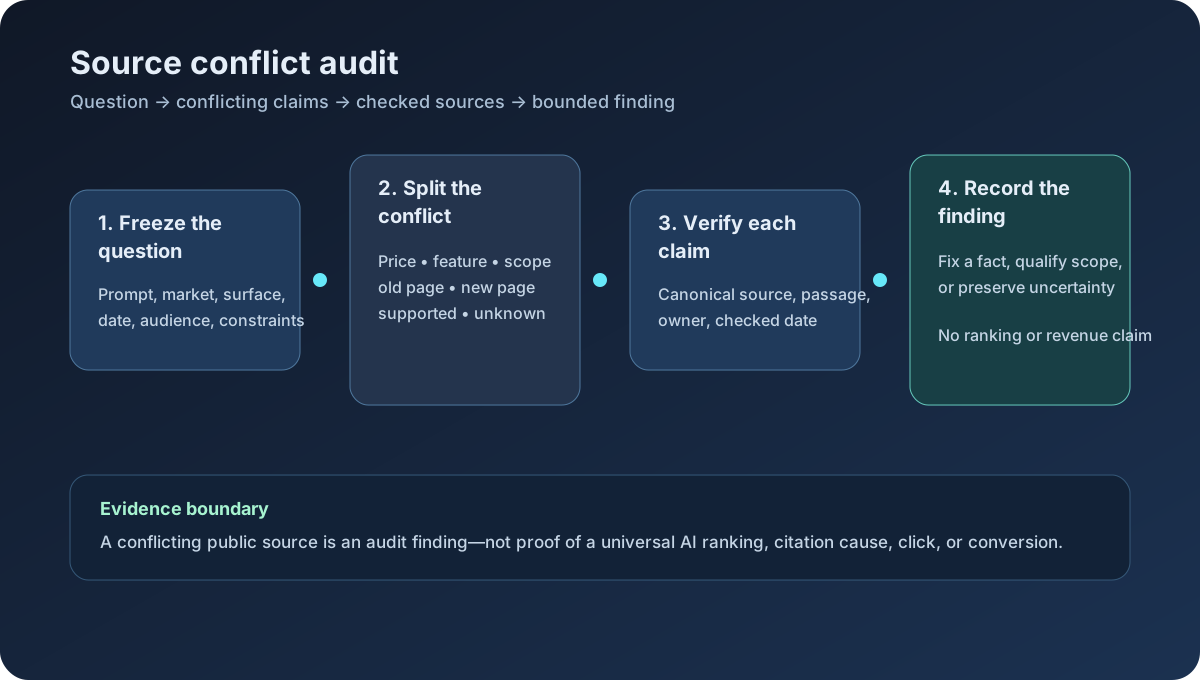
Use this chain:
exact question → conflicting claims → source and scope check → answer capture → bounded actionA conflict can make an answer ambiguous, but an ambiguous answer does not prove a ranking loss, a retrieval cause, or a business outcome. Keep source quality, citation visibility, clicks, and conversions as separate evidence layers.
This guide addresses searches such as “why does AI Search show outdated product information?”, “how do I fix conflicting company facts online?”, and “which source should an AI answer trust?” It complements AI Search Product Fact Audit, AI Search Answer Provenance, and AI Search Answer Freshness Audit.
What a source conflict does—and does not—mean
For this article, a source conflict exists when two accessible sources state materially different versions of the same fact. The difference may be a true contradiction, a change over time, a different market or plan, or a scope mismatch. Do not call every wording difference a conflict.
Google says AI features may show links to supporting web resources and recommends ordinary technical and content fundamentals, while also stating that appearing in an AI feature is not guaranteed (Google Search Central: AI features and your website, checked October 8, 2026). OpenAI documents citations and source information for its web-search tool (OpenAI Developer Docs: Web search, checked October 8, 2026). These are documented contexts, not one shared selection rule for every AI Search surface.
| Observation | It supports | It does not prove |
|---|---|---|
| Two pages state different prices | A price conflict needs scope and date review | Which page an answer engine will select |
| An answer cites the older page | The older URL appeared in that captured answer | That the page universally outranks the newer page |
| Your canonical page is absent | It was not visible in that run | That the page is blocked or permanently ineligible |
| A page was corrected and the answer changed | A before-and-after difference under recorded conditions | That the correction caused the change |
| A monitoring tool reports a source conflict | A metric was calculated under that tool’s method | That another tool observed the same conflict |
| A citation appears | A URL was exposed in an answer | A click, lead, or revenue outcome |
The independent paper GEO: Generative Engine Optimization studies visibility in a defined experimental setting (Aggarwal et al., arXiv, checked October 8, 2026). It is research context, not proof of current production retrieval, a commercial dashboard score, or the effect of resolving one conflict.
1. Freeze the question and the fact
A conflict is impossible to interpret if the fact changes halfway through the investigation. Preserve:
- Exact prompt and requested decision
- Product name, edition, plan, and version
- Market, language, currency, and location
- Surface and mode; model or version when disclosed
- Collection date, time zone, and repeat number
- The exact sentence or field that conflicts
A minimum record might be:
Conflict ID: CF-022 v1
Question: Which AI visibility tools offer weekly reporting for a small agency?
Fact under review: export availability and plan scope
Market/language: United States / English
Surface: recorded answer surface; mode recorded if disclosed
Collected: 2026-10-08 UTC
Decision: verify product facts, not prove a ranking
“Product includes exports” and “the entry plan includes scheduled exports for five users” are different claims. Split the sentence before checking sources.
2. Classify the disagreement before fixing it
Most apparent conflicts fall into one of five categories:
| Conflict type | Example | First check |
|---|---|---|
| Time | A review lists an old plan price | Publication and last-updated dates |
| Scope | A feature exists only on an enterprise plan | Plan, edition, seat, or workspace |
| Market | A service area differs by country | Locale, currency, and eligibility |
| Identity | A rebrand or acquisition creates two names | Official legal and company pages |
| True contradiction | Two current first-party pages disagree | Owner, canonical URL, and support contact |
Do not “solve” a scope conflict by deleting the narrower statement. State the scope. A current US pricing page can coexist with a different regional price; an enterprise feature page can coexist with a starter-plan comparison that omits it.
Google’s people-first guidance recommends content made to help people rather than content made primarily to manipulate rankings (Creating helpful, reliable, people-first content, checked October 8, 2026). Resolving a real factual conflict is useful editorial work. Adding repeated keywords or an unexplained “updated” date is not evidence that an answer will change.
3. Build a claim-level conflict ledger
Keep the source and the claim separate. A source can be authoritative for one fact and irrelevant to another.
| Claim ID | Exact claim | Source A | Source B | Conflict status | Safe wording |
|---|---|---|---|---|---|
| C-01 | The product has an API | Current official docs | Independent review | Aligned or not checked | State the documented capability and access condition |
| C-02 | The entry plan includes API access | Pricing page | Help article | Possible scope conflict | Name the plan and checked date |
| C-03 | The product costs a stated amount | Current pricing | Old comparison | Time conflict likely | Prefer the current official source; label date |
| C-04 | The product is more accurate | Marketing claim | No matched method | Unsupported | Do not publish as established fact |
| C-05 | Customers achieved a business outcome | Vendor case study | No independent corroboration | Vendor-selected evidence | Attribute the claim and disclose the boundary |
For each row record the URL, source owner, source type, publication or update date, access date, relevant passage, market, and confidence. If a page does not expose a date, write “date not exposed”; do not infer recency from its position in search results.
Bing’s webmaster guidance is useful additional platform context for quality and discoverability considerations (Bing Webmaster Guidelines, checked October 8, 2026). It does not establish how every AI answer engine resolves competing sources. Independent reviews and directories can reveal practical workflow observations, but they may be commercial or outdated; label that relationship rather than treating them as neutral authority.
4. Decide which source can support which claim
Use a source hierarchy only as a starting point, not as an automatic answer-selection model:
- Current first-party documentation or policy for the product’s own feature, plan, or terms.
- Independent sources for user experience, recurring concerns, and external context.
- Vendor-selected customer evidence for what the vendor reports about a named customer, not general causal proof.
- AICiteKit editorial judgment for conditional fit and recommended next steps.
Ask four questions of every source:
- Does it describe the same product, plan, market, and date?
- Does the passage support the exact claim, or only a nearby claim?
- Is the source independent, commercial, first-party, or vendor-selected?
- Can a reader verify the claim without trusting the summary alone?
A source may support “the product documents scheduled exports” but not “scheduled exports are reliable,” “the product is best for agencies,” or “exports increase retention.” Preserve the narrower statement.
5. Capture AI answers without rewriting them
A source conflict audit should preserve the answer as observed. Record:
- Exact prompt and panel version
- Full answer or permitted export
- Visible citations and direct URLs
- The sentence each URL appears to support
- Mention, recommendation, and citation as separate fields
- Surface, market, language, date, and repeat
- Unavailable, timeout, or partial-result states
If the system does not expose retrieval steps, label them unavailable. A server request, a dashboard score, or a related-query list is not proof that a particular page caused a citation.
For a repeatable panel, run:
- Baseline: original question in a new recorded conversation.
- Scope variant: add the plan, region, or audience constraint that matters.
- Source follow-up: ask which URL supports one disputed claim.
- Repeat: collect the baseline again under the same declared conditions.
- Retest: use a new panel version after correcting the source conflict.
Keep unavailable runs in the denominator. A useful report might say:
In 4 of 10 captured US-English runs of CF-022 v1, an older comparison URL was visible for the entry-plan export claim; in 3 runs, the current official documentation was visible; 3 runs had no comparable source field. This describes the recorded panel and collection window. It does not estimate universal source preference or business impact.
6. Choose the smallest defensible action
Match the action to the diagnosis:
| Finding | Reasonable action | Do not claim |
|---|---|---|
| Current first-party pages disagree | Assign an owner, reconcile pages, and redirect or canonicalize | That one fix guarantees citation |
| Old public page repeats a stale fact | Update, qualify, or retire it; preserve the access date | That freshness alone caused visibility |
| Sources differ by plan or market | Add explicit scope, currency, edition, and effective date | That the sources are contradictory globally |
| Independent source reports a user concern | Attribute the observation and seek corroboration | That all users share the experience |
| The answer overstates a cited passage | Correct the claim or document the uncertainty | That the cited URL endorses the whole answer |
| Results vary across repeats | Expand or narrow the panel and disclose variation | That one run establishes a trend |
The safest content change is usually a clear fact table with scope and date, a single canonical source for each dynamic claim, and links to the underlying documentation. That improves human verification. Its effect on any particular AI answer remains an empirical question.
Tools can help, but their metrics are not interchangeable
Products such as AI Search Console, Peec AI, Otterly.AI, PromptWatch, Profound, and Rankscale may support prompt collection, source monitoring, or reporting workflows. Compare them by what they actually preserve:
- Exact prompt and version
- Answer text and visible URLs
- Claim-to-source mapping
- Surface, model, market, and timestamp
- Retry and unavailable-state handling
- Source definition and calculation method
- Credit, refresh, export, and retention limits
A dashboard can reduce collection work without proving that its conflict score is a universal measure. Verify raw evidence during a trial before using the metric in a decision.
Common misreadings
“The oldest page was cited, so the engine prefers stale content.”
The captured answer exposed that URL under those conditions. Check whether the page was actually stale for the requested market, whether the claim had changed, and whether the answer used it for the disputed fact. Do not generalize from one citation.
“Our official page is correct, so every other page can be ignored.”
External pages can shape what a buyer or answer encounters. If they are wrong or scoped differently, record the conflict and decide whether to correct, qualify, or retire them. First-party status does not erase an unresolved public contradiction.
“We corrected the page and citations improved.”
That is a before-and-after observation. A stronger causal claim needs controlled conditions, repeated runs, and protection against concurrent changes. Even then, citation visibility is not evidence of traffic or revenue.
“A citation validates the recommendation.”
Read the cited passage. It may support one feature fact while failing to support superiority, current price, customer outcomes, or fit for a particular buyer.
A weekly source conflict workflow
- Choose one buyer decision and one high-risk fact family.
- Freeze the exact prompt, scope, market, and collection conditions.
- Search first-party, independent, and vendor-selected sources separately.
- Split disagreements into atomic claims and classify their source type.
- Record passages, dates, owners, URLs, and unknowns in a conflict ledger.
- Capture answers and visible sources with a fixed panel.
- Resolve the smallest factual or scope issue that the evidence supports.
- Retest without silently changing the prompt set or denominator.
- Report observations, evidence boundaries, and remaining uncertainty together.
The useful output is not “we made the model trust us.” It is a traceable record showing which claims conflict, which sources support them, what the answer exposed, and what remains unproven.
FAQ
How do I fix conflicting information about my company in AI Search?
Identify the exact claim, market, plan, and date first. Reconcile current first-party pages, qualify scope, retire stale duplicates where appropriate, and preserve independent concerns as attributed evidence. Then retest a fixed prompt panel. No universal citation or ranking result is guaranteed.
Which source should I treat as authoritative?
Use current first-party documentation for the product’s own facts, independent sources for external experience and context, and vendor-selected case studies only as attributed vendor evidence. Authority is claim- and scope-dependent; it is not a blanket endorsement of every statement on a page.
Should I add “last updated” dates everywhere?
Add dates when they help a reader understand currency and ownership, but do not use a date as a substitute for checking the claim. A dated page can still contain a wrong price, wrong region, or unsupported outcome.
Can a source conflict explain why an AI answer cited a competitor?
It can be a plausible diagnostic hypothesis when the competitor has a clearer, current, and directly relevant source. A captured competitor URL does not prove that the conflict caused selection. Check access, intent, scope, source passages, and repeated runs separately.
Does fixing source conflicts improve AI visibility?
It may improve factual clarity and reduce ambiguity for readers. A controlled retest can show whether sampled answers changed. It cannot, by itself, establish a universal ranking improvement, traffic increase, or revenue effect.
Sources and verification
- Google Search Central: AI features and your website — checked October 8, 2026; used for the documented boundary around AI-feature links, technical fundamentals, and non-guaranteed appearance.
- Google Search Central: Creating helpful, reliable, people-first content — checked October 8, 2026; used for the editorial distinction between resolving real factual problems and writing for manipulation.
- OpenAI Developer Docs: Web search — checked October 8, 2026; used for the documented distinction between a web-search tool, citations, and source information.
- Bing Webmaster Guidelines — checked October 8, 2026; used as additional platform guidance, not as evidence of a universal AI retrieval algorithm.
- Aggarwal et al., “GEO: Generative Engine Optimization” — checked October 8, 2026; used as independent research context for the evidence boundary.
- AI Search Product Fact Audit — internal companion for checking time-sensitive product claims.
- AI Search Answer Provenance — internal companion for mapping claims to cited passages.
The evidence boundary is deliberate: official documentation supports documented behavior and guidance; independent research supports research context; third-party sources can support external observations when their relationship and date are disclosed; AICiteKit editorial judgment turns those inputs into a conditional workflow. No source cited here proves a universal source-selection algorithm, guaranteed citation, ranking improvement, traffic increase, or revenue outcome.