Enterprise AI Search Reporting: A Framework for Connecting Visibility to Action
A practical framework for enterprise AI Search reporting that separates answer observations, content actions, traffic, and business outcomes without overstating attribution.
The short answer
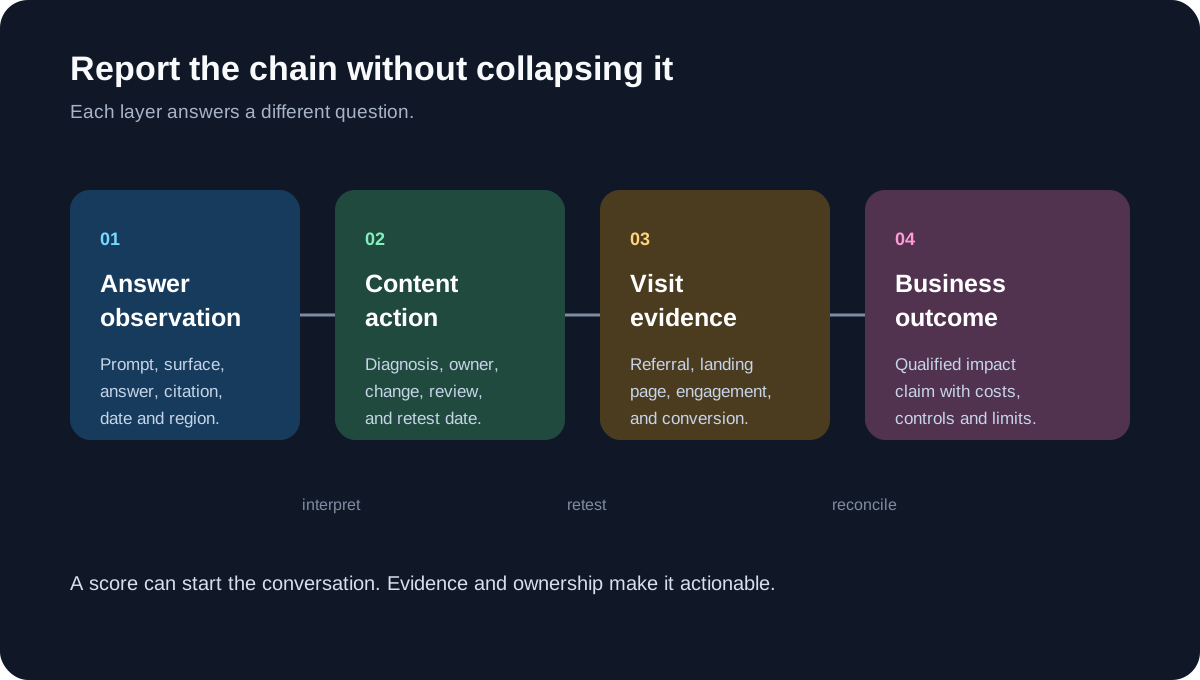
Enterprise AI Search reporting should not be one blended visibility score. It should connect four separate layers:
- Answer observation: what a defined prompt and AI surface returned.
- Content action: what the team changed in a page, source, feed, or entity record.
- Visit evidence: whether detectable AI referrals, engagement, or conversions changed.
- Business outcome: whether the organization can support a bounded, appropriately qualified impact claim.
The reporting chain is:
prompt and surface → answer evidence → diagnosis → content action → retest → analytics reconciliationEach arrow has uncertainty. A brand can appear without a citation, a citation can receive no click, and an AI-referred session can be observed without proving that the AI interaction caused the conversion.
This framework is useful for enterprise SEO teams, agencies, and content leaders evaluating platforms such as BrightEdge AI Catalyst, AirOps, Profound, PromptWatch, and Otterly.AI. The tools differ in workflow and data access; none should be assumed to prove the entire chain.
Why enterprise reporting is harder
A small team can manually save an answer and discuss it in a meeting. An enterprise program has more dimensions:
- Multiple brands, domains, products, or business units
- Country and language differences
- Separate ChatGPT, Perplexity, Google AI Overview, Gemini, or Copilot experiences
- Hundreds of pages and competing content owners
- Legal, medical, financial, or product-accuracy requirements
- Agencies that need repeatable client reporting
- Analytics systems that do not preserve the original AI interaction
A dashboard can hide these dimensions. Two teams may both report “visibility increased,” while one changed its prompt panel, model, region, or scoring rule. The number is not comparable until the denominator and collection method are documented.
1. Define the reporting question first
Start with a decision, not a vendor metric. Common questions include:
| Decision | Evidence needed | Safe output |
|---|---|---|
| Is the brand discoverable? | Category and problem prompts | Observed mention rate in the defined sample |
| Are product facts accurate? | Branded and product prompts with answer capture | Accuracy issues found and resolved |
| Which sources influence answers? | Cited URLs and source classification | Source patterns in the sample |
| Which pages need work? | Answer gaps, page inventory, and content review | Prioritized content backlog |
| Did a bounded change alter answers? | Fixed prompt panel before and after | Observed change under stated conditions |
| Did AI contribute to sales? | Referral data plus CRM or ecommerce evidence | Detected or assisted signal, with attribution limits |
Do not use a visibility score to answer a traffic question. Do not use a crawler request to answer a citation question. Do not use a citation to claim a sale.
2. Build a versioned prompt panel
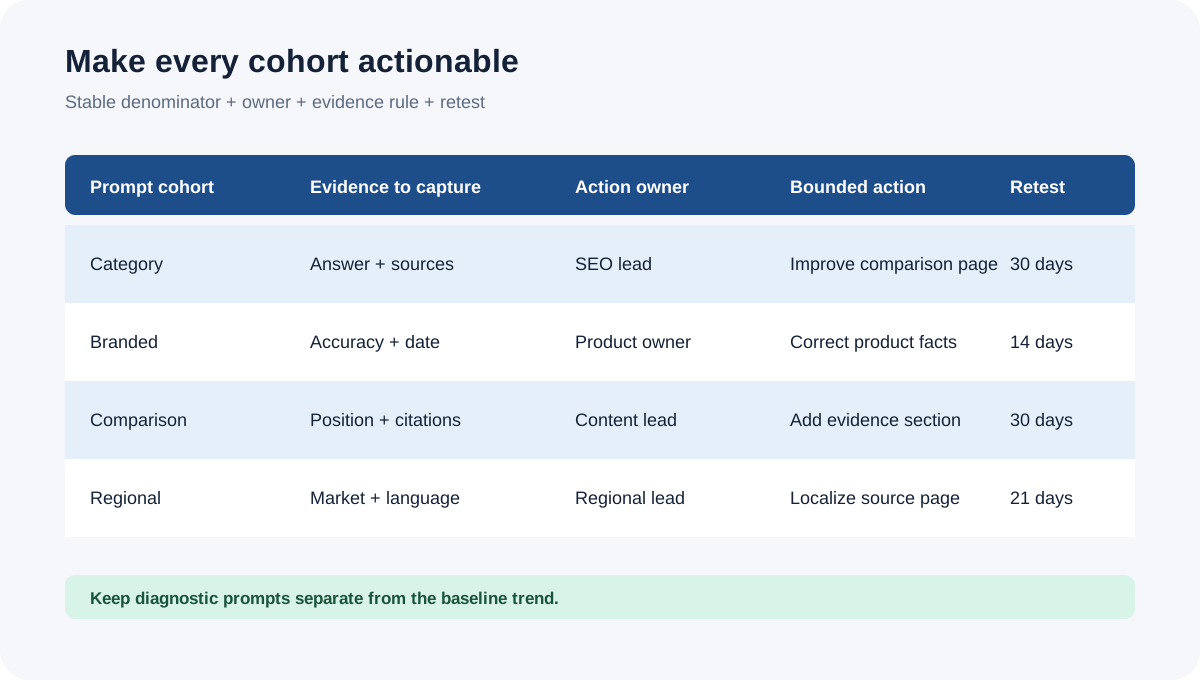
A reporting program needs a stable baseline and a separate diagnostic cohort. A balanced panel can include:
- Branded prompts for accuracy and product facts
- Category prompts for discovery
- Comparison prompts for evaluation
- Alternative prompts for competitor context
- Use-case prompts for customer problems
- Risk, pricing, integration, or compliance prompts where relevant
- Regional and multilingual prompts for actual operating markets
The exact number is an editorial choice. A useful panel is one the team can review, reproduce, and explain. Record at least:
- Prompt text and panel version
- Platform and model or browsing mode
- Country, language, and personalization assumptions
- Collection date and refresh cadence
- Brand and competitor definitions
- Rules for mention, recommendation position, citation, and sentiment
How to Build a Reliable AI Search Prompt Set explains the taxonomy in more detail. Avoid letting branded prompts dominate a claim about category visibility.
3. Preserve answer evidence, not just scores
A score is useful for trend monitoring only when the underlying evidence can be inspected. Store, where the product and platform allow:
- Full answer text or an appropriate capture
- Cited URLs and source positions
- Mentioned brand, product, or competitor
- Recommendation order and wording
- Model, surface, date, region, and language
- Prompt and panel version
- Reviewer decision: accurate, incomplete, outdated, or false
For high-risk facts, quote the answer and compare it with an approved source. A negative answer is not automatically a hallucination: it may be accurate. An inaccurate price, discontinued feature, wrong integration, or invented certification is a different issue.
The AI Search source quality framework can help classify cited pages by relevance, accuracy, freshness, and actionability. The purpose is diagnosis, not a promise that changing one source will force a future model answer.
4. Separate diagnosis from action
A good report does not stop at “visibility down.” It explains the next testable question.
| Observation | Possible diagnosis | Action to consider | Retest |
|---|---|---|---|
| Competitor is recommended for a category prompt | Different evidence or stronger third-party coverage | Review category page, comparisons, and independent sources | Same category cohort |
| Product price is stale | Feed, page, or source freshness issue | Correct product data and validate feed timestamps | Product prompt cohort |
| Brand is mentioned but not cited | Brand knowledge exists without owned-source linkage | Improve authoritative page and source relationships | Branded and category cohort |
| Page is cited for one use case but not another | Content covers a narrow intent | Add evidence-backed sections for the missing use case | Use-case prompts |
| Answer differs by country | Localization or availability mismatch | Review regional pages, language, product data, and market rules | Regional cohort |
Content recommendations from BrightEdge AI Catalyst or AirOps belong in this action layer. They should be reviewed against source facts and business priorities. A content tool’s recommendation is not itself an answer-level result.
5. Design the enterprise dashboard
A useful executive report can have five pages or panels:
Panel A: Coverage
Show prompt count, platforms, models, markets, languages, date range, refreshes, and panel version. This answers “what did we actually measure?”
Panel B: Answer evidence
Show mention rate, recommendation position, citation rate, cited-domain mix, accuracy issues, and representative answer examples. Keep branded and non-branded cohorts separate.
Panel C: Action backlog
Show the affected page or source, diagnosis, owner, priority, proposed change, evidence requirement, and retest date. A score without ownership rarely becomes work.
Panel D: Visit evidence
Show detectable AI referrals, landing pages, sessions, engagement, leads, orders, and revenue according to the analytics system. Label missing or unattributed traffic explicitly.
Panel E: Limitations
State model and region coverage, sampling method, nondeterminism, missing referral data, plan limits, and any vendor-selected evidence. This is not decorative disclaimer text; it determines how far the reader may generalize.
What platforms can and cannot prove
A platform may be strongest in one layer:
- A prompt monitor can preserve repeated answer observations.
- A content optimizer can turn search or answer signals into page actions.
- A crawler analytics product can show machine access in logs.
- An analytics system can show detectable sessions and conversions.
- A CRM or ecommerce system can reconcile downstream business records.
Do not assume that a product with an AI Search label owns every layer. For example, traditional SEO or AI-writing reviews do not automatically validate a newly introduced GEO feature. A vendor-selected customer story can illustrate an implementation, but it is not independent causal evidence.
How to run a controlled content test
A controlled test is more credible than a before-and-after screenshot:
- Select a bounded group of pages and prompts.
- Record the current answer, source, model, market, date, and analytics baseline.
- Change one main variable, such as a factual section, comparison table, FAQ, internal-link path, or source placement.
- Keep the prompt panel and scoring rules stable.
- Wait for a pre-defined observation window appropriate to the platform.
- Re-run the same cohort and review raw answers.
- Compare conventional search, AI answers, citations, referrals, and conversions separately.
- Record alternative explanations, including platform changes and seasonality.
This design still does not guarantee causation. It does make the claim narrower and more auditable: “Under this prompt, platform, market, and period, the observed answer signal changed after the documented content revision.”
Agency reporting and client communication
Agencies should define the denominator in every headline. Replace:
“Your AI visibility grew 35%, so the campaign generated more revenue.”
with:
“Across 80 version-3 prompts in ChatGPT and Perplexity for the US market, observed brand mentions increased from 18 to 24 during the comparison window. Citation and referral data were measured separately; revenue causation was not established.”
A client-ready monthly report should include:
- Executive decision and scope
- Stable prompt panel and coverage
- Answer examples and citation changes
- Content actions completed
- Retest results
- Detectable referral and conversion data
- Risks, unknowns, and next decisions
For a fuller agency workflow, see How Agencies Should Report AI Visibility to Clients.
What the report must not claim
Even a large dataset does not automatically prove:
- Market-wide AI visibility
- Guaranteed ranking or citation improvement
- That a citation received a click
- That every AI answer used the same source selection process
- That a crawler request became a user-facing answer
- That an AI-referred session caused a conversion
- That a content change caused incremental revenue without a suitable design
AI Visibility vs AI Citations vs AI Traffic explains why evidence becomes narrower at each stage.
Enterprise buying checklist
Before selecting a platform or expanding a contract, ask:
- Which surfaces, models, regions, and languages are actually included?
- Is the data from a consumer surface, API, browser automation, or model estimate?
- What exactly consumes a prompt, credit, query, or refresh?
- Are full answers, citations, timestamps, and source URLs exportable?
- Can branded, category, competitor, and diagnostic cohorts be separated?
- What are the retention, API, user, project, and overage limits?
- Can recommendations be traced to a page, query, evidence source, or business priority?
- How are content actions approved and audited?
- Can referral data be reconciled with GA4, server logs, CRM, or ecommerce records?
- Which claims in the sales material are vendor-selected customer evidence?
- What will the pilot measure, and what outcome would stop the purchase?
FAQ
What should an enterprise AI Search report contain?
It should contain scope and coverage, raw or inspectable answer evidence, defined metrics, diagnosis and action backlog, retest results, detectable visit data, and explicit limitations. A single visibility score is not enough.
Is AI visibility a KPI?
It can be a useful directional KPI for a stable prompt and platform sample. It is not a universal market ranking and should not be used as a substitute for traffic, pipeline, or revenue measurement.
Should a content optimization tool and a prompt monitor be the same product?
Not necessarily. A combined workflow can reduce handoffs, but specialized products may provide deeper answer evidence or content controls. Choose based on the evidence layer and decision your team needs.
How often should enterprise prompts be refreshed?
Use a stable cadence for the baseline and reserve separate diagnostic runs for incidents, launches, or regional audits. Record exceptions rather than blending them into the baseline score.
Can AI Search reporting prove ROI?
It can contribute evidence to an ROI analysis when connected with costs, referrals, engagement, leads, orders, and a suitable comparison design. Visibility or citations alone do not prove ROI.
Conclusion
Enterprise AI Search reporting becomes useful when it behaves like a measurement and decision system, not a leaderboard. Preserve the prompt and answer context, connect observations to a bounded action, retest the same cohort, and reconcile visits or outcomes in separate systems.
The practical rule is simple:
visibility is an observation
citation is a source signal
traffic is a visit signal
revenue is a business outcome
Report the connections carefully, but do not erase the boundaries between them.
Sources and verification
- BrightEdge AI Catalyst — official product positioning, checked August 24, 2026.
- BrightEdge products — official description of broader SEO and AI Search capabilities, checked August 24, 2026.
- Google Analytics campaign URL guidance — campaign parameters and referral measurement context.
- AICiteKit: AI Visibility vs AI Citations vs AI Traffic — evidence boundaries.
- AICiteKit: How to Build a Reliable AI Search Prompt Set — prompt panel design.
- AICiteKit: AI Search Source Quality — source review framework.
Verification date: August 24, 2026. Platform coverage, product features, pricing, and analytics behavior can change; verify current terms before procurement.