Local AI Search Visibility: A Practical Audit for Businesses That Want to Be Recommended
Learn how to audit a local business for AI Search without confusing Google Business Profile accuracy, directory coverage, citations, recommendations, and revenue evidence.
The short answer
A local AI Search audit is not a checklist for “ranking in ChatGPT.” It is a controlled review of whether a business publishes consistent local facts, is represented in the sources an answer may consult, and appears in a defined sample of real customer prompts.
Use four evidence layers:
- Business facts: name, address, phone, hours, services, areas served, and important restrictions.
- Local source coverage: the official site, Google Business Profile, relevant directories, review platforms, and specialist sources.
- Prompt observations: what named AI Search surfaces answer for category, comparison, and “near me” questions.
- Business outcomes: separately measured referrals, calls, leads, bookings, or sales.
The layers are connected, but none substitutes for another. A complete Business Profile does not guarantee an AI recommendation. A citation does not prove a visit. A visit does not prove that the AI answer caused a conversion.
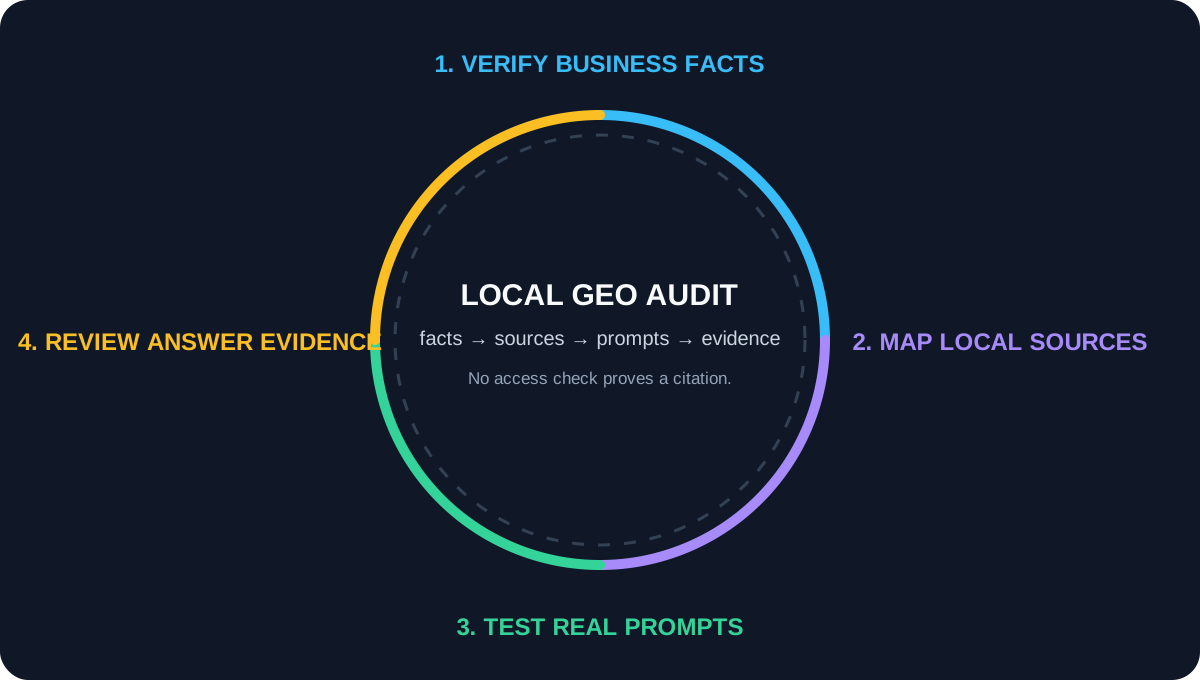
This guide addresses searches such as “how do I get my local business into AI search?” and “why does AI recommend my competitors instead of me?” It is a measurement and diagnosis workflow, not a promise of placement.
What local AI Search can and cannot establish
Google says its AI features are built on foundational Search requirements and that appearing in AI features is not guaranteed (Google Search Central: AI features and your website, checked September 4, 2026). Google’s local-ranking guidance describes relevance, distance, and prominence as factors in local results (Google Business Profile Help: Tips to improve your local ranking, checked September 4, 2026).
Those sources support a practical baseline: accurate public business information and a credible local presence matter. They do not publish a universal formula for how a generative answer selects businesses, nor do they guarantee inclusion in an AI response.
An audit can establish, for a documented sample:
- Whether your business facts are consistent across the pages and profiles you checked.
- Whether a test request can access the relevant public page or profile.
- Whether defined prompts mention, recommend, or cite your business.
- Which sources and claims appear in the captured answers.
- Whether analytics or operational systems record a separately defined referral or conversion signal.
It cannot establish from one answer, a crawler request, or a dashboard score alone:
- A universal AI ranking or “authority” position.
- That a particular page was used internally to generate an answer.
- That a content or listing edit caused a visibility change.
- That a citation produced a visit, call, booking, or sale.
- That adding schema, repeating a phrase, or creating an
llms.txtfile guarantees visibility.
The academic paper GEO: Generative Engine Optimization studies generative-engine visibility in a research setting (Aggarwal et al., arXiv, checked September 4, 2026). It is useful context for studying generated answers, but it is not independent proof of a production ranking mechanism or a result for a specific local business.
1. Define the local decision before you audit
“Local visibility” is too broad to be a useful test. Write the decision a customer is trying to make and the geography involved.
| Decision | Example prompt family | Evidence to capture |
|---|---|---|
| Find a provider | “Best emergency plumber in [city]” | Businesses named, service fit, locations, cited sources |
| Compare options | “Compare [service] companies near [neighborhood]” | Recommendation order, criteria, omissions, source URLs |
| Check suitability | “Does [business] serve [area] and offer [service]?” | Factual answer, freshness, exact supporting page |
| Plan a visit | “Which [business type] is open Sunday near me?” | Hours, distance context, reservation or contact details |
| Validate trust | “Which [local service] has strong reviews and experience with [need]?” | Review-source references, qualifications, and caveats |
Keep category, branded, comparison, and regional prompts in separate cohorts. A branded question tests whether the system can describe a known business. A category question tests whether it is considered among alternatives. Combining both into one percentage can hide a discovery problem.
Record the exact wording, language, country, city or neighborhood, surface, mode, collection date, and whether location or personalization was available. If any of those change, mark the new run as a separate cohort.
2. Build a local fact sheet
Start with facts a customer could act on. Use one canonical value for each field and record where it is published.
| Fact | Canonical value | Pages or profiles checked | Status |
|---|---|---|---|
| Business name | Legal or public-facing name | Site, profile, directories | Verified / conflict |
| Address or service area | Full address or defined area | Site, map profile | Verified / conflict |
| Phone and contact method | Current public contact | Site, profile | Verified / conflict |
| Opening hours | Regular and special hours | Profile, contact page | Verified / stale |
| Services | Services actually offered | Service pages, profile | Verified / ambiguous |
| Eligibility or restrictions | Who is not served | Policy, FAQ, service page | Verified / missing |
| Proof points | Licenses, memberships, experience | Primary evidence | Verified / unsupported |
A fact sheet prevents a common failure mode: optimizing for a recommendation while leaving contradictory hours, service names, or locations in public sources. If a business has multiple locations, give every location its own record; do not let a city-level claim imply that every branch offers the same service.
Google’s structured-data documentation says markup can help Search understand page content, while also warning that structured data does not guarantee a rich result (Introduction to structured data markup, checked September 4, 2026). Use markup to accurately describe visible information. Do not use it as a citation switch.
3. Map the sources that matter locally
Create a source inventory rather than a generic list of directories. The relevant sources depend on the category, country, and customer decision.
First-party sources
- A location page with the full address, hours, service area, and contact path.
- Individual service pages that describe what is actually available.
- A clear about, credentials, and policies section.
- An accessible FAQ that answers real local constraints without stuffing city names.
- A consistent internal link path from the location page to service details.
Platform and directory sources
- The applicable business profile and map listing.
- Major local directories used in the market.
- Industry-specific directories or professional registers.
- Review platforms where customers genuinely evaluate the category.
- Local organizations, associations, or news sources when they independently cover the business.
BrightLocal’s research on AI directory sources is a useful commercial industry reference for thinking about which local platforms may appear in AI answers (Where to get local citations for AI search, checked September 4, 2026). It is not a neutral ranking factor study, and directory presence should not be read as a guarantee of recommendation.
Search Atlas also publishes an empirical study of “near me” query citations (How LLMs rank local businesses, checked September 4, 2026). Search Atlas is a commercial SEO/GEO vendor, so treat its methodology and findings as vendor-authored research. Use it to generate hypotheses, then test your own defined prompts and sources.
Source quality checks
For each source, record:
- Whether the business controls the listing.
- Whether the information is current and consistent.
- Whether the source is relevant to the category and market.
- Whether the page exposes a canonical URL or only a profile label.
- Whether the source is independent, vendor-selected, user-generated, or unknown.
Do not turn the number of listings into a KPI without validating accuracy and relevance. Ten conflicting profiles are not stronger than three accurate ones.
4. Test the prompts customers actually ask
Use a small fixed panel before expanding it. A useful local panel might include:
- Two category prompts for the city.
- Two service-and-neighborhood prompts.
- One comparison prompt with named competitors.
- One branded accuracy prompt.
- One availability or hours prompt.
- One qualification, price-range, or suitability prompt where the answer can be verified.
Run each prompt more than once when the surface allows it, and preserve the full answer or a permitted export. Record:
| Observation | Safe interpretation |
|---|---|
| Business named | It appeared in this defined answer sample |
| Business recommended | The answer used recommendation language or ordering |
| Exact URL cited | That URL was visibly listed as a source |
| Third-party source cited | The answer referenced that source, not necessarily the business site |
| Fact correct | The captured answer matched the checked fact |
| Fact wrong or stale | A correction is needed; cause is not established |
A tool such as AI Search Console, Peec AI, Otterly.AI, or PromptWatch can help organize recurring prompt observations. Their prompt collection, model coverage, locations, scoring definitions, and answer retention may differ. During a trial, compare the export with manually inspected answers; do not assume two products’ visibility percentages are interchangeable.
5. Diagnose the result without inventing a cause
Use the evidence to choose the next investigation, not to declare an algorithm explanation.
The business is absent from category answers
First check prompt fit, location context, service eligibility, and whether the business has a clear page for the requested need. Then inspect whether relevant independent sources describe the business accurately. An absence from a small sample is a signal for research, not proof of low market authority.
The business is mentioned but the facts are wrong
Treat this as an accuracy and freshness issue. Compare the answer with the fact sheet, identify the exact conflicting source, correct the primary record, and request or make appropriate source updates. Do not claim that the correction will produce a recommendation until a matched retest shows an association.
The business site is cited, but the recommendation is weak
A citation and a recommendation answer different questions. Inspect whether the page actually explains service fit, location, constraints, and evidence. Also record whether the answer cites third-party sources that shape trust or comparison.
Competitors appear repeatedly
Do not copy their claims blindly. Compare the same fields: locations served, services, review context, credentials, availability, and source coverage. Mark vendor-selected customer stories as vendor-selected customer evidence, not independent validation.
Different tools disagree
Check the prompt text, surface, model or mode, location, run date, source parsing, and definitions of mention, recommendation, and citation. The disagreement may be a measurement difference rather than a market difference. See Why Two GEO Tools Can Rank the Same Brand Differently for a broader reconciliation workflow.
6. Keep business outcomes separate
A local AI answer may influence a customer without producing a clean referrer. Conversely, a referral tagged as AI does not prove that the answer caused the visit. Use separate ledgers:
| Layer | Example record | What it proves |
|---|---|---|
| Answer | Business named in 4 of 10 captured prompts | Sampled answer observation |
| Citation | Location URL listed in 2 of 10 answers | Visible source citation in that sample |
| Referral | Analytics session attributed to a recorded AI referrer | A separately measured referral signal |
| Lead | Form, call, or booking matched under stated rules | An operational event under those rules |
| Revenue | CRM or commerce attribution | Revenue assigned by that system’s model |
Google Analytics documentation describes traffic-acquisition dimensions and attribution controls, but those reports should be configured and interpreted for the site’s own measurement setup (Google Analytics Help: Traffic-source dimensions, checked September 4, 2026). They are not a transcript of every AI answer or proof that a cited source caused a conversion.
For local businesses, add practical offline signals where lawful and useful: a booking question, a dedicated campaign path, call tracking, or a CRM note. Treat these as measurement instruments with their own bias, not as causal proof by themselves.
A local GEO audit worksheet
Business / location:
Primary customer decision:
Prompt-set version:
Surface / mode:
Market / language:
Collection window:
Canonical fact sheet URL:
Conflicting sources:
Sources independently checked:
Business mentioned in sample:
Business recommended in sample:
Exact URLs cited:
Fact errors observed:
Analytics / call / booking signal:
Known confounders:
One bounded next action:
What this audit cannot prove:
Choose one primary hypothesis per iteration, such as: “The location page does not state that this branch serves the tested neighborhood.” Make the bounded edit, preserve the prior prompt version, and rerun the same panel. Report an association unless the design can isolate the cause.
Who should use this workflow?
This audit is a good fit for:
- Multi-location businesses maintaining consistent local facts.
- Agencies reporting local AI visibility to clients.
- SEO and content teams investigating a specific missing recommendation.
- Product or marketing teams validating service, hours, and eligibility claims.
It is not a substitute for:
- A complete local SEO or technical audit.
- Reputation management or review-quality work.
- A representative study of every AI Search user.
- A guarantee of citations, rankings, calls, or revenue.
FAQ
Do I need to create a separate page for every neighborhood?
Not automatically. Create useful location or service-area content when the business genuinely serves that area and can provide distinct, accurate information. Do not generate near-duplicate pages only to repeat place names.
Are directories more important than my website?
The audit should check both. A directory may be the source shown in an answer, while the business site may be the best place to verify service details. The relevant mix depends on the market and category; no source type is a universal guarantee.
Does Google Business Profile optimization guarantee AI recommendations?
No. Google’s local guidance supports accurate profile information and local relevance, while its AI-features guidance says appearance is not guaranteed. Neither source publishes a guarantee for generated recommendations.
Should I track “mentions” or “recommendations”?
Track both, with separate definitions. A business can be named in a list, discussed as an example, or actively recommended. Your report should show the rule and the underlying answer evidence.
How many prompts are enough?
Enough to represent the local decision you are testing while remaining stable and reviewable. A small balanced panel can diagnose a specific issue; it cannot support a claim about the whole local market.
What should I ask a GEO tool during a trial?
Ask how it sets location, runs prompts, identifies the surface and model, stores raw answers and exact URLs, handles failed runs, separates branded from category prompts, and defines mentions, recommendations, citations, and referrals. Compare its output with a manually inspected sample.
Sources and verification
| Source | Public signal | What it supports | Confidence |
|---|---|---|---|
| Google Search Central: AI features and your website | Official guidance on AI features and foundational Search requirements | Technical and content baseline; no appearance guarantee | High |
| Google Business Profile Help: Tips to improve your local ranking | Official local-ranking guidance | Relevance, distance, and prominence context for local Search | High |
| Google Search Central: Introduction to structured data markup | Official structured-data documentation | Accurate markup can help Search understand content; no guaranteed display | High |
| Google Analytics Help: Traffic-source dimensions | Official analytics documentation | Referral and acquisition measurement context | High |
| BrightLocal: Where to get local citations for AI search | Commercial local-search research and guidance | Hypotheses about local source coverage; not a universal ranking factor | Medium-low |
| Search Atlas: How LLMs rank local businesses | Vendor-authored empirical research | A testable framework for near-me citation research; methodology and commercial bias apply | Medium-low |
| GEO: Generative Engine Optimization | Independent academic research | Research context for generative-engine visibility | Medium |
The sources above were checked on September 4, 2026. Official sources support documented platform, local-search, structured-data, and analytics behavior. BrightLocal and Search Atlas are commercial sources and are labeled accordingly; they do not independently prove a local business will be recommended. AICiteKit has not independently audited any AI platform’s internal retrieval system or replicated the vendor-authored local studies.
AICiteKit editorial verdict
Local GEO work is most useful when it starts with a customer decision and ends with inspectable answer evidence. Businesses should buy or build monitoring only when they can preserve prompt context, location settings, raw answers or exports, source URLs, and clear definitions for mention, recommendation, and citation. They should not buy a promise of guaranteed AI placement.
The strongest evidence in this workflow is an accurate, independently checked fact record plus repeated observations from a defined local prompt panel. The most important limitation is causal uncertainty: even a changed answer after an edit does not, by itself, prove why it changed or that it produced business value.
Before purchase, run a trial on real locations and prompts, inspect the raw evidence, and reconcile at least one tool’s output with manual checks. For broader measurement guidance, compare this workflow with How to Build an AI Search Measurement Baseline Before You Optimize and AI Search Retrieval Audit.