How to Connect Traditional SEO Data to GEO Prompt Research
Search demand can help prioritize AI Search questions, but it is not the same as AI prompt volume. Learn a defensible workflow for turning SEO research into GEO monitoring.
The short answer
Traditional SEO data can improve GEO research by helping teams prioritize real customer topics, competitors, and buying journeys. It cannot tell you exactly how often people ask an AI system the same question, nor can it prove that a brand will be cited or recommended.
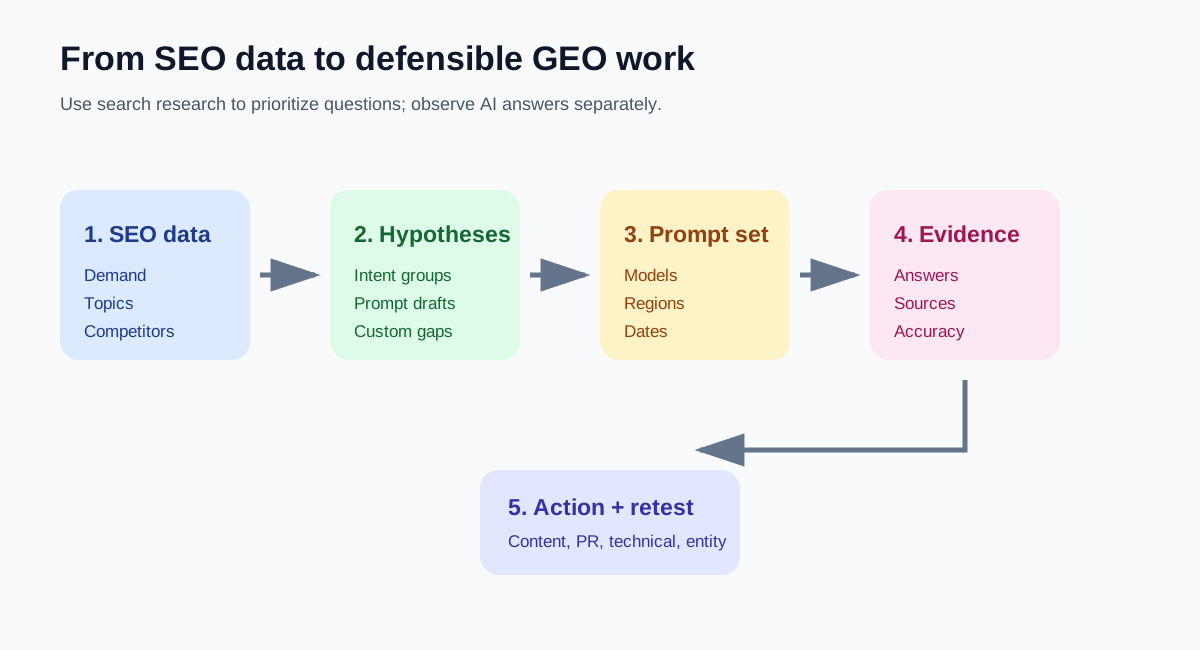
A defensible workflow is:
search demand → prompt hypotheses → balanced prompt set → answer evidence → action → retestAhrefs Brand Radar is a relevant example because its public positioning connects search-backed prompt research with custom AI-search questions. The method is broader than any one product: use SEO data as a prioritization layer, then measure AI answers separately.
Why connect the two datasets?
SEO research contains useful clues about language, demand, competitors, and customer problems. A keyword or topic dataset can reveal:
- Which problems people repeatedly investigate
- Which comparison and alternative pages compete for attention
- Which products, brands, and entities appear in a category
- Which locations or languages deserve dedicated research
- Which questions are commercially important enough to monitor
AI Search adds a different observation. An answer engine may summarize several sources, recommend a competitor without linking to it, or repeat an outdated fact. The important question is not only whether a topic has search demand; it is how AI systems answer the topic and which sources shape that answer.
This is also why visibility, citation, traffic, and revenue must stay separate. A high-demand topic can produce AI mentions without a source link. A citation can exist without a click. An AI-referred visit can exist without proving that the AI answer caused a conversion.
Step 1: Start with search themes, not a keyword dump
Group SEO research into customer and business themes before writing prompts. Useful groups include:
| Theme | Example question to investigate |
|---|---|
| Category | What are the leading tools for a defined job? |
| Problem | How do teams solve a specific operational problem? |
| Comparison | Which product is better for a particular constraint? |
| Alternative | What are the alternatives to a known product? |
| Evaluation | What should a buyer check before choosing? |
| Risk and accuracy | What limitations, costs, or compliance issues matter? |
| Regional | Which providers serve a particular market or language? |
| Brand | How does an AI system describe the company or product? |
Do not automatically convert every high-volume keyword into one prompt. Search results and AI answers have different formats, and a large keyword list can create a false sense of measurement precision.
Step 2: Turn themes into prompt hypotheses
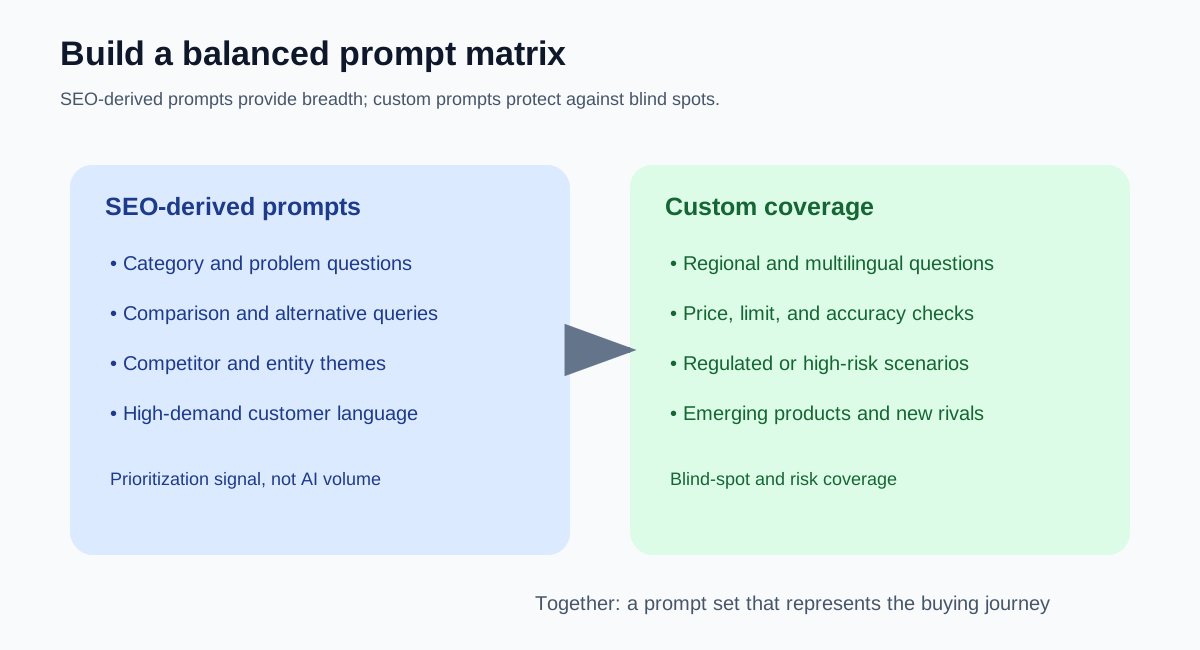
For each theme, write several natural-language questions. Preserve the user’s constraint rather than stuffing a keyword into a sentence. Then add prompts that search data may underrepresent, such as:
- Questions about a current price or feature limit
- Questions about implementation effort
- Questions from a regulated or high-trust industry
- Questions in a local language
- Questions that test whether the brand is described accurately
A search-backed dataset can help find breadth. A manual research pass supplies the depth. Ahrefs Brand Radar advertises both search-backed prompts and custom prompts; buyers should verify the current quota and refresh terms before treating that capability as operationally sufficient.
Step 3: Build a balanced prompt set
A good starting set mixes discovery, evaluation, competitive, and accuracy questions. Avoid using only branded prompts: they can make a brand look visible while saying little about category discovery.
Record at least:
- Exact prompt text
- Prompt group and business intent
- Country, language, and location assumptions
- AI surface or model
- Run date and refresh schedule
- Competitors being compared
- Whether sources and complete answers are retained
- The rule used to score mention, position, sentiment, or citation
Tools such as AI Search Console, Peec AI, Rankscale, and Otterly.AI can support different monitoring workflows. Their scores should not be compared until prompt, model, region, sampling, and calculation assumptions are documented.
Step 4: Separate the measurements
For every run, distinguish these observations:
- Visibility: Did the brand appear in the sampled answer?
- Position or share: How was it ordered or represented within the defined sample?
- Citation: Did the answer link to or name a source, and which source?
- Accuracy: Were the brand’s facts correct, current, and complete?
- Traffic: Did analytics observe a visit attributed to an AI surface?
- Business outcome: Did a separately measured action or conversion occur?
The chain is useful, but it is not a guaranteed funnel:
visibility ≠ citation ≠ traffic ≠ revenueA citation can influence a decision without producing an observable referral. A crawler request is not human traffic. A conversion after an AI referral is still not automatically proof that the visibility change caused the conversion.
For more detail, see AI Visibility vs AI Citations vs AI Traffic and Tracking AI Citations.
Step 5: Use source evidence to choose an action
When a competitor appears and your brand does not, do not jump straight to “publish more content.” Inspect the answer and its sources:
- Is the answer using an authoritative product, review, forum, or news source?
- Does the cited page contain facts that your site lacks?
- Is the competitor’s advantage topical, reputational, technical, or simply sampling noise?
- Is your own page crawlable, current, and explicit about the relevant entity and facts?
- Would the right action be content improvement, digital PR, structured data, product-feed work, or a correction to an inaccurate third-party source?
This is where GEO connects to execution. Frase and AirOps are more relevant when content research and production are the bottleneck. Schema App is relevant when entity relationships and structured data need governance. None of these actions guarantees an AI citation.
What the method does not prove
Connecting SEO and GEO data does not prove:
- That search volume equals the number of AI conversations
- That a high-demand keyword is a high-value AI prompt
- That one tool’s visibility score is a universal market ranking
- That a content change caused an answer change
- That more mentions produce more clicks
- That citations produce traffic or revenue
- That traditional Ahrefs or Semrush reviews validate a newer GEO feature
Commercial product pages and vendor-selected customer evidence are useful for understanding what a tool claims to do. They are not independent proof of outcome claims. Independent reviews should be linked and described narrowly: a review of a broad SEO platform does not automatically validate its newer AI visibility module.
A practical reporting template
A client or internal report should include:
| Section | Minimum detail |
|---|---|
| Scope | Engines, countries, languages, dates, and prompt count |
| Prompt design | Groups, inclusion rules, and whether prompts were branded or category-level |
| Answer evidence | Full answer or capture, sources, position, and accuracy notes |
| Change | Before/after result with the same prompt definition where possible |
| Action | Specific content, authority, technical, entity, or product change |
| Limits | Sampling, non-determinism, attribution gaps, and untested surfaces |
| Business metrics | Separate analytics evidence for observed AI referrals and conversions |
A useful report can say “the brand appeared in 18 of 60 sampled category answers this month” without turning that observation into “the brand gained 30% more revenue from AI.”
Recommended workflow by team type
In-house SEO team
Use search data to prioritize topics, let content and PR owners investigate source gaps, and maintain a fixed monthly prompt panel. Add a smaller rotating panel for emerging products, regions, and accuracy risks.
Content team
Use AI-answer evidence as a briefing input. Improve clarity, factual completeness, first-party evidence, and entity consistency. Measure whether the target answers change, but do not treat a changed answer as proof of traffic impact.
Agency
Show the prompt methodology and answer samples beside every score. Make plan limits and sampling assumptions visible in the proposal. Profound and PromptWatch may fit agencies needing deeper enterprise or crawler/referral workflows, while Otterly.AI can suit a lighter monitoring setup.
Ecommerce brand
Add product, price, availability, review, and comparison prompts. Verify freshness and product-feed dependencies. AI Shopping coverage should be tested separately from generic brand visibility.
Checklist
- Search themes were grouped by customer intent.
- Category, comparison, alternative, risk, regional, and brand prompts are represented.
- Search-derived prompts are labeled as hypotheses, not AI-volume facts.
- Custom prompts cover important questions missing from SEO data.
- Model, region, language, date, and sampling details are recorded.
- Mention, citation, traffic, and revenue are reported separately.
- Answer sources and factual accuracy are reviewed before choosing an action.
- The same prompt definitions are used for retesting where possible.
- Any vendor-selected evidence is labeled as such.
FAQ
Can SEO tools replace a GEO platform?
Not necessarily. SEO tools can supply valuable demand, competitor, and content context. A GEO platform may add answer capture, repeated monitoring, source analysis, regional execution, or reporting controls. Compare the specific job and evidence model rather than the brand category.
How many prompts should a team track?
There is no universal number. Start with a balanced, stable panel that covers the buying journey, then expand when a new market, product, risk, or competitor justifies it. More prompts are not automatically better if the team cannot review the answers.
Should high-search-volume topics always come first?
No. Business relevance, customer intent, risk, strategic importance, and measurement stability also matter. A lower-volume compliance or pricing question may deserve more attention than a broad informational topic.
Can a visibility increase be reported as SEO success?
Only as a visibility observation. Connect it to citations, observed AI referrals, engagement, and conversions only when those separate datasets support the claim.
Sources and verification
- Ahrefs Brand Radar — official description of search-backed prompts, custom prompts, and AI-tool coverage; checked August 8, 2026.
- Google Search Central: AI features and your website — official guidance that fundamental SEO practices continue to matter for Google AI features; checked August 8, 2026.
- Google Analytics campaign URL guidance — official guidance for identifying tagged campaign traffic; checked August 8, 2026.
- Google Search Central: Creating helpful, reliable, people-first content — official content-quality context; checked August 8, 2026.
- Ahrefs pricing — official general pricing context; Brand Radar-specific quotas require separate confirmation.
The method in this article is AICiteKit editorial guidance. It is not a claim that any listed tool guarantees visibility, citations, traffic, rankings, or revenue.