Field notes / ai-search
AI Search Citation Position: How to Measure Source Order Without Inventing a Ranking
A practical framework for recording citation position in AI Search answers, checking what source order supports, and reporting repeated observations without claiming a universal ranking.
The short answer
Citation position is an observation about where a visible source appeared in a captured answer. It is not, by itself, an AI Search ranking, a source-quality score, or proof that the first-listed URL caused the answer.
Use this sequence:
fixed prompt → full answer capture → position record → claim/source check → repeated sample → bounded conclusionA defensible report might say:
Source X appeared first in 7 of 20 qualifying US-English answers for this prompt panel between October 10 and October 13, 2026.
That statement is useful. “Source X is the highest-ranked source in AI Search” is a much larger claim that the observation does not establish.
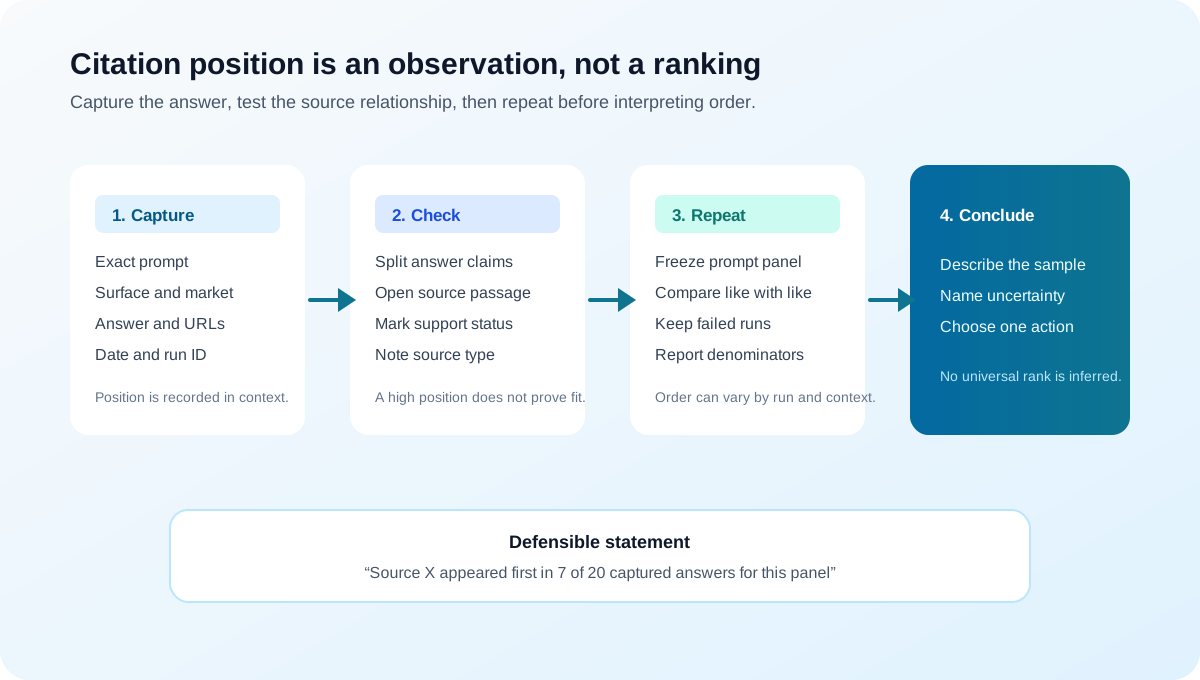
This guide addresses searches such as “does citation position matter in AI Search?”, “how do I track the first cited source?”, and “is the first AI citation the most authoritative?” The method is intentionally empirical: it describes the answer captures and source checks you actually performed rather than assuming that every AI surface uses the same ordering logic.
What citation position can and cannot tell you
A visible source may be listed first because of retrieval, answer composition, interface design, claim proximity, or another mechanism that the surface does not disclose. Without controlled access to the system, the cause of order is usually unknown.
| Observation | What it supports | What it does not prove |
|---|---|---|
| A URL appears first in one answer | It was the first visible URL in that capture | That it is universally preferred or most authoritative |
| A URL appears beside a product claim | The surface exposed a source near the claim | That the source supports every sentence in the answer |
| A domain is first in 7 of 20 runs | A first-position pattern in the named sample | A stable ranking across prompts, users, markets, or dates |
| A source moves from second to first | The displayed order changed | That the source became more trusted or influential |
| A page is crawled or indexed | A technical access event or index state was observed | That the page will be cited or placed first |
| First position and a business visit co-occur | The events were observed together if measurement permits | That position caused the visit, lead, or sale |
Google’s documentation on AI features and your website, checked October 13, 2026, says AI features may show links to supporting web resources and points site owners toward foundational Search practices. It does not publish a universal citation-order metric or promise that a page will be selected.
OpenAI’s web search documentation, checked October 13, 2026, documents citations and source fields for a particular API tool. That is useful product-specific documentation, not evidence that every ChatGPT experience or answer engine exposes the same ordering semantics.
The independent Generative Engine Optimization research paper by Aggarwal et al., checked October 13, 2026, provides research context for visibility in generative-engine responses. It does not validate a commercial tool’s current position score, explain a specific consumer interface, or establish a causal formula for citation order.
1. Define what “position” means
Do not mix different positions into one metric. Before collecting data, choose the unit you will count:
- Citation-card position: the order of visible source cards or links in the interface.
- Inline-marker position: the order of source markers attached to answer text.
- Claim-adjacent position: the rank of a source among URLs visibly associated with one claim.
- Answer-section position: the order of a source in a particular section, such as a comparison list.
- Mention position: where a brand or product appears in the prose, which is not the same as citation position.
Write the rule in the measurement record. If one surface shows a single source card and another shows inline markers, report them separately unless you have a documented normalization rule.
A minimal definition is:
Position 1 = the first visible source URL in the captured answer.
Exclude: sources hidden behind an interaction, unavailable URLs, and runs with no visible sources.
Preserve: full answer, source labels, prompt, surface, market, timestamp, and run ID.
If a UI reorders or truncates sources, record what was visible rather than inferring hidden order.
2. Freeze the prompt and collection context
Source order is easy to overinterpret when the underlying questions are changing. A comparison prompt, a product-fact prompt, and a broad category prompt may retrieve different source types for sensible reasons.
For each run, save:
- Exact prompt text and prompt-set version
- New conversation or prior-turn context
- Surface, mode, and model label when disclosed
- Country, language, and material location settings
- Collection date, time zone, and run number
- Full answer or an allowed near-raw capture
- Visible source URL, title, and displayed position
- The claim or answer section each source appears to support
- Failed, empty, login-gated, and unavailable states
A record can look like this:
Run: POS-014 / 03
Prompt: Which GEO monitoring tools fit a small agency that needs source URLs?
Surface: recorded AI Search surface; mode disclosed in capture
Market: United States / English
Collected: 2026-10-13 UTC
Visible sources: 5
Position 1: source URL A
Position 2: source URL B
Claim scope: comparison and workflow, not pricing
Status: qualifying capture
Do not silently remove runs where no citation appeared. Put them in a disclosed “no visible source” category so the denominator remains auditable.
For recurring collection, tools such as AI Search Console, Peec AI, Otterly.AI, PromptWatch, and Profound may expose different combinations of prompts, answers, citations, and derived metrics. Their position fields are not automatically interchangeable. During a trial, verify whether the export preserves the exact answer, source URL, timestamp, surface, market, and failed run.
3. Separate source order from source support
A position metric becomes more useful when it is paired with a claim check. A first-listed source can be relevant but still fail to support a specific product fact. A lower-listed source may contain the clearest passage for another claim.
Split the answer into claim units:
Answer: Tool A supports daily tracking, is suitable for agencies,
and costs $X per month.

Claim 1: daily tracking
Claim 2: agency fit
Claim 3: current price and billing basis
Then record the source relationship separately:
| Position | Claim | Source check | Status | Boundary |
|---|---|---|---|---|
| 1 | Tool A supports daily tracking | Relevant official documentation found | Supported for checked scope | Plan and date still matter |
| 1 | Tool A is suitable for agencies | No direct evidence in the same passage | Unverified judgment | Position does not prove audience fit |
| 3 | Current price is $X | Pricing page differs or is unavailable | Needs verification | Billing interval and region matter |
Use supported, partial, contradicted, or unverified for the passage check. “Supported” means the source passage supports the stated claim under the checked scope; it does not mean the source caused the answer or deserves first position.
For a deeper method, see AI Search Answer Claim Audit and AI Search Answer Provenance. Both distinguish a visible source relationship from proof of causation or universal authority.
4. Report position with denominators
For a fixed panel, keep the basic counts visible:
first-position rate for source X
= qualifying captures where X was position 1 ÷ qualifying captures with visible sources

any-citation rate for source X
= qualifying captures where X appeared ÷ qualifying captures

claim-support rate for source X
= checked claims supported by X ÷ claims checked against X
Name the denominator and exclusions. For example:
In 7 of 20 qualifying captures with at least one visible source, source X appeared first. It appeared anywhere in 11 of 24 total captures. We checked six claim relationships; four were supported for the stated scope, one was partial, and one was unavailable.
This is not a universal rank. It is a sample description with a separate source-support check.
Avoid collapsing these into one “citation quality” score. A single score hides whether the source was frequent, first, relevant, current, or actually supportive. If a vendor dashboard provides a position or visibility metric, record the vendor’s definition, sample, freshness, and whether raw answer evidence is available.
5. Compare like with like
Position comparisons are only meaningful when the conditions are sufficiently matched. Use cohorts rather than one blended total:
| Cohort | Keep constant where possible | Why it matters |
|---|---|---|
| Branded prompts | Brand wording, market, language, surface | Tests product identity and factual accuracy |
| Category prompts | User need, buyer constraints, prompt version | Tests discovery and comparison framing |
| Product-fact prompts | Exact feature, plan, and date scope | Tests whether current facts are retrievable |
| Regional prompts | Country, language, location settings | Source order may vary by market |
| Time retests | Prompt panel and collection procedure | Separates repeated pattern from one-off output |
Do not compare a US category panel with a UK branded panel and call the change a source-ranking movement. Do not merge answers from different modes when the interface exposes different retrieval or citation behavior.
The research context matters too. Academic or independent findings can help define a method, but they do not automatically describe a current vendor product or consumer surface. Likewise, a commercial comparison can identify workflow tradeoffs without being neutral evidence.
6. Investigate a position change without overclaiming
When a source moves up or down, work through the evidence chain before changing content:
- Did the exact prompt, surface, market, and mode remain comparable?
- Did the answer change, or only the visual ordering of the same URLs?
- Did the cited claim change with the source order?
- Did the source page, price, product edition, or publication date change?
- Did the answer include a new constraint or follow-up context?
- Was the sample large enough to describe a repeated pattern?
- Did the collection or parser change?
Possible diagnoses include prompt drift, answer volatility, source freshness, a claim mismatch, a changed interface, or an actual shift in the sampled source pattern. A content edit may be one hypothesis, not the default explanation.
If the source mix changes after a page release, report the sequence first. A before-and-after observation does not prove that the release caused the change. For controlled retests, see AI Search Regression Testing and AI Search Prompt Drift.
What to do with a position finding
A position observation should lead to a bounded action, not a race to become “number one.” Choose the action that matches the evidence:
- Unsupported product fact: correct or clarify the first-party documentation.
- Missing comparison context: add a sourced comparison section that answers the buyer’s stated criteria.
- Stale source: verify dates, availability, plan scope, and edition before updating the claim.
- Measurement mismatch: repair the prompt, cohort, or parser record before editing content.
- Repeated independent evidence gap: investigate whether a relevant third-party source or review context is missing; do not assume outreach will earn a citation.
- Noisy position movement: continue the fixed-panel observation rather than making a large change from one run.
The goal is not to manipulate an undisclosed ordering system. It is to make important facts easier to verify and to understand what your sample does and does not show.
What this audit can and cannot prove
| Finding | Reasonable interpretation | Boundary |
|---|---|---|
| A source is first in a fixed sample | It occupied first visible position under the recorded conditions | Not a universal ranking or authority score |
| A source is frequently first and supports checked facts | It was prominent and relevant in the sample | Not proof it caused selection or conversion |
| A source moves after a content edit | The observed output changed after the edit | Not causal proof without stronger design |
| A brand is cited near a recommendation | The surface exposed a source near that answer | Not proof of preference, trust, or purchase intent |
| Position correlates with visits | The two measures co-occurred if analytics captured them | Not proof position caused traffic or revenue |
| A monitoring tool reports position | The tool calculated a metric under its method | Not a standardized cross-tool score |
A practical monthly workflow
- Define position. Decide whether you are counting source cards, inline markers, or claim-adjacent URLs.
- Freeze the panel. Version exact prompts, surfaces, markets, languages, and modes.
- Capture the answer. Preserve visible URLs, order, claims, timestamps, and unavailable states.
- Check the sources. Open the relevant passage and classify support by claim.
- Segment the cohorts. Keep branded, category, product-fact, and regional prompts separate.
- Report denominators. Show first-position rate, any-citation rate, and source-support checks independently.
- Investigate changes. Check context, freshness, parser changes, and answer volatility before editing.
- Choose one bounded action. Improve a documented evidence gap or keep observing when the signal is weak.
FAQ
Is the first AI Search citation the most authoritative source?
Not necessarily. It is the first visible source in the recorded answer. Authority, relevance, claim support, freshness, and interface order are different properties. Check the source passage and report the exact sample rather than assigning a universal meaning to position.
Should I optimize my page to become the first citation?
Treat first position as an observation, not a guaranteed optimization target. Improve clear, current, supportable information for the user’s question. A position change after an edit is not proof that the edit caused the change or will produce traffic.
How many runs do I need?
There is no universal number that makes a result true. Start with a stable panel large enough to expose failed runs and variation, then report the actual denominator and context. A small exploratory sample can guide a hypothesis, but should not be presented as a market-wide ranking.
Can a GEO tool’s citation-position score be compared with another tool’s score?
Only after checking definitions, prompt panel, surfaces, sampling, parser rules, time window, and whether raw answer evidence is available. A score with a different denominator or position definition is not directly comparable. Compare the underlying captures where possible.
Does citation position predict clicks or revenue?
Not by itself. Position can be paired with detectable referral or business measurements, but co-occurrence is not causal attribution. Keep answer evidence, source evidence, access evidence, visits, and business outcomes as separate layers.
Sources and verification
- Google Search Central: AI features and your website — official guidance on AI features, supporting links, and foundational Search practices; checked October 13, 2026.
- OpenAI: Web search — official documentation for citations and sources in an OpenAI API web-search tool; checked October 13, 2026.
- Aggarwal et al., “GEO: Generative Engine Optimization” — independent academic research context for generative-engine visibility; checked October 13, 2026.
- AI Search Answer Claim Audit — AICiteKit methodology for testing what a citation supports.
- AI Search Answer Provenance — AICiteKit methodology for connecting claims, sources, and context.
- AI Search Regression Testing — AICiteKit methodology for comparing answer changes under fixed conditions.
Evidence confidence
Medium. The measurement framework is grounded in public official documentation and independent research context, but AI surfaces differ in their interfaces and do not generally publish a universal citation-order definition. Conclusions about position should remain sample-, surface-, and date-bound.
Last reviewed: October 13, 2026.