Field notes / ai-search
AI Search for Nonprofits: How to Audit Mission, Program, and Donation Answers
A practical AI Search and GEO audit for nonprofits: test mission accuracy, program recommendations, local intent, source quality, and donation information without treating visibility as impact.
The short answer
Nonprofits should treat AI Search as a trust and discoverability audit, not as a donation forecast. Test whether an AI answer correctly explains the organization, recommends the right program for a stated need, identifies the right location or eligibility conditions, and points to current first-party or independent evidence.
A useful audit chain is:
mission facts → evidence sources → real questions → answer review → bounded correction → retestDo not collapse these into one outcome:
mention ≠ recommendation ≠ citation ≠ referral ≠ donation impact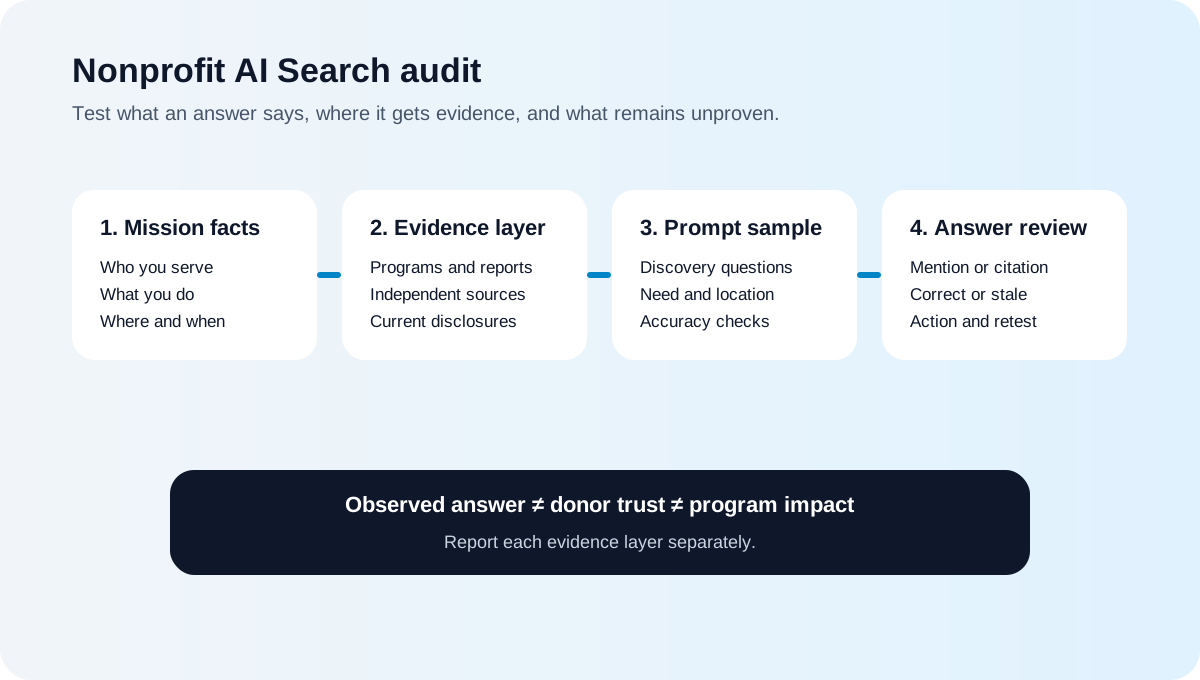
This guide is for nonprofit communications teams, fundraisers, program leaders, and agencies supporting mission-driven organizations. It complements How to Build a Reliable AI Search Prompt Set and How to Evaluate AI Search Source Quality.
Why nonprofit AI Search needs a different audit
A commercial buyer may ask which product to choose. A nonprofit audience may ask whether an organization is legitimate, who qualifies for help, where services are available, how donations are used, or what to do in an urgent situation. A wrong answer can therefore create more than a visibility problem: it can misdirect a person seeking support or misstate a charity’s work.
The public documentation checked for this article explains how major search and AI systems expose or retrieve information, but it does not establish that a particular nonprofit will receive more donations, recommendations, or citations after an optimization. Public nonprofit-specific evidence about AI recommendations is limited. Buyers should treat the audit as an evidence and accuracy workflow rather than a promised growth channel.
1. Define the audiences and decisions first
Start with decisions a real person might make. A balanced nonprofit panel should cover several of these groups:
| Audience or decision | Example question | Risk to check |
|---|---|---|
| Person seeking help | “Where can I find food assistance in [place]?” | Eligibility, location, opening hours |
| Volunteer | “How can I volunteer with [organization]?” | Current roles, age or screening requirements |
| Donor | “How can I donate to [organization] and what does it fund?” | Official destination, restricted funds, outdated claims |
| Partner or grantmaker | “What does [organization] do and whom does it serve?” | Mission, geography, program scope |
| Brand accuracy | “Is [organization] a nonprofit?” | Identity, legal name, similar organizations |
| Urgent or high-risk user | “Who helps with [need] today?” | Do not imply emergency or professional advice without verification |
The examples are a starting taxonomy, not a universal prompt count. Record the exact wording, country, language, location, platform, date, and any logged-in or personalized context.
2. Build a nonprofit prompt panel
Avoid a panel made only of branded questions. Branded prompts test whether an AI system recognizes the organization; they do not test whether people discover it while asking for help.
A practical starting set contains:
- Mission prompts: what the organization does, who it serves, and where;
- Need prompts: services for a problem, population, or life event;
- Local prompts: service availability in a city, region, or neighborhood;
- Program prompts: eligibility, application steps, schedule, and contact path;
- Donation prompts: how to give, recurring giving, restricted funds, and official channels;
- Volunteer prompts: roles, time commitments, screening, and current availability;
- Comparison prompts: how the organization differs from alternatives or public services;
- Accuracy prompts: legal identity, current programs, leadership, reports, and contact details.
For higher-risk services, ask a human program owner to approve the prompt wording and the scoring rules. An AI answer can be fluent while still being unsuitable for a person in a time-sensitive situation.
3. Create a claim and evidence register
Before reviewing answers, list the facts the organization wants to keep accurate. For each claim, record:
| Claim field | Example evidence to preserve |
|---|---|
| Mission and population | Current mission page and program description |
| Service geography | Location page, service map, or current directory entry |
| Eligibility | Official eligibility and application instructions |
| Contact path | Current phone, email, form, or referral route |
| Donation destination | Official donation page and campaign terms |
| Financial or program reporting | Current annual report or independently maintained profile |
| Date-sensitive information | Publication date, review owner, and next check date |
The source register should distinguish first-party facts from independent context. A vendor-selected case study or an organization’s own impact claim is not independent evidence. A directory, regulator, community partner, or reputable publisher may add useful context, but it can also become stale. Preserve the source URL, source type, claim supported, date checked, and confidence.
This is the same evidence boundary described in AI Search Answer Provenance: a citation shows that a source was presented or retrieved; it does not automatically validate every sentence in the answer.
4. Review answers at the claim level
For each captured answer, score the following separately rather than assigning an unexplained “AI visibility” number:
| Dimension | Review question |
|---|---|
| Identity | Is the correct organization being described? |
| Mission | Does the answer accurately state the purpose and audience? |
| Program | Are the named services real and current? |
| Geography | Does the answer distinguish service area from headquarters? |
| Eligibility | Are conditions and limitations stated without invention? |
| Action | Does the user receive a current, official next step? |
| Source | Are linked or named sources relevant and current? |
| Risk | Could the answer mislead someone seeking help or donating? |
Capture the complete answer where the platform allows it, plus cited URLs, prompt, platform or model, country, language, location, and timestamp. A dashboard that only shows a percentage or domain count cannot support a precise correction.
5. Audit the source mix, not just the number of citations
A nonprofit may appear in an answer because of its own website, a government directory, a local news article, a review or rating site, a community partner, a social profile, or a stale listing. These sources answer different questions.
Ask:
- Which source supported the mission claim?
- Which source supported the service or eligibility claim?
- Was the source first-party, independent, user-generated, or unknown?
- Was the page current when checked?
- Did the answer combine facts from different organizations?
- Was an official donation or application URL supplied?
AI Search Source Quality provides a reusable relevance, accuracy, freshness, and actionability framework. AI Search Source Portfolio explains why a nonprofit should not rely on one type of source for every claim.
A source gap is not automatically a content gap. If a local publisher or directory is outdated, rewriting the nonprofit’s own page may not correct the third-party record. The remediation owner may instead be communications, partnerships, directory administration, or legal/compliance.
6. Handle local and urgent questions conservatively
Local prompts vary by city, language, location settings, and time. A single answer cannot establish coverage across a service area. Test a fixed set of locations and label the result as an observation from that sample.
For urgent or high-risk questions:
- Put the official contact and eligibility path on a clearly maintained page;
- State service hours and geographic limits explicitly;
- Avoid claiming 24/7 support unless it is verified;
- Include an appropriate emergency or public-service route where relevant;
- Ask a qualified program owner to review the answer examples;
- Never treat an AI answer as a substitute for professional, legal, medical, or emergency advice.
The local AI Search audit has a broader location framework. Nonprofits should add a human safety review when the answer could affect access to essential services.
7. Correct the smallest evidence gap first
Use the answer review to choose a bounded action:
- Identity error: clarify the legal and public-facing names, related entities, and official domain.
- Mission error: make the audience, geography, and program scope explicit on first-party pages.
- Program error: update eligibility, schedule, intake, and contact information together.
- Donation error: make the official donation route and restricted-fund language easy to verify.
- Source gap: pursue accurate independent coverage or correct stale directory information.
- Access gap: inspect indexing, robots rules, redirects, and server logs; access does not prove citation.
- Sampling issue: keep monitoring before changing content when only one volatile answer changed.
Retest the same prompt cohort after a defined interval. Report what changed in the sampled answers, not what the organization hopes the change caused.
What tools can and cannot answer
Tools such as AI Search Console, Peec AI, Otterly.AI, PromptWatch, and Scrunch represent different approaches to monitoring prompts, answers, sources, and visibility. Their coverage, sampling, exports, and plan limits should be checked directly before purchase.
A tool can help you collect and compare observations. It cannot, by itself, prove:
- That every person asking for help saw the same answer;
- That a cited page was read or trusted;
- That a recommendation caused a donation or volunteer signup;
- That a changed page caused an answer change;
- That visibility represents the full local or national market;
- That a crawler request became a user-facing answer.
Google’s public AI features guidance says standard SEO fundamentals remain relevant and that appearing in AI features does not require special markup. OpenAI’s bot documentation distinguishes its crawler roles and user-agent behavior. Those documents support technical and source-access checks; they do not promise placement in answers.
A practical nonprofit audit template
Use this minimum record for each observation:
| Field | Required value |
|---|---|
| Prompt ID and exact wording | Versioned prompt text |
| Audience and intent | Donor, service seeker, volunteer, partner, or accuracy |
| Platform and model/surface | As exposed by the tool or platform |
| Country, language, and location | Include the test context |
| Date and run number | Timestamp and repeat count |
| Mention | Yes/no, with exact organization reference |
| Recommendation | Yes/no, and position or wording |
| Citation | URL, source type, and associated claim |
| Accuracy | Correct, incomplete, stale, or wrong |
| Action owner | Communications, program, partnerships, engineering, or other |
| Retest condition | What will be checked and when |
For reporting, separate four layers:
- Observed answers — what appeared in the captured sample;
- Evidence quality — whether the supporting sources were relevant and current;
- Operational action — what the organization changed or requested;
- Business or mission outcome — referrals, applications, donations, or service access measured elsewhere.
FAQ
Do nonprofits need a GEO tool?
Not necessarily. A small organization can begin with a versioned prompt spreadsheet, manual captures, a claim register, and human review. A monitoring tool becomes more useful when the organization needs recurring runs, multiple locations, many programs, or exportable evidence.
Should a nonprofit optimize for citations?
Citations can be useful when they point users to accurate, current evidence. They should not be the only goal. A citation to an outdated directory or a page with incorrect eligibility information may be a warning, not a success.
How many prompts should a nonprofit track?
There is no universal number. Start with a balanced, reviewable panel covering the organization’s most important audiences and risks. Keep the denominator stable before comparing periods, and expand only when the additional prompts support a defined decision.
Can AI Search visibility prove fundraising impact?
No. Visibility and citations are observations. Fundraising impact requires separate analytics and operational records, with a clearly defined attribution method and its limitations.
What should a nonprofit test during a tool trial?
Import the real prompt panel, inspect complete answers and cited URLs, compare two locations, export raw evidence, and verify whether the system preserves dates, models, and prompt versions. Ask who can review high-risk answers and how stale or incorrect observations are flagged.
Sources and verification
- Google Search: AI features and your website — checked September 28, 2026 for public guidance on AI features, standard SEO fundamentals, and the absence of a special required markup.
- Google Search Central: Creating helpful, reliable, people-first content — checked September 28, 2026 for guidance on useful, reliable, people-first content and self-assessment.
- OpenAI: Overview of OpenAI crawlers — checked September 28, 2026 for crawler roles and user-agent documentation.
- Pew Research Center: Google AI Overviews are more common for some searches than others — checked September 28, 2026 as independent context that AI feature appearance varies by query; it is not nonprofit-specific evidence and does not establish donation outcomes.
- AICiteKit: How to Build a Reliable AI Search Prompt Set — prompt taxonomy and panel design.
- AICiteKit: AI Search Source Quality — source evaluation and evidence boundaries.
- AICiteKit: Local AI Search Visibility — local prompt and location considerations.
Verification date: September 28, 2026. Platform behavior, documentation, and tool coverage can change; verify live sources and run a human review before relying on an answer for service access or fundraising decisions.