AI Search Source Diversity: How to Audit Citation Concentration Without Chasing a Score
A practical framework for auditing whether AI Search answers rely on a narrow source set, grouping citations by role, and choosing evidence-led actions without claiming a universal ranking.
The short answer
AI Search source diversity is a description of the sources observed in a defined answer sample. It is not a public ranking factor, a trust score, or a guarantee that adding more domains will create more citations.
A useful audit asks four questions:
- Which sources appeared across the same prompt panel?
- Were they first-party, independent, community, research, or unclear sources?
- Did a small number of domains supply most of the visible evidence?
- Does the pattern reveal a factual, coverage, freshness, or sampling issue worth investigating?
Use this workflow:
fixed prompt panel → answer capture → source grouping → concentration review → bounded action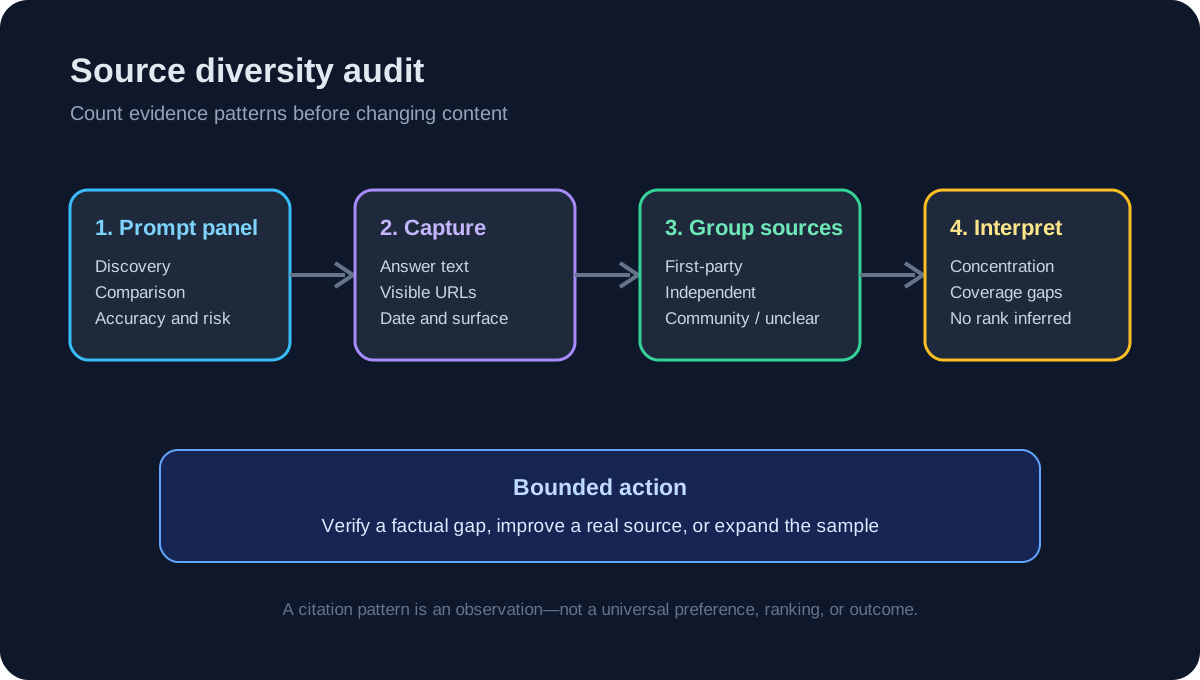
This guide addresses searches such as “why does AI Search cite the same websites?”, “how do I measure citation diversity?”, and “does AI Search prefer authoritative domains?” The evidence supports inspecting a defined sample. It does not support a universal formula for citation selection.
What source concentration can—and cannot—tell you
A narrow source set can have several explanations. The prompt may be narrow, the sample may be small, the answer engine may have selected sources for a particular subtopic, or one source may simply state the relevant fact clearly. Concentration is therefore a reason to inspect the evidence, not a diagnosis by itself.
| Observation | Defensible interpretation | Unsupported leap |
|---|---|---|
| One domain appears in 12 of 20 sampled answers | The domain was visible often in this prompt and date scope | The domain has a universal AI ranking advantage |
| A publisher supplies most comparison claims | The sampled answers relied on that publisher for comparison context | The publisher is objectively the most trusted source |
| First-party pages appear for product facts | The answers exposed those pages for the observed facts | First-party pages will be cited for every query |
| Sources differ between markets | The source pattern varied by the recorded market or language | One market explains all AI Search behavior |
| The source mix changes after an edit | The observed sample changed after the edit | The edit caused the change or increased revenue |
Google says its AI features can show links to supporting web resources and points site owners toward foundational Search practices (AI features and your website, checked September 15, 2026). That supports checking visible links and maintaining useful pages. It does not publish a universal source-diversity metric or guarantee that a particular page will be selected.
OpenAI documents web search and source citations as features available in its API tools (OpenAI web search guide, checked September 15, 2026). That is documentation for one implementation. It should not be generalized to every ChatGPT, search, or answer surface.
1. Define the decision before counting domains
A source count is only useful when it supports a decision. Choose one primary question:
- Are important product facts supported by current first-party documentation?
- Do category answers rely on one type of source while omitting relevant independent context?
- Are comparison claims coming from pages with a disclosed commercial relationship?
- Is a regional prompt producing a different source mix?
- Is the sample too small to interpret a concentration pattern?
Do not begin with “how do we increase source diversity?” More sources are not automatically better. A short answer may need one authoritative page for a narrow fact. A comparison answer may reasonably cite several independent sources. The correct source mix depends on the claim and user intent.
For a monitoring workflow, AI Search Console, Peec AI, Otterly.AI, PromptWatch, and Profound may expose different combinations of prompts, answers, citations, and derived metrics. Compare their raw evidence and definitions rather than treating a vendor’s “visibility” or “share of voice” number as a diversity measure.
2. Build a balanced prompt panel
Use prompt groups that represent the decisions people make. A branded-only panel can make first-party coverage look stronger than it is; a category-only panel can miss critical product-accuracy problems.
| Prompt group | Example | Source question |
|---|---|---|
| Category discovery | “Which tools help an agency monitor AI citations?” | Which source types frame the category? |
| Fit and use case | “What should a small SaaS team use for weekly AI Search reporting?” | Which sources explain audience and workflow? |
| Comparison | “Compare three GEO monitoring tools for raw answer exports.” | Which pages support tradeoffs and limits? |
| Product fact | “Does Tool A offer CSV export and what are its limits?” | Is the current first-party source visible and accurate? |
| Risk | “What should buyers verify before purchasing an AI visibility platform?” | Are caveats supported or repeated without evidence? |
| Regional | “Which AI Search tools support teams in the UK?” | Does the source mix change by market or language? |
Freeze the prompt text, intent group, surface, language, market, date, and model or mode when disclosed. Record follow-up turns separately from new conversations. A changing prompt panel is a sampling change, not evidence that source diversity improved or declined.
For the measurement foundation, see How to Build an AI Search Measurement Baseline Before You Optimize and How to Build a Reliable AI Search Prompt Set.
3. Capture answer-level source evidence
Save more than the domain name. For each run, preserve where permitted:
- Exact prompt and prompt-set version
- Full answer or a faithful permitted capture
- AI surface, mode, and model label when available
- Country, language, device or account context when material
- Collection date and time zone
- Visible source URLs and source labels
- The answer claim each source appears to support
- Mention, recommendation, citation, and unavailable states
A source appearing near a claim does not automatically prove that the page supports it. Open the URL, identify the relevant passage, check the publication or update date, and record whether the source actually covers the same product edition, market, and scope.
A minimal evidence row might look like this:
| Prompt ID | Claim in answer | Visible source | Source class | Support check |
|---|---|---|---|---|
| CAT-03 | Tool A supports weekly prompt monitoring | Exact URL captured | Official documentation | Confirmed for the checked plan |
| COMP-07 | Publisher recommends Tool B for agencies | Review URL captured | Independent or commercial review | Recommendation context requires review |
| FACT-02 | Tool C includes an API | URL captured | Unclear | Not verified until current docs are checked |
This is an editorial worksheet, not a claim about any vendor’s internal data model. If the platform exposes only a domain or source label, mark the missing URL and reduce confidence.
4. Group sources by role, not just domain
A domain list hides the difference between a pricing page, a review, a forum thread, and a research paper. Classify each source by role:
| Source class | Strongest use | Boundary |
|---|---|---|
| First-party documentation or pricing | Current features, limits, policies, setup | Vendor-controlled; not independent outcome proof |
| Independent editorial or comparison | Workflow observations and tradeoffs | May be dated, affiliate-supported, or commercially positioned |
| Community discussion | Questions, edge cases, lived experience | Anecdotes are not prevalence estimates |
| Research or standards source | Definitions, methods, research context | Does not automatically validate a commercial feature |
| Vendor-selected customer evidence | What the vendor reports about one selected case | Not independent causal proof |
| Unclear or inaccessible | A visible source whose role cannot be verified | Do not assign confidence by domain familiarity |
Use the label vendor-selected customer evidence for vendor case studies. Do not present them as independent evidence of traffic, revenue, rankings, citations, or recommendations.
The paper GEO: Generative Engine Optimization studies visibility in generative-engine responses (Aggarwal et al., arXiv, checked September 15, 2026). It supplies academic context for generative-engine visibility and evaluation; it does not establish a production source-diversity formula or validate a commercial dashboard.
5. Measure concentration descriptively
Start with raw counts. For each cohort, report:
- Number of valid answers reviewed
- Number of unavailable or excluded runs
- Unique domains and exact URLs observed
- Number of answers containing each domain
- Source class counts
- Claims supported, unsupported, or unverified
- Prompt groups, markets, surfaces, and dates
You may calculate a simple observed coverage rate:
domain coverage = answers containing the domain ÷ valid answers reviewedThis is a sample description. It is not market share, rank, authority, or probability of future citation.
A concentration table can make the boundary visible:
| Source group | Answers containing group | Share of valid answers | What to inspect next |
|---|---|---|---|
| First-party sources | Current facts, limits, scope | ||
| Independent sources | Methods, disclosure, freshness | ||
| Community sources | Context and recurring edge cases | ||
| Research / standards | Definition or methodological support | ||
| Unclear / unavailable | URL and claim verification |
Do not fill this table with a benchmark from another site. The numbers belong to the prompt panel you actually collected.
If a team wants a formal concentration statistic, document the unit and denominator before calculating it. A domain can appear multiple times in one answer, while another analysis counts only whether it appeared at least once. These are different measurements. Do not combine them silently.
6. Diagnose concentration before taking action
Use an evidence tree rather than assuming that a concentrated source set is a content gap.
Sampling explanation
The prompt panel may be small, branded, limited to one market, or dominated by one intent. Expand or rebalance the panel before editing pages.
Claim explanation
The answer may need one precise source for a narrow fact. Concentration can be appropriate when the source is current, relevant, accessible, and actually supports the claim.
Freshness explanation
A commonly cited page may contain stale pricing, limits, or availability. Compare the cited wording with current official documentation. Read AI Search Answer Freshness Audit for a claim-level workflow.
Coverage explanation
The answer may draw on independent comparisons because the first-party site does not explain alternatives, use cases, or tradeoffs. That is a source-coverage question, not a reason to imitate a competitor’s unsupported wording.
Access explanation
A useful page may be inaccessible under the tested conditions, poorly rendered, or difficult to parse. Access is a prerequisite for retrieval in some workflows; it is not proof that a page will be cited.
Product or platform explanation
Different surfaces may expose different sources, and platform behavior can change. Keep cohorts separate. Do not use one surface’s source pattern as a universal statement about AI Search.
Evidence snapshot
| Source | Public signal | What it supports | Confidence |
|---|---|---|---|
| Google Search Central: AI features and your website | Official guidance says AI features can show links to supporting web resources | Product-level context for visible links and foundational Search practices | High for the documented guidance; not a source-diversity formula |
| OpenAI Developer Docs: Web search | Official documentation for one API web-search implementation | Context for returned sources and citations in that implementation | High for the implementation; not universal |
| Aggarwal et al., GEO: Generative Engine Optimization | Independent academic paper | Research context for generative-engine visibility and evaluation | Medium; not validation of a vendor metric |
| Google: Creating helpful, reliable, people-first content | Official content-quality guidance | Editorial boundary against publishing content only to manipulate systems | High for the guidance |
| AICiteKit editorial framework | Prompt, capture, grouping, and review method in this article | A bounded way to describe source concentration | Editorial |
The public evidence supports inspecting answer-level sources and writing useful, verifiable pages. It does not establish that source diversity causes citations, rankings, traffic, or revenue. AICiteKit has not independently audited the internal retrieval systems or sampling methods of the AI surfaces or commercial tools named here.
A practical audit workflow
Step 1: State the cohort
Write the surface, mode, market, language, prompt version, date range, and valid-run rule. Separate branded, category, comparison, and regional cohorts.
Step 2: Capture the answer
Preserve answer context and visible source URLs. Do not infer hidden retrieval steps or reconstruct unavailable citations from a chart.
Step 3: Map claims to sources
For every material claim, record the source that appears to support it. Verify whether the page is current, relevant, accessible, and within scope.
Step 4: Group and count
Classify sources by role and report raw counts before percentages. Keep unavailable and unclear records visible.
Step 5: Diagnose one gap
Choose sampling, freshness, content, source, technical access, or product-fact review as the next investigation. Do not call a diagnosis proven when it is only a hypothesis.
Step 6: Make one bounded change
Correct a factual page, clarify a genuine buyer question, improve access, or expand the prompt panel. Avoid publishing pages solely to manufacture a desired source mix.
Step 7: Retest the same cohort
Use the same prompt version and report any model, market, date, or platform changes. A changed source mix is an observation about the retest, not proof of causation.
Who should use this method?
This audit is useful for SEO, content, product marketing, and agency teams that need to explain why an answer cites a narrow set of sources. It is especially useful when a dashboard shows a source or citation count but the team needs to inspect the claims underneath.
It is not a substitute for a representative study of all AI users, an internal retrieval trace that a platform does not expose, or a causal experiment linking a citation to revenue. It may be excessive for a single exploratory query; begin with a small, manually reviewed cohort when the decision is still unclear.
FAQ
Does AI Search prefer diverse sources?
There is no universal public rule that establishes this. A source mix depends on the prompt, surface, retrieval context, available pages, freshness, and other factors. Measure the sources observed in a defined cohort instead of promising that more domains will improve visibility.
Is citing the same domain many times a problem?
Not automatically. It may be appropriate for a narrow factual question. It becomes a useful investigation when the source is stale, irrelevant, commercially conflicted, inaccessible, or repeatedly used for claims it does not support.
Should I create more third-party content to increase source diversity?
Not by default. First identify whether the issue is a missing first-party fact, a weak comparison resource, a sampling limitation, or an unverified interpretation. Third-party content should be genuinely independent and useful, not manufactured to imitate a citation pattern.
Can source diversity be an AI Search ranking factor?
The sources reviewed here do not establish a universal ranking factor or score. A citation pattern can be measured in a sample, but it should not be presented as a hidden platform rule.
Can a source-diversity change prove more traffic or revenue?
No. Visibility, citations, referrals, and conversions are separate evidence layers. Analytics and attribution require their own definitions, and a before-and-after source change does not by itself prove causation.
Sources and verification
- Google Search Central: AI features and your website — official guidance on AI-feature links and foundational Search practices; checked September 15, 2026.
- OpenAI Developer Docs: Web search — official documentation for one web-search and citation implementation; checked September 15, 2026.
- Google Search Central: Creating helpful, reliable, people-first content — official content-quality guidance; checked September 15, 2026.
- Aggarwal et al., GEO: Generative Engine Optimization — independent academic research context; checked September 15, 2026.
- AICiteKit: How to Evaluate AI Search Source Quality — related source-review framework.
- AICiteKit: AI Search Source Portfolio — related evidence planning framework.
Last reviewed: September 15, 2026
This is AICiteKit editorial guidance. It does not guarantee visibility, citations, rankings, traffic, or revenue.