Field notes / ai-search
AI Search Buyer Journey Measurement: How to Connect Discovery, Evaluation, and Action
A practical framework for measuring AI Search across the buyer journey, separating discovery mentions from recommendations, citations, referrals, and downstream business evidence.
The short answer
AI Search measurement is more useful when it follows a buyer decision instead of compressing every observation into one visibility score. A discovery prompt, a comparison prompt, a product-fact question, a citation, a referral, and a conversion are different events with different evidence requirements.
Use this chain:
buyer question → journey stage → fixed prompt cohort → answer evidence → site behavior → bounded business decisionA brand can be mentioned during discovery without being recommended. A recommendation can cite an independent review rather than the brand’s site. A citation can appear without a measurable click. A visit can occur without proving that a particular answer caused it. The measurement should preserve those boundaries.
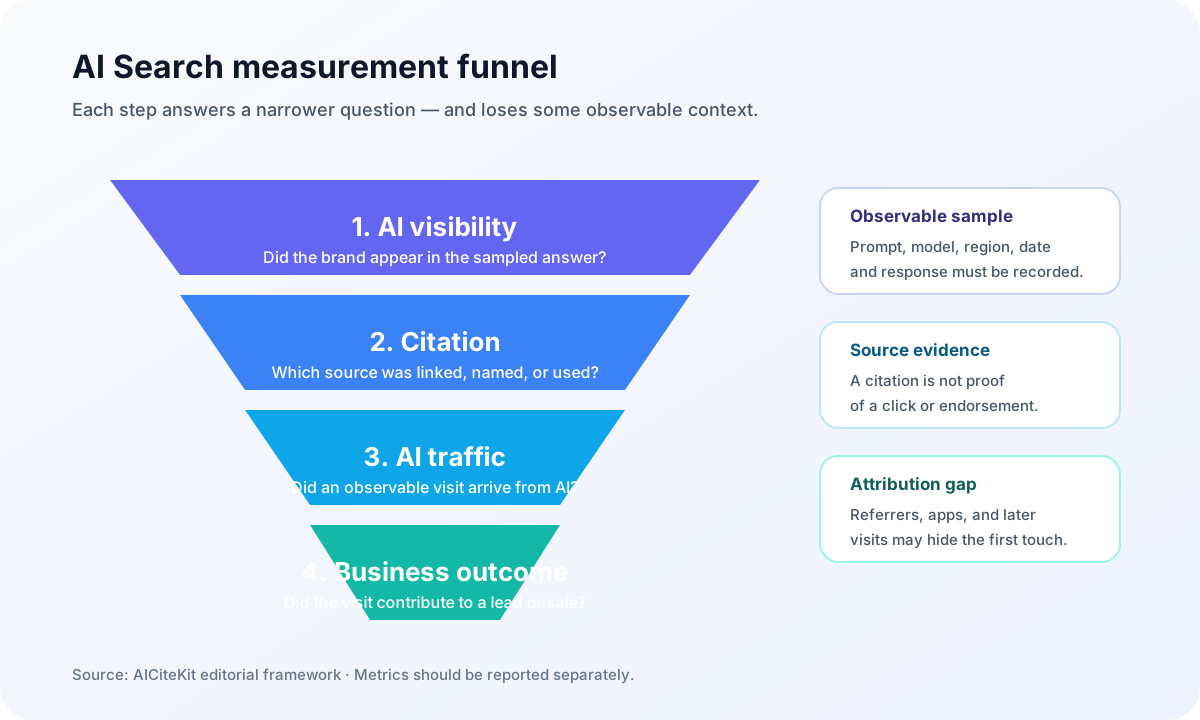
This guide addresses searches such as “how do I measure AI search across the funnel?”, “how do I track AI recommendations to conversions?”, and “what is the difference between AI visibility and AI traffic?” It complements AI Visibility vs AI Citations vs AI Traffic, AI Search Mentions vs Recommendations, and How Agencies Should Report AI Visibility to Clients.
Why one AI visibility number hides the buyer journey
The phrase “AI visibility” can describe several different observations. Define the unit before choosing a dashboard or reporting cadence.
| Journey stage | Example question | Useful observation | It does not prove |
|---|---|---|---|
| Discovery | “What tools solve this problem?” | Brand mention and category context | That the buyer prefers the brand |
| Evaluation | “Which option fits a small agency?” | Recommendation, criteria, and cited support | That the recommendation is correct or universal |
| Verification | “Does this product support the integration?” | Claim, source passage, and scope | That the product will work in the buyer’s environment |
| Visit | “Where can I learn more?” | Measured referral or landing-page session | That the answer caused every subsequent action |
| Commercial action | “Which product should we buy?” | Qualified lead or conversion with attribution evidence | Incremental revenue without a controlled design |
Google says its AI features may show links to supporting web resources and recommends foundational Search practices, while also noting that appearance in an AI feature is not guaranteed (Google Search Central: AI features and your website, checked October 9, 2026). OpenAI documents citations and source information for its web-search tool (OpenAI Developer Docs: Web search, checked October 9, 2026). These sources document specific product contexts; neither publishes a universal funnel metric or causal attribution method for all AI Search surfaces.
The independent paper GEO: Generative Engine Optimization evaluates visibility in a defined experimental setting (Aggarwal et al., arXiv, checked October 9, 2026). It is useful research context, not proof of a current commercial platform’s ranking, traffic, or revenue effect.
1. Start with the buyer decision, not the tool’s metric
Write the decision the measurement must support. Examples include:
- Should we clarify a product fact that AI answers state incorrectly?
- Are category buyers discovering our brand for an unbranded problem?
- Do comparison answers apply the criteria our sales team hears from buyers?
- Are cited sources sending identifiable visits to the site?
- Is a content or product-page change worth testing further?
A tool can collect prompts faster than a spreadsheet, but collection volume is not the same as decision quality. Products such as AI Search Console, Peec AI, Otterly.AI, PromptWatch, Profound, and Rankscale may expose different combinations of answers, sources, prompts, platforms, or reports. Compare the evidence they preserve, not just the headline score.
2. Map prompts to journey stages
Build a prompt inventory from actual customer language before generating variants. Useful inputs include sales calls, support questions, site search, product documentation gaps, review-platform questions, and competitor comparisons. Label the source and collection date; one sales conversation is a useful candidate, not proof of population-wide demand.
| Cohort | Prompt pattern | Primary output |
|---|---|---|
| Problem discovery | “How do teams solve [problem]?” | Mentions, categories, source types |
| Category shortlist | “What tools help with [job]?” | Brands, criteria, citations |
| Comparison | “Compare [A] and [B] for [audience]” | Criteria, recommendation, support |
| Constraint fit | “Which option works with [budget, region, integration]?” | Qualification and exclusion reasons |
| Product fact | “Does [product] support [feature]?” | Claim-level accuracy and source |
| Post-visit | “Where can I verify [fact]?” | Source path and measurable visit |
Keep branded and unbranded prompts separate. A branded accuracy prompt tests whether the system can describe the entity; an unbranded category prompt tests discovery. Combining them into one average can make a weak discovery result look healthy.
3. Define the evidence contract for each stage
For every cohort, document the minimum evidence required before reporting a result.
| Stage | Minimum record | Safe report |
|---|---|---|
| Discovery | Exact prompt, run, mention, and answer context | “Mentioned in 8 of 20 recorded runs” |
| Evaluation | Criteria, recommendation wording, and visible sources | “Recommended in this panel under these constraints” |
| Verification | Exact claim, cited passage, product version, and date | “The source supports this scoped fact” |
| Visit | Referrer or campaign signal, landing page, timestamp | “A measurable session was attributed to this source” |
| Action | Defined conversion, attribution window, and denominator | “These conversions were observed under this attribution rule” |
Do not promote a lower-evidence observation into a higher-evidence claim. A citation is not a visit. A visit is not a conversion. A conversion is not incremental lift.
NIST’s AI Risk Management Framework, checked October 9, 2026, is broader than GEO, but its emphasis on measuring, documenting, and managing uncertainty is a useful independent governance context. It does not validate any particular AI Search metric.
4. Capture answers and sources before aggregating
A defensible run record should preserve:
- Prompt ID and exact wording
- Journey cohort and panel version
- Surface, mode, market, language, and timestamp
- Model or version when disclosed
- Full answer or permitted near-raw export
- Mentioned and recommended brands as separate fields
- Every visible URL and the claim it appears to support
- Failed, unavailable, or partial runs
- Follow-up questions and conversation state
If a field is not exposed, record not disclosed. Do not infer hidden retrieval steps from a citation, server request, or dashboard label.
A simple evidence ledger can use one row per answer:
| Run | Stage | Observation | Source evidence | Next check |
|---|---|---|---|---|
| 01 | Discovery | Brand mentioned, not recommended | Two independent URLs visible | Review category framing |
| 02 | Evaluation | Brand recommended for stated audience | Recommendation cites comparison page | Check criteria passage |
| 03 | Verification | Integration limit misstated | No supporting first-party URL | Audit current documentation |
| 04 | Visit | Referral recorded | Analytics session with source metadata | Validate attribution rule |
This structure avoids treating a generated summary as the source record. For source-to-claim review, see AI Search Answer Provenance.
5. Report rates with their denominators
Use descriptive measures whose scope is visible:
mention rate = runs with a target mention ÷ qualifying runs
recommendation rate = runs with a target recommendation ÷ qualifying runs
citation rate = runs with the target URL visible ÷ qualifying runs
supported-claim rate = reviewed claims supported by the cited passage ÷ reviewed claims
referral rate = measured AI-attributed sessions ÷ sessions under the declared attribution rule
For each rate, disclose the prompt cohort, surface, market, date range, run count, unavailable runs, and definition of “qualifying.” Do not call a panel rate market share or a universal probability.
A report might say:
In 12 of 30 qualifying US-English captures of the fixed evaluation panel collected October 9, 2026, the brand was recommended under the stated small-agency constraint. The result describes this panel and collection method; it does not estimate all AI Search recommendations or prove a business outcome.
If analytics show 14 attributed sessions, report the attribution method and landing pages. Do not state that the AI answer caused all 14 sessions unless the data and design support that claim.
6. Connect the answer layer to site behavior carefully
The handoff from answer evidence to analytics is where many reports overreach. Use separate joins:
- Answer to URL: Was the URL visibly cited, and which claim did it support?
- URL to visit: Did analytics or tagged links record a visit that can be attributed to the source?
- Visit to action: Did a defined session or user complete the selected action?
- Action to incrementality: Is there a valid comparison that estimates what would have happened without the exposure?
Server logs can show automated requests, but a crawler request is not proof that a user saw an answer. Similarly, an AI referral may be undercounted, redirected, or grouped differently by analytics systems. AI Crawler Analytics covers the access-versus-answer boundary.
7. Diagnose the stage before changing content
Different observations call for different actions:
| Finding | First action | Do not claim |
|---|---|---|
| Mentioned but not recommended | Review criteria, audience fit, and source context | That adding keywords guarantees recommendation |
| Recommended but factually wrong | Correct the scoped first-party fact and retest | That the correction guarantees visibility |
| Cited but unsupported | Inspect the passage and revise the claim or source | That citation equals endorsement |
| Cited but no measurable referral | Check link presentation, analytics, and attribution limits | That no visit means no influence |
| Referrals but no conversions | Review landing page and conversion definition | That AI traffic is unqualified by default |
| Conversions after a content change | Preserve the baseline and comparison rule | That the change caused incremental revenue |
A content edit should answer a real information gap. Google’s people-first content guidance, checked October 9, 2026, supports creating useful, reliable content for people rather than content primarily designed to manipulate ranking systems. That guidance does not promise citation or conversion gains.
A practical monthly workflow
- Choose one business decision and one primary journey stage.
- Build a versioned prompt cohort from real customer questions.
- Freeze wording, market, surface, and collection conditions.
- Capture answer text, recommendations, citations, and unavailable states.
- Review the exact claim-to-source relationship.
- Join only the answer fields that analytics can independently support.
- Select one bounded content, product, or measurement action.
- Retest the same panel and report changes with denominators.
- Keep discovery, evaluation, verification, referral, and conversion results separate.
Common reporting mistakes
“We were mentioned, so AI recommends us.”
Mention and recommendation are different fields. Preserve the answer wording and criteria before classifying the event.
“Our page was cited, so it drove the lead.”
A citation establishes visible source evidence in a captured answer. It does not establish a click, a visit, or causality.
“AI traffic converted better, so AI Search is the best channel.”
Check sample size, attribution, landing pages, selection effects, and a comparable baseline. A small attributed cohort can be useful operationally without proving channel-wide superiority.
“A single score measures the funnel.”
A score may be convenient for monitoring, but its components and denominator must be disclosed. A blended number can hide strong product-fact accuracy alongside weak category discovery.
FAQ
What should I measure first in AI Search?
Start with the decision that matters most. For a product team, that may be factual accuracy. For a category marketer, it may be unbranded discovery and comparison. For an agency, it may be repeatable answer evidence and client reporting. Do not begin with the largest prompt allowance.
Can AI Search visibility be connected to conversions?
Sometimes a referral or campaign can be measured, but the connection is usually weaker than the answer observation itself. Preserve the answer, source, referral, conversion, attribution rule, and denominator as separate records. Conversion impact requires stronger evidence than visibility.
How many prompts do I need for a buyer-journey report?
There is no universal number. Use enough prompts to cover the decisions and cohorts you intend to report, keep a stable core panel, and disclose the sample. How Many AI Search Prompts Should You Track? explains the coverage approach.
Should discovery and comparison prompts share one score?
Usually not. They answer different questions and often have different denominators. Report them separately first; combine only when the weighting and interpretation are explicit.
Which tools can support this workflow?
Monitoring products can reduce collection and reporting work, but capabilities vary. During a trial, verify whether the tool preserves exact prompts, answer text, URLs, claim context, market, model disclosure, timestamps, failed runs, exports, and credit rules. A dashboard metric is not automatically comparable with another vendor’s metric.
Sources and verification
- Google Search Central: AI features and your website — checked October 9, 2026; official context for AI-feature links, foundational Search practices, and the absence of an appearance guarantee.
- OpenAI Developer Docs: Web search — checked October 9, 2026; official documentation for a web-search tool’s source and citation information.
- Google Search Central: Creating helpful, reliable, people-first content — checked October 9, 2026; official editorial guidance and evidence boundary.
- NIST AI Risk Management Framework — checked October 9, 2026; independent public-sector framework used only for measurement and uncertainty documentation context.
- Aggarwal et al., “GEO: Generative Engine Optimization” — checked October 9, 2026; independent academic research context, not a current platform benchmark.
- AI Visibility vs AI Citations vs AI Traffic — internal companion for separating evidence layers.
- AI Search Answer Provenance — internal companion for claim-to-source review.
The evidence boundary is deliberate: official sources support documented product guidance; independent research and public frameworks provide context; captured answers and analytics support only the conditions actually recorded. No source cited here proves a universal AI Search funnel, guaranteed citation, ranking improvement, traffic increase, or revenue outcome.