Field notes / ai-search
AI Search Citation Log Template: What to Record Before You Compare Results
A practical AI Search citation log template for recording prompts, answer evidence, source URLs, claim support, and uncertainty without turning a small sample into a ranking claim.
The short answer
An AI Search citation log is a structured record of what an answer showed under defined conditions. It should preserve the prompt, surface, market, date, answer text, visible sources, claim relationship, and uncertainty. It is not a universal ranking report and it does not prove that a citation caused a visit, lead, or sale.
Use this sequence:
real question → versioned prompt → answer capture → source and claim check → repeatable comparisonA useful entry can say:
In 6 of 18 qualifying US-English captures for prompt set P-04, the brand’s documentation appeared as a visible source for the plan-limit claim. Two captures had no comparable source field; the sample does not establish a universal citation rate.
That is more defensible than “the brand has a 33% AI citation ranking.”
This guide addresses searches such as “how do I track AI citations?”, “what should an AI Search monitoring report include?”, and “how can I prove a source was cited?” The method is designed for teams that need an auditable observation rather than a decorative visibility score.
Why a citation log matters
AI answer surfaces can expose links, source cards, or inline markers, but they do not necessarily expose the same fields or selection process. Google says its AI features may show links to supporting web resources and points site owners toward foundational Search practices (Google Search Central: AI features and your website, checked October 14, 2026). OpenAI documents citations and source fields for a particular web-search tool (OpenAI Developer Docs: Web search, checked October 14, 2026).
Those documents provide platform-specific context. They do not create one shared citation definition across every product, mode, model, location, or user session.
A log prevents common category errors:
| Logged observation | What it supports | What it does not prove |
|---|---|---|
| A URL appeared in a captured answer | The URL was visible under recorded conditions | That it was the only source used internally |
| A source appeared beside a claim | The interface associated the source with that claim | That it supports every sentence in the answer |
| A brand was mentioned | The answer contained a brand mention | That the brand was recommended |
| A competitor was recommended | A recommendation was observed in the capture | That the recommendation caused a purchase |
| A source appeared in 8 of 20 runs | A pattern in the named sample | A stable market-wide citation rate |
| A crawler requested a page | Access occurred in the observed logs | That the page was cited to a user |
The independent paper GEO: Generative Engine Optimization studies visibility in a defined experimental setting (Aggarwal et al., arXiv, checked October 14, 2026). It is useful research context, not proof of a current production interface, a vendor dashboard metric, or a business outcome.
1. Start with a real search decision
Do not begin with “track everything.” Begin with a decision a buyer, customer, or stakeholder actually needs to make. Examples include:
- Which product is suitable for a small agency with source exports?
- What are the current limits of the plan we are considering?
- Which local providers serve a named area?
- What alternatives are mentioned when a user rejects the category leader?
- Which documentation page should support a technical implementation answer?
A prompt should represent that decision without embedding the expected answer. Record the original question, its intent, and the reason it matters.
| Prompt field | Example | Why preserve it |
|---|---|---|
| Prompt ID | COMP-07 v2 | Lets a later run use the same definition |
| Exact wording | Which GEO tools show source URLs for agency reporting? | Small wording changes can change the answer |
| Intent | Commercial comparison | Separates comparison from product-fact prompts |
| Buyer constraint | Small agency, source URLs required | Makes fit criteria explicit |
| Expected evidence | Named products, capabilities, source links | Defines what the reviewer will inspect |
| Owner and date | Research team, 2026-10-14 | Establishes provenance |
A real-question panel can include branded, category, product-fact, alternative, local, and problem-solving prompts. Keep those cohorts separate. A broad category question should not be blended with a price question and presented as one “visibility” measure.
For prompt design, see AI Search Prompt Mapping and How Many AI Search Prompts Should You Track?. They support different planning decisions; neither makes a small prompt set representative of every user.
2. Freeze the collection context
The same text can produce different answers when the context changes. For every run, record as much of the following as the surface exposes:
- Surface and product name
- Mode, model label, or search setting when disclosed
- Country, language, currency, and location context
- New conversation or prior-turn context
- Exact prompt and prompt-set version
- Collection timestamp and time zone
- Run number and retry status
- Logged-in or anonymous state when material
- Whether the answer was complete, partial, empty, or unavailable
If a field is not exposed, write not exposed or unavailable. Do not invent a hidden retrieval query, model version, personalization state, or reason for source selection.
A minimum run record might look like this:
Run ID: COMP-07-v2 / 04
Prompt: Which GEO tools show source URLs for agency reporting?
Surface: named AI Search surface; mode recorded if disclosed
Market: United States / English
Context: new conversation
Collected: 2026-10-14 UTC
Answer status: qualifying capture
Visible source fields: yes
Notes: recommendation and source list were displayed separately
When comparing dates, preserve failed and no-source runs. Removing them makes the denominator look cleaner while making the evidence less representative of the collection process.
3. Capture the answer before summarizing it
A summary is an interpretation. Capture the answer first, subject to the platform’s terms and any applicable privacy rules. Preserve:
- The exact prompt.
- The answer text or an allowed export.
- Visible product and brand mentions.
- Recommendations and their stated criteria.
- Every visible source title and direct URL.
- The source’s displayed position or section.
- The sentence, claim, or section the source appears to support.
- Collection metadata and unavailable states.
Do not log only “cited: yes.” That loses the distinction between a source that supports a current price, a source that merely appears in a reference list, and a URL that is visible but unrelated to the claim.
A practical answer table is:
| Field | Example value |
|---|---|
| Answer ID | COMP-07-v2 / 04 |
| Mentioned brand | Brand A |
| Recommendation | Recommended for agency reporting |
| Citation visible | Yes |
| Source URL | Direct URL captured from the interface |
| Source location | Beside the export-capability claim |
| Claim status | Partial: capability supported, agency fit not established |
| Source type | Official documentation |
| Confidence | Medium |
AI Search Answer Provenance provides a deeper claim-to-source workflow. AI Search Citation Attribution Audit covers how to avoid assigning one source credit for an entire multi-source answer.
4. Separate mentions, recommendations, and citations
These are related but different fields:
- Mention: the brand or product appears in the answer.
- Recommendation: the answer selects, ranks, or suggests the brand for a stated need.
- Citation: a source URL is visibly associated with answer text or a source list.
- Claim support: the source passage supports the specific claim being recorded.
One answer can mention a product without recommending it, recommend it without linking its official page, or cite a page that supports one fact but not the recommendation. Keep the fields separate.
| Observation | Safe label | Do not collapse it into |
|---|---|---|
| Product name in a comparison list | Mention | Recommendation |
| “Best for agencies” wording | Recommendation | Independent customer proof |
| Official pricing URL beside a plan fact | Citation | Proof of current pricing everywhere |
| Review page linked near a usability statement | Citation with source type | Proof that all users agree |
| Source passage matches the claim | Supported for checked scope | Proof of causation or superiority |
A rating or review count, when available, is evidence about a public feedback signal. It is not evidence of traffic growth, revenue growth, guaranteed citations, guaranteed rankings, or guaranteed recommendations.
5. Check the source at claim level
Read the passage that the interface exposes or that the linked page provides. Grade the relationship, not just the domain name.
| Claim check | Question | Useful result |
|---|---|---|
| Relevance | Is this the same product, feature, and buyer question? | Direct, partial, unrelated |
| Accuracy | Does the source support the wording used? | Supported, contradicted, unverified |
| Scope | Does it match plan, edition, market, and date? | Matched, narrower, broader, mismatched |
| Freshness | Is the fact current for the recorded purpose? | Current, stale, undated, unknown |
| Source type | Is it first-party, independent, commercial, or user-generated? | Explicit attribution |
| Completeness | Does it support the whole claim or only one clause? | Full, partial, insufficient |
For example, an official page may support “the product documents scheduled exports.” It does not automatically support “scheduled exports are reliable,” “the product is best for agencies,” or “exports increase retention.” An independent review may support a workflow observation while being too old to verify a current limit.
Use the labels supported, partial, contradicted, unverified, and unavailable. “Supported” means supported for the checked scope; it is not a universal endorsement of the source or the answer.
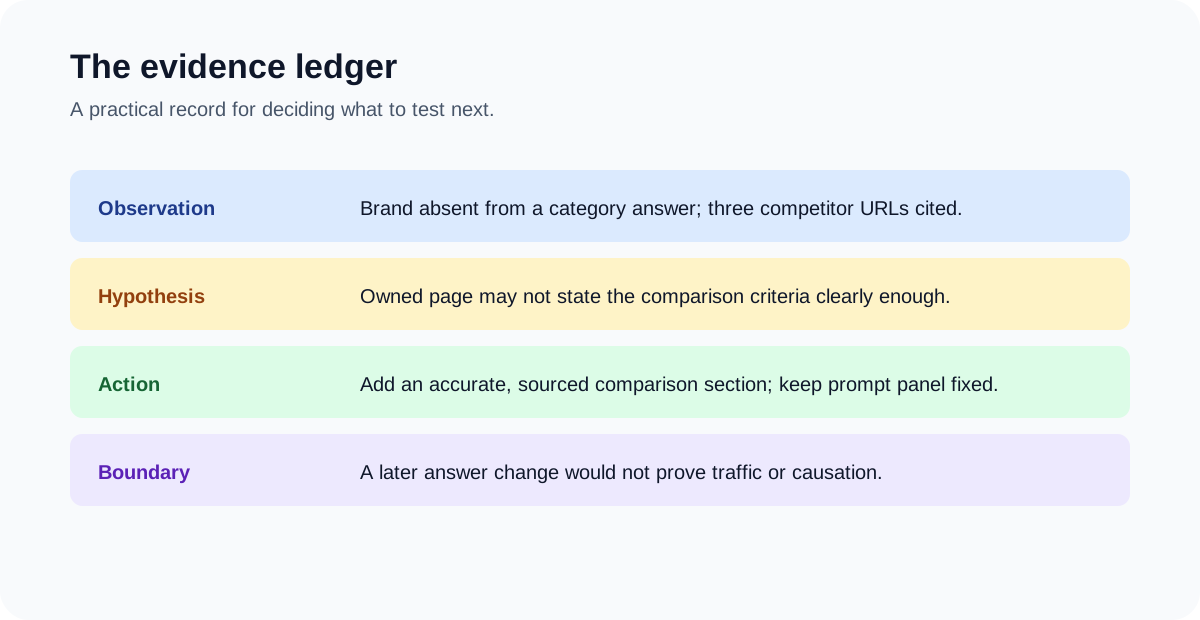
6. Use an evidence ledger
A ledger joins the run, answer, source, and claim without pretending they are one metric.
| Run | Claim | Visible source | Source type | Support | Boundary |
|---|---|---|---|---|---|
| COMP-07 / 04 | Shows source URLs | Official docs | First-party | Supported for documented workflow | Plan and access conditions need checking |
| COMP-07 / 04 | Best for agencies | Product page | First-party | Unverified | Marketing positioning is not independent evidence |
| COMP-07 / 04 | Easy to export | Independent review | Commercial/independent context | Partial | Review date and product edition matter |
| COMP-07 / 05 | Current price | Pricing page | First-party | Needs date and currency check | Price may vary by plan or billing interval |
Record the source URL directly in the working file or database. A source list at the bottom of a report is not enough if a reader cannot tell which URL supports which observation.
If a source is vendor-selected customer evidence, label it exactly that way. A named case study can support the narrow statement that the vendor reports a named customer experience. It is not independent proof of a general result.
7. Calculate only defined measures
Once the raw records are stable, calculate simple rates with visible denominators. For a fixed panel:
citation visibility rate
= qualifying runs where the target source appeared ÷ qualifying runs with comparable source fields

mention rate
= runs containing the target brand ÷ all qualifying runs

claim-support rate
= checked claim relationships marked supported ÷ claim relationships reviewed
Do not silently use different denominators. A run with no visible source field is not necessarily a negative citation observation; it may be an unavailable measurement. Report it separately.
A bounded report might say:
The target source appeared in 9 of 22 qualifying captures with a comparable source field. The brand was mentioned in 14 of 25 total captures. We reviewed 12 claim relationships: 7 supported for the stated scope, 3 partial, and 2 unavailable. The sample does not estimate all users or explain source selection.
Avoid a single composite “AI visibility score” unless its components, weights, exclusions, and time window are disclosed. Even then, treat it as a reporting construct, not a standardized ranking.
8. Compare tools by raw evidence, not labels
Tools such as AI Search Console, Peec AI, Otterly.AI, PromptWatch, and Profound may support different monitoring workflows. Their labels and metrics are not automatically interchangeable.
Before comparing products, verify whether each preserves:
- Exact prompt text and version
- Full answer or an auditable excerpt
- Direct source URLs and displayed source position
- Market, language, surface, and model context
- Mention, recommendation, and citation as separate fields
- Failed, empty, and unavailable runs
- Claim-to-source notes or raw evidence export
- Sampling, refresh, credit, retention, and recalculation rules
A tool can reduce collection work without proving that its score measures the same thing as another tool’s score. During a trial, export the underlying records and recreate one rate manually.
For a broader buying workflow, see How to Evaluate an AI Search Visibility Tool Before You Buy. The key test is not whether a dashboard looks precise; it is whether a reviewer can inspect what produced the number.
What a citation log can and cannot prove
| Finding | Reasonable interpretation | Boundary |
|---|---|---|
| A URL appeared in one answer | It was visible in that capture | Not a stable ranking or preference |
| A URL appeared repeatedly in a fixed panel | A repeated sample pattern | Not a universal market share |
| A source supported one claim | The checked passage supported that claim | Not support for the whole answer |
| A page was crawled | Access occurred | Not a user-facing citation |
| Citations increased after an edit | A before-and-after association | Not causal proof without stronger design |
| A cited source was followed by a visit | The events co-occurred if measured | Not proof the citation caused the visit |
| A dashboard score changed | Its calculation changed under its method | Not evidence that the underlying surface changed identically |
Google’s people-first guidance says content should be created to help people rather than primarily to manipulate search rankings (Creating helpful, reliable, people-first content, checked October 14, 2026). A citation log supports accuracy and reviewability; it is not a mechanism for guaranteeing selection.
A weekly citation-log workflow
- Choose one real buyer or customer decision.
- Version the prompt and record its intent.
- Freeze market, language, surface, mode, and collection rules.
- Capture the answer before writing a summary.
- Record every visible source and the claim it appears to support.
- Classify source type and claim support separately.
- Keep no-source and failed runs visible.
- Calculate only rates with explicit denominators.
- Compare matched cohorts, not blended totals.
- Retest after a documented change and report uncertainty.
The useful output is an auditable evidence trail: what was asked, what was shown, which source was visible, what passage supported the claim, and what remains unknown.
Evidence snapshot
| Source | Public signal | What it supports | Confidence |
|---|---|---|---|
| Google Search Central: AI features and your website | Official guidance on AI features and supporting web resources | Platform context and the absence of a universal appearance guarantee | High |
| OpenAI Developer Docs: Web search | Official documentation for one web-search tool | Citations and source fields in that documented API context | High |
| Google: People-first content | Official content guidance | Editorial standard for useful, accurate, non-manipulative updates | High |
| GEO: Generative Engine Optimization | Independent academic research | Research context for generative-engine visibility evaluation | Medium; not proof of a vendor metric or causal outcome |
| AICiteKit editorial framework | Citation log, evidence ledger, and bounded-rate method in this article | Practical reporting workflow | Editorial |
Practical citation log template
Copy and adapt this structure for a spreadsheet or database:
Run ID:
Prompt ID and version:
Exact prompt:
Intent and buyer decision:
Surface / mode / model label:
Market / language / currency:
Conversation context:
Collected at (UTC):
Answer status: qualifying / partial / empty / unavailable
Full answer or permitted capture:
Brand or product mentioned:
Recommendation observed:
Citation visible: yes / no / not exposed
Source title:
Source URL:
Displayed source position or section:
Claim associated with source:
Source type: first-party / independent / commercial / user-generated / vendor-selected
Claim support: supported / partial / contradicted / unverified / unavailable
Scope and freshness notes:
Reviewer:
Follow-up action:
FAQ
Is a brand mention the same as an AI citation?
No. A mention is text in the answer. A citation is a visible source relationship. Log both fields because a product can be mentioned without its page being linked, or linked without being recommended.
How many runs should a citation study include?
There is no universal number that makes a result representative. Start with a defined panel large enough to expose failed runs and variation, preserve the denominator, and expand it when the decision is high risk. Report the actual sample rather than using a threshold as a guarantee.
Should I count a source that appears in a collapsed panel?
Define the rule before collecting. If the source was not visible in the ordinary capture, record it as hidden or unavailable rather than silently treating it as equivalent to a visible citation. Repeat the rule consistently.
Can a citation prove that a page caused an AI answer?
Usually not. A visible link shows an answer-level relationship under the recorded conditions. It does not reveal the complete internal retrieval or composition process. Keep source observation separate from causal attribution.
Can citation logs prove traffic or revenue impact?
No. Pair answer records with separately defined referral, lead, and business data if the privacy and measurement setup permits, but do not treat co-occurrence as causation. A citation, visit, and conversion are different evidence layers.
Should I buy a tool that reports a citation score?
Ask for the score definition, denominator, prompt panel, source rules, refresh behavior, failed-run handling, and raw export. Recreate one sample manually if possible. A precise-looking label is less useful than evidence a reviewer can inspect.
Sources and verification
The official documentation and independent paper linked above were checked on October 14, 2026. Platform fields, interfaces, sampling behavior, and vendor product limits can change. AICiteKit has not independently audited the internal retrieval or historical-recalculation methods of the monitoring tools named in this article.
This is AICiteKit editorial methodology. It does not claim that any tool, content update, markup, citation, or monitoring score guarantees rankings, visibility, traffic, leads, or revenue.