Field notes / ai-search
AI Search Evidence Confidence: A Practical Framework for GEO Audits
Learn how to score confidence in AI Search and GEO observations by checking prompt scope, answer captures, source support, and the limits of the conclusion.
The short answer
AI Search evidence confidence is a judgment about how well a specific claim is supported by a recorded observation and its sources. It is not the same as a vendor’s visibility score, a model’s confidence language, or an analyst’s feeling that an answer “looks right.”
Use this chain before making a GEO recommendation:
scope → capture → source check → confidence label → bounded actionA brand appearing in one answer can be a high-confidence observation that it appeared in that answer. It is low-confidence evidence for a broader claim such as “the brand is visible across AI Search,” and it says nothing by itself about clicks, leads, or revenue.
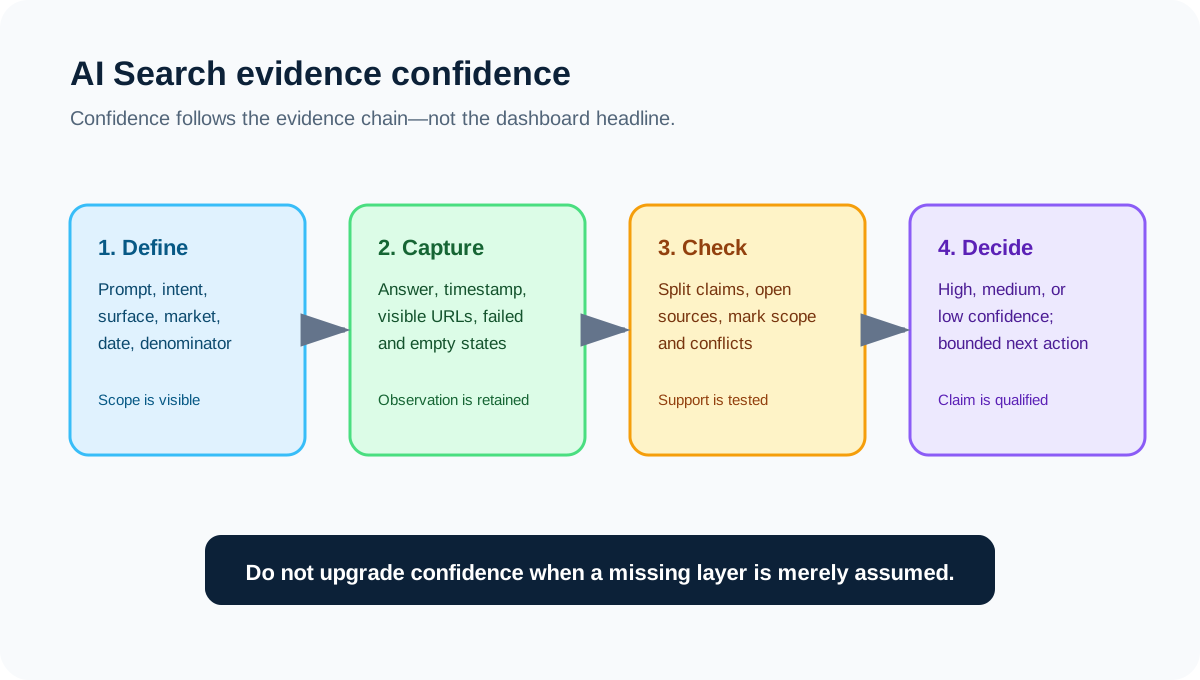
This guide targets searches such as “how do I measure AI Search evidence?”, “how reliable are GEO visibility reports?”, and “how should I audit an AI citation?” It is an audit method, not a guarantee of rankings, citations, traffic, or business outcomes.
What confidence means in this context
Confidence should attach to a claim with a defined scope, not to an entire dashboard or tool. A useful record distinguishes at least four questions:
| Question | Example | Evidence needed |
|---|---|---|
| Did the observation occur? | The answer displayed a link to example.com | Captured answer, URL, timestamp, surface |
| Was the claim represented accurately? | The source supports the stated plan limit | Source passage, date, scope, reviewer |
| Is the observation repeatable in this sample? | 6 of 10 matched prompts contained the brand | Frozen panel, denominator, run records |
| Did the observation cause an outcome? | The citation caused a lead | Referral and attribution evidence; usually separate |
The first question may be high confidence while the last is unsupported. Do not let a strong answer-level record silently upgrade a causal or market-wide conclusion.
Google’s documentation on AI features and your website, checked October 19, 2026, says AI features can show links to supporting web resources and recommends foundational Search practices. It supports inspecting the links that appear in a defined Search context; it does not define a universal GEO confidence score or promise inclusion.
OpenAI’s web search documentation, checked October 19, 2026, describes citations and sources for a specific API tool. That is evidence about fields exposed by that tool, not proof that every ChatGPT experience or commercial monitor exposes sources in the same way.
The independent paper GEO: Generative Engine Optimization, checked October 19, 2026, provides academic context for studying visibility in generative-engine responses. It does not validate a vendor’s score, establish production causality, or prove that an editorial change will create citations.
A four-layer confidence model
1. Scope confidence: what exactly was tested?
Start by recording the measurement contract. At minimum, keep:
- Exact prompt text and prompt-set version
- Intent: branded, category, comparison, product fact, local, or risk
- Surface and mode; model label only when disclosed
- Country, language, location, and device context when relevant
- Collection date, timezone, run number, and retry status
- Brand and competitor variants
- Definitions for mention, recommendation, position, and citation
- Number of qualifying answers and treatment of failures
If these fields are missing, the result may still be useful as an exploratory observation. Lower confidence in comparisons and trends. A report that says “visibility rose 14%” without the panel, denominator, and collection conditions is not auditable enough to support a high-confidence trend claim.
This is the same reason a prompt panel needs versioning. AI Search Prompt Drift explains how wording, market, surface, and parser changes can create a false trend even when the underlying answer behavior did not change.
2. Capture confidence: was the observation preserved?
A score or screenshot is a derived representation. Preserve the strongest permitted evidence:
- Exact prompt and panel version.
- Full answer or a compliant near-raw capture.
- Visible source titles and exact URLs.
- Answer position or source order when shown.
- Mention, recommendation, caveat, and omission states.
- Empty, blocked, login-gated, timed-out, and no-source states.
- Timestamp and collection conditions.
Mark unavailable fields explicitly. “No URL exported” is not the same as “no URL existed.” It may mean the surface did not show one, the collector could not access it, or the product’s export omits it.
A crawler request is not an answer citation. A domain in a dashboard is not necessarily an exact source URL. A brand mention is not a recommendation. Keeping these layers separate prevents a neat report from overstating what was observed. AI Search Monitoring Data Retention provides a fuller export checklist.
3. Support confidence: do the sources support the wording?
Split the answer into claim units before checking sources. For example:
Answer: Tool A tracks prompts, includes source exports,
and is the best option for agencies.

C-01: Tool A tracks prompts.
C-02: Source exports are available.
C-03: Source exports are available on the tested plan.
C-04: Tool A is the best option for agencies.
C-01 and C-02 may be documented product facts. C-03 needs a current plan-specific source. C-04 is an editorial or recommendation claim that requires criteria and comparative evidence; it is not proved by the first three claims.
Use a claim ledger:
| Claim | Source | Status | Boundary |
|---|---|---|---|
| A feature is documented | Official product documentation | Supported / partial / unavailable | Product and checked date |
| A feature is included in a plan | Current pricing or plan page | Supported / partial / unavailable | Plan, currency, billing interval |
| Users find the workflow easy | Independent reviews | Signal, not proof | Review sample and platform |
| A customer achieved an outcome | Vendor case study | Vendor-selected evidence | Not independent causal proof |
| A tool is best for a buyer | AICiteKit interpretation | Editorial | Depends on stated criteria |
A source appearing beside an answer supports the observation that the link was visible in that capture. It does not automatically support every nearby sentence. Check the relevant passage, date, and qualifier.
4. Decision confidence: what action is justified?
The action should be narrower than the evidence when uncertainty is material. Examples:
- High confidence: Correct a current product fact that conflicts with the official source checked on the same date.
- Medium confidence: Add a source-review task after a defined panel repeatedly shows an unsupported or stale claim.
- Low confidence: Form a hypothesis when one answer changes but the prompt, surface, or retrieval context is not fully known.
Confidence is not a universal numerical scale. A simple label is often more honest than a pseudo-precise percentage, provided the notes state why the label was assigned.
A practical confidence rubric
Use the following five checks. They are an AICiteKit editorial framework, not an industry standard.
| Check | High confidence | Medium confidence | Low confidence |
|---|---|---|---|
| Scope | Prompt, context, date, and denominator recorded | One non-material field missing | Material scope unknown |
| Capture | Answer and visible sources retained | Excerpt, screenshot, or partial export | Only a score or summary |
| Source support | Source passage matches claim and qualifiers | Source is relevant but scope is incomplete | No usable source relationship |
| Repeatability | Same rule observed across a declared sample | Some variation or small sample | One unreplicated observation |
| Decision fit | Action directly addresses checked claim | Action depends on interpretation | Action assumes cause or outcome |
Do not average the rows into a magic score. One critical failure can cap confidence. For example, a perfect screenshot does not make an unrecorded prompt panel sufficient evidence for a market-wide trend.
A useful report can say:
Medium confidence for the sampled answer observation; low confidence for a broader visibility trend. The exact prompt and source URL were retained, but the run count was small and the surface’s retrieval conditions were not exposed.
That sentence is more decision-useful than “the tool is 80% accurate.”
How to audit a GEO tool with this framework
Products such as AI Search Console, Peec AI, Otterly.AI, PromptWatch, Profound, and Rankscale may support overlapping monitoring workflows. This article does not claim that they expose the same fields or measure the same thing. Verify the current product, plan, surface, and export behavior during a trial.
Ask each product to demonstrate the same six checks:
- Prompt control: Can the exact wording and panel version be exported?
- Context: Are surface, mode, market, language, date, and model disclosure recorded?
- Raw evidence: Can you inspect the answer or a faithful permitted excerpt?
- Source detail: Are exact URLs separated from domains, mentions, and inferred sources?
- Failure handling: Are empty, blocked, and failed runs visible rather than silently removed?
- Metric rule: Can another analyst reconstruct the numerator, denominator, and deduplication rule?
Record “unknown” when the trial or documentation does not answer a question. Unknown is a valid evidence state; it is not permission to infer support.
A small matched test is usually more useful than a large uninspectable export. Use the same prompt panel, competitor set, market, date window, and review rules. Compare raw observations before comparing dashboard scores. How to Evaluate an AI Search Visibility Tool gives a broader buying-trial checklist.
Common confidence errors
Treating a rating or score as outcome evidence
A rating can be a satisfaction signal. It does not prove traffic growth, revenue growth, citation frequency, or ranking improvement. Likewise, a visibility score shows what a product calculated under its method; it does not automatically prove that a brand is preferred across the market.
Treating one citation as authority
A visible source link is evidence of source visibility in that capture. It is not necessarily an endorsement, a quality judgment, or a click. Check the claim-to-source relationship separately.
Treating repetition as independence
Ten runs from one prompt, surface, and collection method are not automatically ten independent market observations. Report the panel and run structure. Repeated captures can improve understanding of variation without becoming a universal sample.
Treating vendor-selected evidence as independent
Case studies and customer logos can document what a vendor says happened. Label them vendor-selected customer evidence. Do not present them as independent proof of causality.
Treating missing data as a negative observation
“No source exported,” “model not disclosed,” and “answer unavailable” describe the record. They do not prove that no source, model, or answer existed. Preserve the distinction between not observed, not exposed, and collection failed.
A reusable audit worksheet
Copy this record for each material observation:
Audit ID:
Decision this supports:
Prompt ID / version:
Exact prompt:
Intent:
Surface / mode:
Model label: disclosed / not disclosed
Market / language / location:
Collected at:
Run status: qualifying / empty / blocked / failed / partial
Answer retained: full / excerpt / screenshot / unavailable
Visible source URLs:
Claims checked:
Source passages and checked dates:
Mention: yes / no / unclear
Recommendation: yes / no / unclear
Citation rule:
Numerator / denominator:
Confidence: high / medium / low
What this supports:
What this does not support:
Next action:
Reviewer and date:
The two most important fields are often what this supports and what this does not support. They prevent a narrow observation from being reused as a much larger claim in a presentation, brief, or case study.
AICiteKit interpretation
Evidence confidence is most useful when it changes the decision standard. For a product-fact audit, official current documentation may be the strongest source. For usability or recurring workflow concerns, independent review evidence is more relevant. For a causal business outcome, neither a captured answer nor a dashboard score is sufficient by itself.
The practical recommendation is to buy or build the workflow that preserves the evidence your decision requires. If the job is source-level auditing, prioritize answer and URL exports. If the job is trend monitoring, prioritize stable panels, context fields, failure states, and versioned metric rules. If the job is attribution, connect the observation to analytics with an explicitly limited attribution design rather than treating visibility as revenue.
FAQ
Is an AI Search visibility score reliable?
It can be reliable for the defined calculation if the prompt sample, collection conditions, denominator, and metric rule are documented and stable. Reliability for that sample does not make the score a universal ranking or a prediction of traffic or revenue.
How many AI Search answers do I need before I can trust a result?
There is no universal threshold. The required sample depends on the decision, prompt diversity, surfaces, markets, and acceptable uncertainty. Start with a panel you can inspect, disclose the number of prompts and runs, and avoid presenting a small exploratory sample as market-wide evidence.
Does a cited URL prove the page influenced the answer?
It proves that the URL was visible as a source in the captured answer, under the recorded conditions. It does not by itself prove causal influence, a click, endorsement, or conversion.
Should I use a numerical confidence score?
Only if the scoring rules are declared and reviewers can apply them consistently. For many GEO audits, high/medium/low labels with row-level reasons are easier to audit than a precise-looking number whose weights are hidden.
What should I test during a tool trial?
Test exact prompt exports, context fields, raw answers, exact source URLs, failed-run handling, metric definitions, history, and data portability. Run the same small panel through each candidate and record unknown fields rather than filling gaps with assumptions.
Sources and verification
- Google Search Central: AI features and your website — official documentation for AI features and supporting links; checked October 19, 2026.
- OpenAI: Web search — official documentation for citations and source fields in a specified API tool; checked October 19, 2026.
- Aggarwal et al., GEO: Generative Engine Optimization — independent academic research context; checked October 19, 2026.
- AICiteKit: AI Search Answer Provenance — related editorial workflow for mapping claims to sources.
- AICiteKit: AI Search Prompt Drift — related editorial workflow for versioning measurement inputs.
Last reviewed: October 19, 2026
Evidence confidence: Medium for the framework and cited documentation; individual product capabilities and commercial terms require current plan-level verification.