Field notes / ai-search
AI Search for Healthcare: How to Audit Answers Without Turning Visibility Into Medical Proof
A practical healthcare GEO and AI Search audit framework for checking health answers, source quality, stale claims, safety boundaries, and human escalation.
The short answer
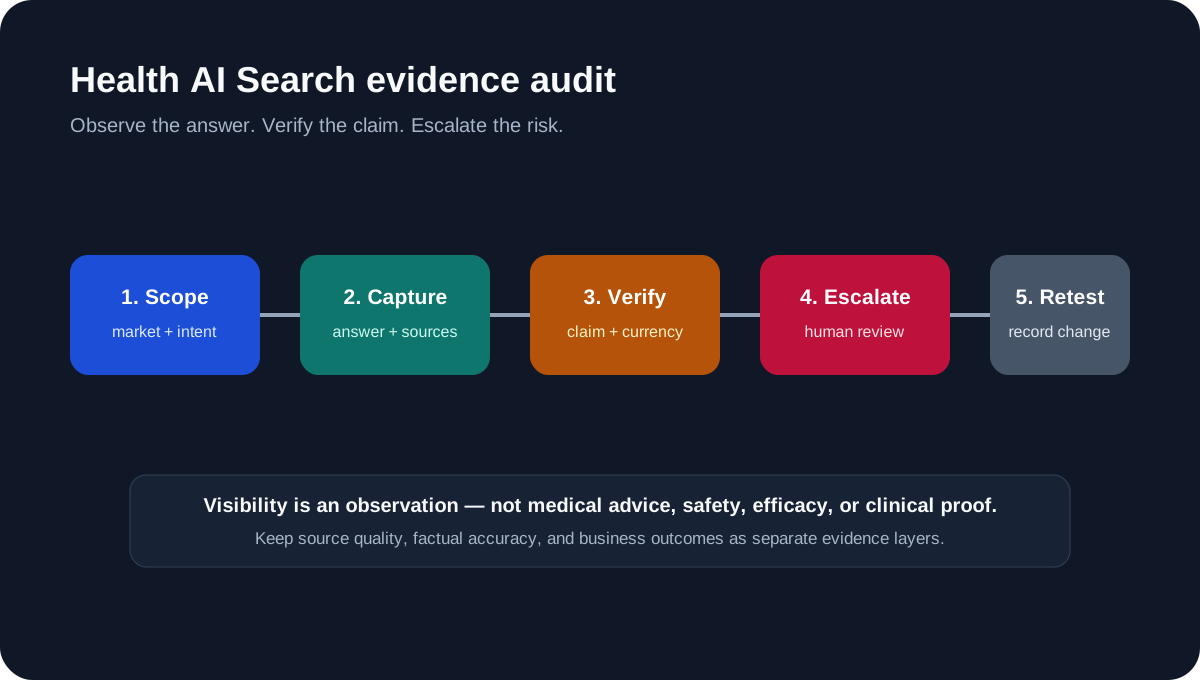
Healthcare organizations should treat AI Search monitoring as an accuracy, provenance, and escalation workflow—not as proof of clinical quality, treatment efficacy, patient suitability, or regulatory compliance. Start with a risk-weighted prompt set, capture the complete answer and visible sources, verify each material claim against current approved information, and route advice-like or safety-sensitive outputs to an appropriate human reviewer.
Use this sequence:
scope → prompt panel → answer capture → claim verification → risk review → retestA brand mention, recommendation, or citation is an observation about a sampled answer. It does not prove that a treatment is safe, that a provider is suitable for a patient, that a health claim is substantiated, or that visibility caused an appointment or purchase.
This guide addresses search intent such as “how should healthcare companies monitor AI Search?”, “how do I check whether ChatGPT gives accurate health information?”, and “does an AI citation prove a medical claim?” It is an editorial measurement framework, not medical, legal, or regulatory advice. Requirements vary by jurisdiction, product, audience, clinical context, and channel.
Why healthcare answers need a stricter evidence boundary
An incomplete product description can be inconvenient. An incomplete health answer can change a person’s decision about care, medication, symptoms, urgency, or prevention. Small wording differences can matter:
- “May help” can be rewritten as “treats” or “cures.”
- A general educational answer can sound like individualized medical advice.
- A study result may be presented without population, endpoint, dosage, or limitation.
- A provider’s specialty, location, availability, or credentials may be stale.
- A supplement or device claim may omit contraindications, interactions, or required supervision.
- A source can be reputable but still not support the exact claim made in the answer.
The World Health Organization’s guidance on ethics and governance of artificial intelligence for health, checked September 24, 2026, emphasizes risks including incorrect or biased information and the need for accountability and human oversight. It is a global governance source, not a substitute for local clinical or advertising requirements.
The NIST AI Risk Management Framework, checked September 24, 2026, provides a voluntary framework for managing AI risks. It is useful method context, but it is not a healthcare certification. The US Federal Trade Commission’s health claims guidance explains that health-related advertising claims need appropriate substantiation; the FTC page was access-limited in this research environment, so buyers should open and review the current guidance directly.
Google says its AI features can show links to supporting web resources and recommends foundational Search practices in AI features and your website, checked September 24, 2026. That describes Search behavior and site guidance. It does not make a cited answer clinically correct or compliant.
1. Define the audit scope before checking visibility
Do not begin with “is our hospital or product visible?” Begin with the decision the audit must support. Useful scopes include:
| Audit scope | Example question | Primary risk to investigate |
|---|---|---|
| Service facts | “What services does this clinic offer?” | Wrong location, specialty, or availability |
| Patient education | “What are common symptoms of condition X?” | Omission, overconfidence, or outdated guidance |
| Treatment information | “What are the options for condition X?” | Advice-like framing or missing contraindications |
| Product claims | “Does this device help with condition X?” | Unsupported efficacy or safety implication |
| Provider discovery | “Which providers treat condition X near me?” | Stale credentials, ranking implication, or unsuitable match |
| Urgent symptoms | “Should I seek immediate care for these symptoms?” | Dangerous delay or false reassurance |
| Comparison | “Which health plan or clinic is best?” | Unstated criteria and unsupported recommendation |
Record the jurisdiction, language, market, audience, service or product edition, test date, AI surface, and whether the prompt is branded, category, comparison, educational, or urgent. A US patient-education prompt should not be silently compared with a country-specific clinical-service prompt.
For recurring collection, AI Search Console, PromptWatch, Otterly.AI, and Profound represent different monitoring and reporting approaches. Their dashboards are not interchangeable evidence. Verify the prompt, surface, market, sampling, answer capture, and scoring rules before comparing results.
2. Build a risk-weighted prompt panel
A branded panel can show that an AI surface recognizes an organization while missing the questions that affect patient decisions. Include prompt groups such as:
- Identity and service facts: entity name, locations, specialties, hours, contact routes, and service boundaries.
- Education: plain-language questions that should point to current, reviewed information.
- Treatment and product claims: efficacy, safety, use, limitations, and alternatives.
- Eligibility and access: age, geography, referral, insurance, appointment, or other stated conditions.
- Urgency and escalation: questions where the answer should acknowledge uncertainty and direct the user to appropriate professional or emergency help.
- Comparison and recommendation: category prompts that expose criteria, omissions, and unsupported “best” language.
- Regional and language variants: local terminology, country-specific guidance, translations, and service availability.
Version every prompt. Preserve exact wording, location, language, date, conversation state, surface, and model or mode when disclosed. A regenerated answer is a new observation, not a correction of the old record.
A useful prompt record looks like this:
HC-URG-003 / v2
Market: United States
Surface: web answer with citations
Intent: urgency and escalation
Prompt: “When should someone seek urgent help for [symptom]?”
Run: 2026-09-24, America/New_York
Review status: pending clinical review
Do not publish a test prompt containing a real patient’s private information. Use synthetic, de-identified, or organization-approved examples and follow the applicable privacy process.
3. Capture the answer, not only the score
A visibility score can tell you that a brand appeared in a defined sample. It cannot show whether the answer was safe, current, or properly qualified. Preserve, where the product and platform permit:
- The complete answer or an allowed capture;
- Prompt text, surface, model or mode, market, language, date, and conversation context;
- Every visible source URL and the claim it appears to support;
- Mentioned providers, products, treatments, and competitors;
- Advice-like wording, certainty, warnings, and escalation language;
- Reviewer status and the approved source used for comparison;
- Any limitation imposed by the collection method.
A source list without answer text is insufficient for claim review. An answer without source URLs is insufficient for provenance review. A dashboard export that removes the date or market is weaker evidence than the score suggests.
4. Verify claims at the smallest useful level
Break the answer into material claims instead of labeling the whole response “good” or “bad.” For each claim, record:
| Field | Review question |
|---|---|
| Claim | What exact statement was made? |
| Type | Service fact, education, efficacy, safety, access, urgency, or comparison? |
| Source | Which URL or approved document supports it? |
| Match | Does the source support the exact wording, not merely the topic? |
| Currency | Is the source current for this market, product, and date? |
| Conditions | Were population, limitations, warnings, and eligibility retained? |
| Risk | What could a reader do if the claim is wrong or incomplete? |
| Action | Correct, annotate, escalate, monitor, or leave unchanged? |
Use a small vocabulary for findings:
- Supported: the current source supports the claim as written.
- Partially supported: the source supports a narrower or more conditional claim.
- Unsupported: no adequate source was found in the review set.
- Contradicted: an approved or authoritative source conflicts with the answer.
- Unresolved: the reviewer lacks enough context or the answer is too variable to classify.
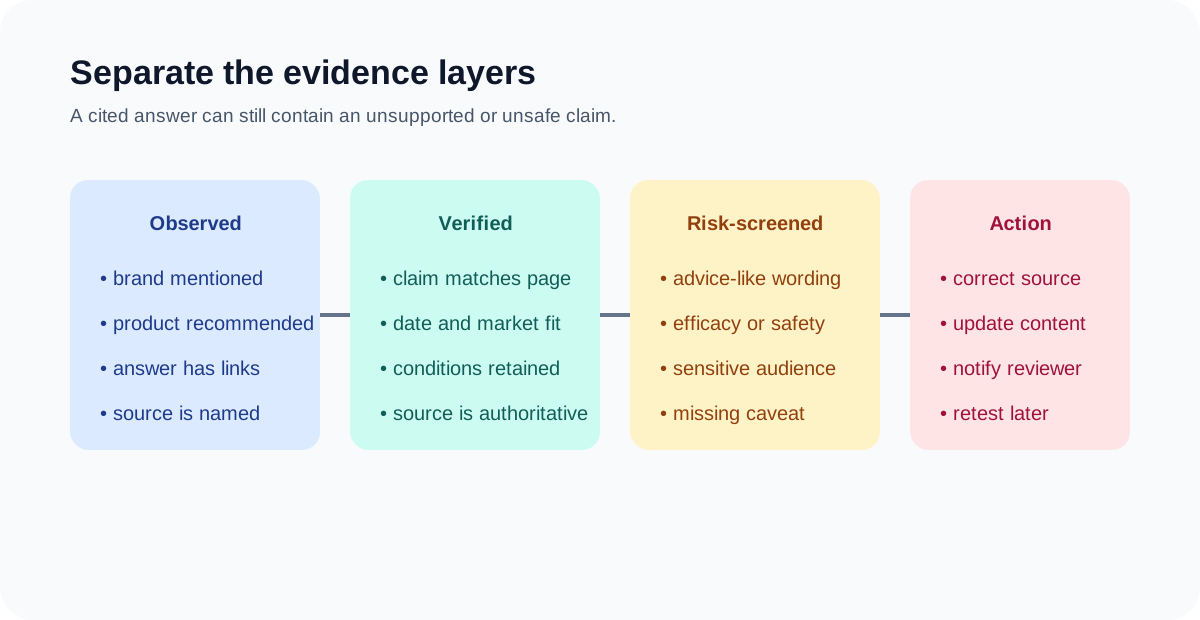
“Cited” is not a synonym for “supported.” A URL can be relevant while failing to support a dosage, outcome, availability statement, or recommendation.
5. Route high-risk findings to a human reviewer
Not every answer needs the same workflow. Define escalation rules before running the audit. Escalate when an answer:
- Gives individualized treatment, diagnosis, dosage, or medication instructions;
- Makes a safety, cure, prevention, or efficacy claim without adequate support;
- Omits a material warning, contraindication, limitation, or uncertainty;
- Gives urgent-care guidance that could delay needed help;
- Misstates a provider’s credentials, service availability, or geographic coverage;
- Combines a real source with a materially stronger conclusion;
- Exposes or appears to infer private or sensitive personal information.
The correct action may be to correct first-party content, request a source update, add a clearer qualification, notify a clinical or compliance reviewer, or document the observation without publishing a marketing claim. Do not “optimize” a page to make a risky answer more visible.
6. Separate four reporting layers
A healthcare report should keep these layers distinct:
| Layer | Example observation | What it does not prove |
|---|---|---|
| Visibility | Organization appeared in 18 of 50 sampled answers | Total patient awareness or market demand |
| Citation | Organization page was linked in 9 answers | The page supported every claim or received a click |
| Accuracy | 3 answers stated an outdated service location | That a correction will change every model |
| Safety / review | 2 answers required clinical escalation | That the organization is compliant or liable |
| Traffic / outcome | Analytics recorded tagged AI-referred sessions | That AI caused an appointment, treatment choice, or revenue |
This is the same measurement boundary used in AICiteKit’s guides on AI Search answer provenance, AI Search product fact audits, and AI visibility versus citations versus traffic. Healthcare increases the cost of confusing these layers; it does not remove the uncertainty.
7. Test changes without claiming clinical causation
When a team changes a page, source, or technical setting:
- Capture a baseline over repeated runs, not one answer.
- Record the exact change, owner, and publication date.
- Keep prompt wording, market, surface, and review rules stable where possible.
- Re-run the same panel over a defined observation window.
- Compare answer text, source support, stale facts, and escalation outcomes separately.
- Record model updates, campaigns, public-health events, and other confounders.
- Have the appropriate reviewer approve any public interpretation.
A careful conclusion might be:
After the service page was corrected, the organization appeared in more answers in the defined sample, and fewer sampled answers contained the old location. The observation is useful for monitoring, but it does not establish improved clinical outcomes, patient safety, traffic, or causation.
Do not write that a citation “improved patient outcomes,” that a visibility score “proves trust,” or that a content edit “caused more treatments” unless a separate, appropriately designed study supports that claim.
What this audit cannot prove
Even a careful audit cannot establish:
- That an AI answer is safe for a particular patient;
- That a treatment, device, supplement, or provider is effective or suitable;
- That a cited source was the model’s only or decisive evidence;
- That a source link was clicked or influenced a decision;
- That crawler activity represents a patient visit;
- That a change caused an appointment, treatment choice, or health outcome;
- That visibility or recommendation equals regulatory approval or compliance;
- That a sample represents all AI conversations, markets, or patient populations.
These boundaries are not a reason to avoid monitoring. They are the reason to preserve the answer, claim, source, date, reviewer, and uncertainty separately.
A practical healthcare AI Search checklist
- Jurisdiction, market, language, audience, and product or service are recorded.
- Prompt groups cover facts, education, claims, access, urgency, comparison, and regional wording.
- Synthetic or approved test data is used instead of real patient information.
- Complete answers, visible citations, prompt metadata, and dates are preserved where allowed.
- Claims are reviewed individually rather than scored only at answer level.
- Source relevance is separated from exact claim support.
- Currency, conditions, limitations, and warnings are checked.
- Escalation rules exist for advice-like, safety-sensitive, and privacy-related outputs.
- Visibility, citation, accuracy, review status, traffic, and outcomes remain separate.
- Public conclusions state sampling limits and avoid clinical or causal overclaiming.
FAQ
Can a healthcare organization optimize for AI Search visibility?
It can improve the clarity, accessibility, and factual quality of public information and monitor how sampled answers describe it. That is different from optimizing for a guaranteed recommendation or trying to increase the visibility of an unsupported health claim.
Does an AI citation make a health answer trustworthy?
No. A citation is evidence that a link was shown or associated with an answer. Reviewers still need to check whether the source is appropriate, current, relevant to the market, and sufficient for the exact claim.
Should healthcare teams monitor urgent-care prompts?
They may be valuable high-risk tests when designed and reviewed responsibly. The purpose is to detect dangerous omissions or overconfident wording, not to replace emergency guidance, clinical review, or local policy.
Can structured data solve healthcare AI Search accuracy?
Structured data can help machines interpret eligible page facts when implemented correctly, but it is not a citation switch, clinical validation mechanism, or guarantee that an AI system will use a page. See AI Search Structured Data: How to Audit Schema for the technical boundary.
Which tool should a healthcare team use?
Choose based on the evidence required: answer captures, citation inspection, prompt monitoring, crawler data, exports, permissions, and review workflow. Ask each vendor to demonstrate the raw answer and source record for a high-risk prompt. Do not choose from a single visibility score or assume traditional SEO reviews validate healthcare AI-monitoring features.
Sources and verification
- Google Search Central: AI features and your website — Google’s guidance on AI features and supporting web resources; checked September 24, 2026.
- World Health Organization: Ethics and governance of artificial intelligence for health — governance context for risks, accountability, and human oversight; checked September 24, 2026.
- NIST AI Risk Management Framework — voluntary risk-management framework used as methodology context, not healthcare certification; checked September 24, 2026.
- Federal Trade Commission: Health claims — public health-claims guidance; the page was access-limited during this environment’s check, so verify the current text directly before relying on it; checked September 24, 2026.
- AICiteKit: AI Search Answer Provenance — related evidence and source-verification method.
- AICiteKit: AI Search Product Fact Audit — related workflow for current facts, limits, and availability.
This is AICiteKit editorial methodology. It does not provide medical, legal, regulatory, or clinical advice, and it does not claim that any tool or content change guarantees visibility, citations, safety, patient trust, traffic, or health outcomes.