Field notes / ai-search
AI Search Structured Data: How to Audit Schema Without Treating It as a Citation Switch
A practical, evidence-led workflow for checking Schema.org markup, first-party facts, entity relationships, and AI Search claims without promising rankings or citations.
The short answer
Structured data is a machine-readable description of a page or entity. It can help search systems interpret facts such as a product, organization, person, service, or relationship. It is not a switch that guarantees an AI answer, citation, recommendation, ranking, click, or conversion.
A defensible AI Search structured-data audit connects four layers:
first-party facts → Schema.org representation → validation and page review → answer evidenceGoogle says structured data can make pages eligible for enhanced search appearances, but also says correct markup does not guarantee that a rich result will be shown (Google Search Central, “Introduction to structured data markup in Search”, checked September 21, 2026). Google’s policies also require that markup represent the visible page content and not be misleading (Structured data general guidelines, checked September 21, 2026). Those statements are useful boundaries for GEO work: valid syntax is not the same as observed AI visibility.
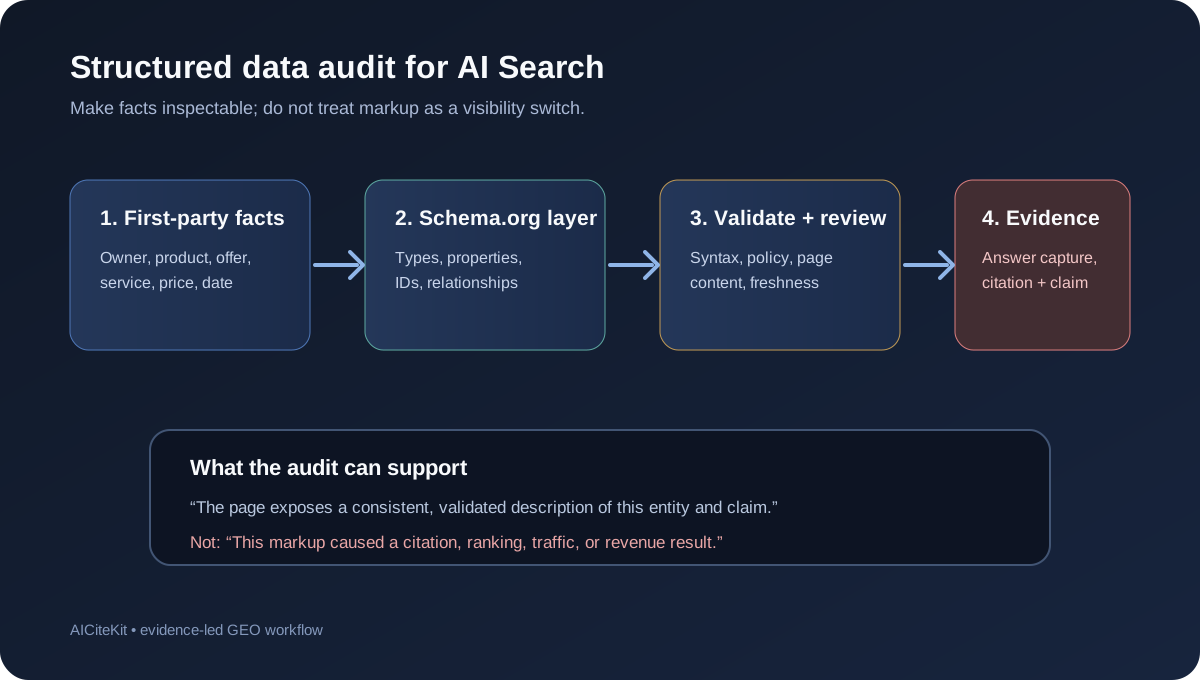
This guide addresses searches such as “does schema markup help AI search?”, “how do I audit structured data for GEO?”, and “can JSON-LD guarantee citations?” It complements Knowledge Graphs for GEO, AI Search Entity Disambiguation, and AI Search Product Fact Audit.
What structured data can and cannot establish
Separate the claim before choosing a test. “The markup is valid” and “the page was cited” are different observations.
| Observation | What it supports | What it does not prove |
|---|---|---|
| JSON-LD parses successfully | The syntax can be read by a validator | The facts are true, visible, current, or used by an answer engine |
| A required property is present | A defined schema shape is more complete | That a search feature or AI answer will display it |
| Markup matches visible page content | Better alignment with Google’s documented policy boundary | A citation, recommendation, or ranking outcome |
| A page is crawled | A bot request reached the site under logged conditions | That the page was retrieved for a user-facing answer |
| A prompt cites the page | The URL was visible in that captured answer | That schema caused the citation |
| A fact is repeated in several answers | The fact was observed in the sampled outputs | That it is universally accepted or causally attributable to markup |
AI Search Mentions vs Recommendations is useful when an answer names a brand without recommending it. The same discipline applies here: do not collapse markup validity, retrieval, citation, recommendation, and business impact into one metric.
1. Start with the source of truth
Do not begin by adding types to a page. Begin with the facts an answer system might need to interpret:
- Legal or preferred organization name
- Canonical URL and stable entity identifier
- Products, services, locations, authors, and responsible organizations
- Current descriptions, availability, dates, and relevant offers
- Relationships such as “product offered by organization” or “article written by person”
- The page owner and review date for each important fact
Create a small fact ledger before editing markup:
| Fact | First-party source | Visible on page? | Schema property or relation | Owner | Recheck date |
|---|---|---|---|---|---|
| Product name | Product page | Yes | Product.name | Product marketing | 2026-09-21 |
| Organization identity | About page | Yes | Organization / sameAs | Brand team | 2026-09-21 |
| Offer availability | Pricing or offer page | Yes | Offer.availability | Commercial team | 2026-09-21 |
| Author identity | Author profile | Yes | Person / author | Editorial | 2026-09-21 |
The date in this example is the audit date, not evidence that a fact stays current. Dynamic claims need a new check when the page, plan, product, or offer changes.
If the fact is not publicly documented, mark it as unknown. Do not fill a missing price, limit, review count, or integration with an inference merely because a schema property exists for it.
2. Choose types and relationships conservatively
Schema.org is a vocabulary for structured data, not a guarantee that every consumer will use every type or property. The Schema.org getting started guide, checked September 21, 2026, explains the basic model: describe things, their properties, and relationships using supported serialization formats.
A practical selection rule is:
- Model the primary thing the page actually describes.
- Add properties that are supported by visible, current content.
- Use stable identifiers when the organization can maintain them.
- Connect related entities only when the relationship is real and inspectable.
- Avoid adding a more specific type solely because it sounds more valuable.
- Keep editorial review in the publishing workflow.
For example, a product page may legitimately describe a product and its manufacturer. It should not silently add an award, aggregate rating, review count, or availability claim that the page does not support. A service page can identify a provider and area served, but it should not imply universal availability when the offer is restricted.
JSON-LD, Microdata, or RDFa?
The serialization choice is an implementation decision. JSON-LD is often operationally convenient because it separates structured data from the visible HTML, while Microdata and RDFa annotate elements in the page. The more important audit questions are whether the representation is accurate, maintained, connected to the right page, and validated after deployment.
Do not report “we use JSON-LD” as an outcome. Report the implementation and then test the observations that matter.
3. Audit the page and the markup together
A validator checks a representation. A GEO audit also checks the source page around it.
Use this sequence:
- Fetch the canonical URL as a normal user would.
- Confirm the page is accessible and the canonical target is intentional.
- Locate the visible fact in the rendered content.
- Inspect the structured-data block and its entity IDs.
- Compare names, dates, prices, availability, authorship, and relationships.
- Check for duplicate or conflicting blocks generated by a CMS, plugin, or tag manager.
- Validate syntax and required properties using the relevant official testing tools.
- Record warnings separately from errors; neither is an AI citation result.
- Recheck after deployment, template changes, and major content updates.
A useful finding is specific:
The page visibly says the offer is available in the United States, while the structured data omits the geographic constraint. The team should decide whether the structured representation needs a supported restriction and then verify the result after deployment.
A weak finding is causal and broad:
Adding JSON-LD will make the brand appear in ChatGPT.
The second statement is not supported by the official sources cited here. OpenAI’s crawler documentation describes bot purposes and user agents, but a crawler request is not evidence that a page was cited in an answer (Overview of OpenAI Crawlers, checked September 21, 2026).
4. Treat entities as an accuracy problem first
Entity work is valuable when it reduces ambiguity. Ask whether two pages refer to the same organization, whether a product is confused with a similarly named product, or whether an author and publisher are represented consistently.
Review:
- Canonical names and alternate names
- Stable URLs or identifiers
- Organization, publisher, author, manufacturer, and provider relationships
sameAslinks that point to genuine official profiles- Duplicate entities created by separate templates or business units
- Conflicting facts across the site and important external sources
- Regional variants that should remain separate
sameAs is not a reputation vote. It should point to a page that identifies the same thing. A long list of loosely related profiles can make governance harder rather than making the entity clearer.
Tools such as Schema App, WordLift, InLinks, and Yext approach structured data or entity governance in different ways. Their product pages describe capabilities, but those descriptions are not independent proof that markup causes AI citations or commercial outcomes. Buyers should compare the actual workflow: fact ownership, deployment method, validation, change history, entity IDs, and exportability.
5. Test claims in a separate answer sample
After correcting the source and markup, use a fixed prompt panel if the decision concerns AI Search visibility. Keep the answer test separate from the implementation test.
Record at least:
- Exact prompt and version
- Answer surface and browsing mode
- Model or version when disclosed
- Market, language, account context, and timestamp
- Full answer or permitted export
- Mentioned brands and recommended brands
- Every visible citation URL and the claim it appears to support
- Whether the target URL was cited, and whether its content supported the claim
Then compare the baseline and post-change samples. Report a bounded observation such as:
In the fixed English-language prompt panel, the target URL was visible in 2 of 10 captured answers after the documented page and markup update, compared with 1 of 10 before it. The sample does not isolate markup from page changes, retrieval changes, or normal answer variation.
That is more useful than “schema increased AI visibility by 100%.” The latter hides the denominator and implies causality that the test may not establish. AI Search Answer Volatility provides a fuller repeated-capture method.
6. Measure the right layer
A structured-data program should have separate success measures:
| Layer | Example measure | Evidence needed |
|---|---|---|
| Data quality | Percentage of audited facts with an owner and current source | Fact ledger and review log |
| Implementation | Pages with intended, valid, non-conflicting markup | Crawl, validator, and deployment records |
| Entity clarity | Resolved duplicate or contradictory identities | Entity map and source comparison |
| Search feature | Eligible or displayed enhancement where documented | Platform-specific reporting, not assumption |
| AI answer | Target URL or supported claim observed in a fixed panel | Raw answer and citation ledger |
| Business outcome | Referrals, leads, orders, or revenue | Analytics and CRM with attribution limits |
Do not replace these layers with one “schema score.” A high implementation score can coexist with stale facts. A low citation rate can coexist with excellent markup if the prompt panel does not ask about the entity. A citation can coexist with unsupported wording.
What to verify before buying a structured-data or entity tool
Ask for a workflow demonstration using a page and fact that matter to your business:
- Can the system show the source fact behind each generated property?
- Can an editor approve, reject, and audit changes before deployment?
- How are duplicate entities and stable IDs handled?
- Does it detect conflicts between visible content and markup?
- Can it show validation errors, warnings, and historical changes separately?
- What happens when a CMS template creates duplicate JSON-LD?
- Can the team export raw markup, entity relationships, and change history?
- Does the product measure captured AI answers, or only provide a semantic/technical foundation?
- If it reports AI visibility, what are the prompt, platform, market, model, and denominator?
- Which claims are vendor-selected case studies rather than independent evidence?
A tool can reduce implementation effort without proving a GEO outcome. Treat those as different buying jobs.
Evidence snapshot
| Source | Public signal | What it supports | Confidence |
|---|---|---|---|
| Google Search Central: Introduction to structured data markup | Official explanation of structured data and eligibility for enhanced search appearances | Structured data can help systems understand page content; eligibility is not a display guarantee | High for the documented guidance |
| Google Search Central: Structured data general guidelines | Official policy requirements for accurate, representative markup | Markup should match visible content and avoid misleading use | High for the documented guidance |
| Schema.org: Getting started | Maintainer documentation for types, properties, and relationships | Vocabulary and modeling context; not a promise of downstream use | High for the narrow documentation claim |
| OpenAI: Overview of OpenAI Crawlers | Official crawler purposes and user-agent information | Bot-access context; not proof of answer-level citation | High for the narrow documentation claim |
| Schema App | AICiteKit tool page describing vendor product capabilities | Example of enterprise schema and entity-governance workflow; not independent outcome evidence | Medium for the capability summary; low for causal outcome |
| WordLift | AICiteKit tool page separating semantic SEO capabilities from GEO evidence | Example of knowledge-graph workflow and its evidence boundary | Medium for the capability summary |
| AICiteKit editorial framework | Fact ledger, implementation audit, and fixed answer-panel method in this article | Practical way to separate data quality, markup, answer evidence, and business outcomes | Editorial |
Evidence boundaries
The official documentation supports claims about structured-data concepts, policy boundaries, and documented crawler behavior. It does not establish that a particular schema type, plugin, entity platform, or markup change will produce an AI citation, recommendation, ranking, traffic increase, or revenue result. Tool references describe workflows and should not be read as independent user evidence. Those outcomes require a defined test and separate analytics.
FAQ
Does schema markup make ChatGPT cite my website?
No guarantee follows from adding schema. A page may be accurate and validly marked up without appearing in a particular answer. If citation visibility matters, capture a fixed prompt sample and preserve the visible sources.
Is JSON-LD a GEO ranking factor?
There is no basis in the sources above for treating JSON-LD as a universal GEO ranking factor. Use it to represent accurate, visible facts and relationships, then measure the answer behavior separately.
Should every page have the same schema?
No. The type and properties should fit the page and its visible content. A site-wide template can create duplicates or inaccurate claims if it applies one shape to unrelated page types.
Can structured data fix an entity-confusion problem?
It can provide clearer first-party identifiers and relationships, but it cannot by itself resolve every conflicting or ambiguous signal. Audit names, URLs, relationships, and external sources together.
What is the difference between schema validation and AI Search monitoring?
Validation checks whether a structured representation conforms to a syntax or documented requirement. AI Search monitoring observes answers, mentions, recommendations, citations, or sources under specified conditions. One does not substitute for the other.
Should I use a schema platform or implement markup myself?
That depends on scale, governance, deployment complexity, and the need for change history or entity management. A small site may prefer direct implementation; a large or frequently changing site may value governed workflows. Test the exact pages and approvals your team needs before buying.
Practical checklist
- The important facts have first-party sources and named owners.
- The structured data describes the visible page rather than hidden or unsupported claims.
- Entity names, URLs, IDs, and relationships are consistent.
- Prices, availability, dates, authors, and offers have been checked for freshness.
- Duplicate or conflicting markup has been investigated.
- Validation output is separated from search-feature and AI-answer observations.
- A fixed prompt panel is used if the decision concerns AI Search visibility.
- Answers, visible URLs, claims, and conditions are retained.
- Any traffic or revenue statement uses separate analytics and explicit attribution limits.
- Tool claims are labeled as official capability evidence, not independent outcome proof.
Verification date: September 21, 2026. Platform guidance, tool capabilities, and site facts can change; recheck live documentation before implementation or purchase.