Field notes / ai-search
AI Search Internal Linking Audit: How to Connect Claims, Sources, and Topic Hubs
A practical AI Search internal linking audit for mapping important claims to canonical pages, finding orphaned evidence, and testing whether an internal link change improves retrievability without claiming guaranteed citations.
The short answer
An AI Search internal linking audit checks whether the pages that explain your important topics, products, and claims are connected by crawlable, descriptive links and supported by a clear canonical source. It is not a test that can guarantee an AI citation.
Use this chain:
buyer question → topic hub → supporting page → specific claim → source evidenceThe practical goal is to reduce ambiguity and improve the path a reviewer or crawler can follow. A stronger internal link structure may make a site easier to navigate and interpret, but it does not prove that an answer engine retrieved, selected, cited, or recommended any page.
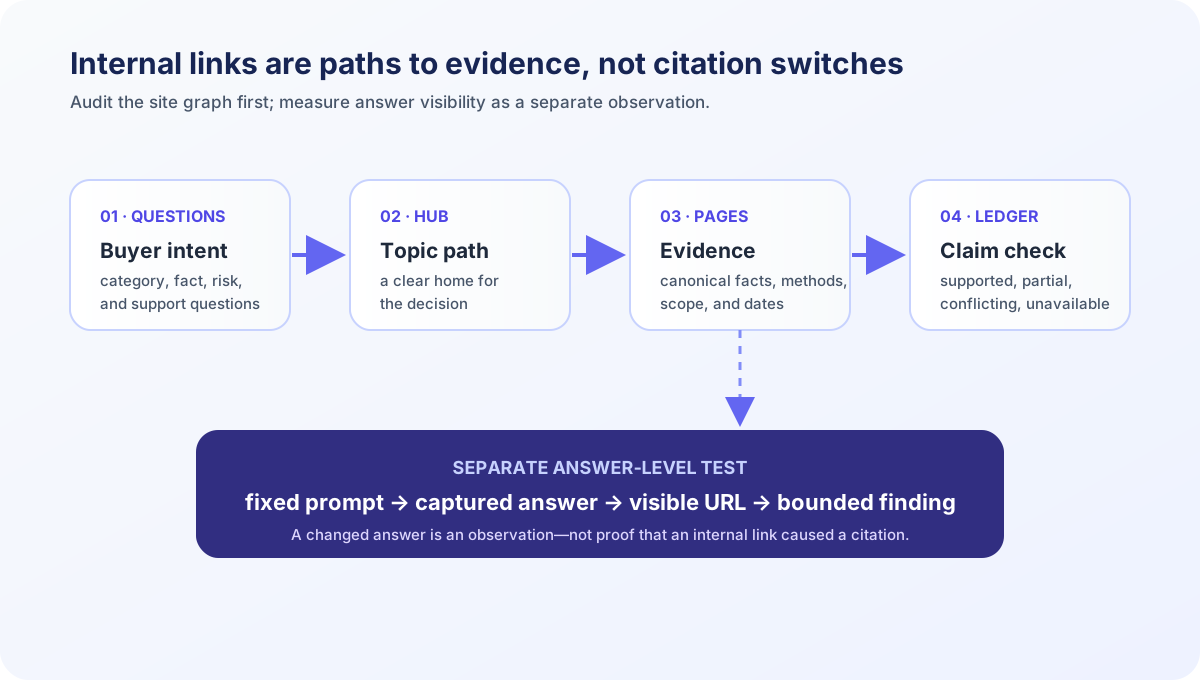
This guide addresses searches such as “do internal links help AI Search visibility?”, “how do I audit internal links for GEO?”, and “how should I structure content so AI can find related pages?” The answer is an evidence-led site audit, not a magic link count.
What internal links can—and cannot—show
Google’s documentation says crawlable links help Google find pages and describes links as a way to connect pages. Its SEO Starter Guide also discusses logical site organization and descriptive anchor text (Google: Make your links crawlable, checked October 1, 2026; SEO Starter Guide, checked October 1, 2026). These are first-party search guidance, not a published rule that an internal link causes an AI answer citation.
The independent research paper GEO: Generative Engine Optimization studies generated-answer visibility in a defined experimental setting (Aggarwal et al., arXiv, checked October 1, 2026). It provides research context for measuring generative-engine responses, but it does not validate a commercial internal-link score, establish current production behavior, or prove that a link edit produces traffic or revenue.
Keep the evidence layers separate:
| Observation | What it supports | What it does not prove |
|---|---|---|
| A crawlable internal link exists | The tested page exposes a link that a compliant crawler can follow | That an AI system followed it or cited the destination |
| A page has several relevant inlinks | The page is connected within the tested site graph | That it is authoritative, correct, or preferred in an answer |
| A page is in an XML sitemap | The URL is included in a discovery signal | Crawling, ranking, citation, or recommendation |
| An answer cites a destination page | That URL was visible in the captured answer | That an internal link caused the citation |
| A link change precedes a different answer | Two observations differ over time | That the link caused the difference |
The audit should improve a documented information architecture problem even when answer-level impact remains unknown.
1. Start with real questions, not a preferred site diagram
An internal-link map should support decisions people actually make. Begin with a question inventory from customer interviews, sales calls, support tickets, search data, product documentation, and a fixed AI Search prompt panel. Do not let a diagram become the definition of demand.
Group questions by the job they represent:
| Question group | Example | Useful destination |
|---|---|---|
| Category discovery | Which tools monitor AI citations? | Category or comparison hub |
| Evaluation | What should a small agency verify before buying? | Buyer-guide page with criteria |
| Product fact | Does Product A export exact source URLs? | Canonical feature or documentation page |
| Risk | What are the limits of using an AI visibility score? | Methodology or limitations page |
| Support | How do I configure the integration? | Task-specific help page |
A category page should not be forced to answer every product-fact question. If a claim has a different owner, scope, or update cadence, link to a page that can maintain it.
For prompt design, AI Search Prompt Mapping explains how to turn real questions into a defensible test set. A prompt panel is an observation tool; it is not a substitute for a crawl or content inventory.
Record the question-to-page decision
For each important question, keep a small record:
Question ID: GEO-CAT-014
Intent: category discovery
Primary hub: /blog/ai-search-monitoring-vs-content-optimization/
Supporting pages: documented list of relevant guides and tool evaluations
Canonical product facts: separate tool detail page
Owner: content team
Review trigger: product, pricing, or methodology change
This prevents the common failure where a new article links to a convenient page that does not actually support the claim.
2. Build a claim-to-page inventory
Internal links are most useful when the destination is chosen for the claim, not merely for topical similarity. Create an inventory of claims that an AI answer might need to verify:
| Claim type | Canonical destination | Review question |
|---|---|---|
| Definition | Stable explanatory page | Does the page define the term without a narrower hidden assumption? |
| Feature | Product detail or official documentation | Does the page describe the exact edition and scope? |
| Price or limit | Current pricing or plan page | Is the value dated, scoped, and owned by a responsible reviewer? |
| Method | Methodology or research page | Can another reviewer reproduce the stated rule? |
| Comparison | Clearly labelled comparison page | Are the criteria and evidence boundaries visible? |
| Outcome | Independent study or analytics record | Does the source actually establish the result? |
A link from a blog post to a pricing page can help a reader find the commercial fact. It does not make the blog post a current pricing source, and it does not make the price true for every plan or market.
Distinguish source authority from link prominence
A page can receive many internal links and still be a poor source for a claim. Link count is an inventory signal, not a truth score. For high-risk facts, record the canonical URL, scope, check date, and fallback when the source is unavailable.
Use explicit states:
- Supported: the destination directly covers the claim and scope.
- Partial: the page covers only part of the wording.
- Conflicting: another authoritative page disagrees.
- Unclear: the destination is too general or stale to verify the claim.
- Unavailable: the page could not be checked under the stated conditions.
Do not turn “linked” into “verified.”
3. Audit the graph, not just the menu
Navigation is one part of an internal-link graph. Inspect links in body copy, related-content modules, breadcrumbs, category pages, documentation indexes, and product pages. A page can be reachable from the menu while its most important claim has no contextual link from a relevant explanation.
For each target page, check:
- Discoverability: Is there at least one crawlable path from a known page?
- Context: Does the surrounding sentence explain why the destination matters?
- Anchor clarity: Does the anchor describe the destination without stuffing or vague wording?
- Canonical alignment: Does the link point to the intended canonical URL?
- Status: Does the destination return the expected response without a redirect chain or access wall?
- Scope: Does the destination cover the same product, market, edition, and date?
- Maintenance: Is there an owner or trigger for updating the link?
Google’s link guidance is about crawlable links and page discovery. Apply it as technical guidance, not as evidence that an answer engine uses the same graph or ranking process.
Orphaned evidence pages
An orphaned page is not automatically useless, and a highly linked page is not automatically accurate. The audit question is narrower: can a reader or compliant crawler reach the page through a meaningful path from the pages that discuss its subject?
Prioritize pages that are:
- Canonical sources for high-risk product facts
- The only explanation of an important category or use case
- Frequently cited by external sources but disconnected internally
- Newly published and absent from relevant hubs
- Linked only through temporary, filtered, or parameterized URLs
Do not add links solely to increase a page’s count. Add a link when it clarifies the relationship or supports a real task.
4. Use descriptive anchors without writing for a parser
A useful anchor tells a reader what they will find. “Read more” and repeated exact-match anchors hide the relationship. Over-optimized anchors can also make the page harder to read and can misstate the destination’s scope.
Prefer:
- “AI Search answer provenance workflow” when the destination explains provenance
- “prompt sampling framework” when the destination explains panel design
- “AI Search product fact audit” when the destination covers pricing, limits, and availability
Avoid linking a phrase such as “guaranteed AI citations” to a page that only discusses crawl access. The link would connect words, but not evidence.
Anchor review table
| Anchor pattern | Likely problem | Better audit action |
|---|---|---|
| “Click here” | Destination purpose is hidden | Rewrite around the task or topic |
| Same exact keyword everywhere | Artificial repetition or lost context | Vary naturally while preserving accuracy |
| Claim stronger than destination | Link implies unsupported evidence | Narrow the claim or change the destination |
| Product name without edition | Scope may be ambiguous | Add edition, plan, or date where needed |
| Long paragraph as anchor | Relationship is difficult to scan | Use a concise, descriptive phrase |
Anchor text is one clue in a page relationship. It is not a guarantee that a model will use the same wording.
5. Check the technical link path
A content audit should be paired with a small technical test. For each sampled link, record:
- Source URL and destination URL
- Link element and rendered visibility when relevant
- Absolute or relative URL
- HTTP status and redirect chain
- Final canonical URL
nofollowor other link attributes, where material to the decision- Access policy and authentication assumptions
- Collection time and user-agent used for the check
Do not confuse a client-side visual link with a universally crawlable link. Test the delivered HTML and the rendered experience deliberately when the site depends on JavaScript. If an access policy blocks a path, record the policy finding separately from any answer result.
AI Search Access Audit covers robots.txt, sitemaps, page delivery, and the boundary between access evidence and citation evidence.
A minimal sampled-link ledger
Link ID: LINK-042
Source: /blog/ai-search-source-quality/
Destination: /blog/ai-search-answer-provenance/
Anchor: AI Search answer provenance workflow
Status: 200; canonical matches destination
Context: source-verification section
Claim supported: provenance records connect claims to visible sources
Checked: 2026-10-01
Answer citation observed: not tested in this ledger
Boundary: technical relationship only
The final field matters. A link audit should not quietly become a citation claim.
6. Create topic hubs with explicit boundaries
A topic hub is useful when it helps a reader choose the next page. It should state what the cluster covers and where the evidence stops. A hub that links every related URL can become a directory without a decision path.
A practical hub can include:
- A concise definition and audience.
- The main question the cluster answers.
- Links to foundational concepts.
- Links to workflows or audits.
- Links to product evaluations when a tool decision is relevant.
- A limitations or evidence section.
- Dates and owners for volatile facts.
For AICiteKit readers, a hub about AI Search measurement might connect AI Search Measurement Baseline, AI Search Evidence Ledger, AI Search Answer Provenance, and AI Search Answer Claim Audit. Those pages answer related questions, but they should not be represented as one universal metric or one proof of visibility.
Avoid circular authority
If five pages repeat the same unsupported claim and link to one another, the graph creates repetition, not independent evidence. Trace the claim to the strongest available source and label editorial interpretation as interpretation.
A vendor case study remains vendor-selected customer evidence even when several internal pages link to it. A product page remains vendor-controlled evidence for product facts. Internal links improve navigation; they do not change source provenance.
7. Test a link change without pretending it is an experiment
If you change internal links and later see a different AI answer, several explanations remain possible: answer variation, model or surface changes, source changes, prompt drift, or the link edit. Design the observation so that alternatives are visible.
Before a test, freeze:
- Exact prompt wording and prompt version
- Surface, mode, market, and language
- Collection dates and run policy
- Target pages and link changes
- Mention, recommendation, and citation definitions
- Answer capture and source-URL rules
Use a stable core and an exploratory panel. Preserve the answer and visible sources, not only a score. AI Search Prompt Drift explains why changing the question can invalidate a clean trend comparison.
Report a bounded result
Prefer:
After the internal-link change, the fixed 20-question panel produced different captured answers on the later run. The prompt and surface were held constant where recorded; answer variation, retrieval changes, and source changes remain possible explanations.
Avoid:
The new internal links increased AI visibility by 30%.
The second statement hides the denominator and claims causality that the observation does not establish.
Internal linking versus AI Search monitoring
Internal-link auditing and prompt monitoring answer different questions:
| Workflow | Primary question | Evidence retained |
|---|---|---|
| Internal-link audit | Can readers and compliant crawlers follow a meaningful path to the relevant source? | URL graph, anchors, status, canonical, scope |
| Content audit | Does the destination accurately support the claim? | Claim ledger, source passages, dates, owners |
| AI Search monitoring | What did a defined answer surface display for a fixed prompt? | Prompt, answer, visible URLs, context, run metadata |
| Referral analysis | Did a separately recorded visit occur? | Analytics or server evidence with attribution limits |
Products such as AI Search Console, Peec AI, Otterly.AI, PromptWatch, and Profound may expose different combinations of prompts, answers, sources, crawls, and derived metrics. During a trial, verify whether the product can show the exact prompt, captured answer, cited URL, page relationship, timestamp, and unavailable state. Do not assume a prompt dashboard has performed a site-graph audit.
A practical weekly workflow
- Select a decision. Choose one category, product-fact, risk, or support question.
- Map the canonical source. Identify the page that should support the claim and its scope.
- Inspect the path. Check contextual links, anchor wording, canonical URL, redirects, and access.
- Review the destination. Confirm that it is current, specific, and evidence-led.
- Log gaps. Mark orphaned, ambiguous, stale, conflicting, or unavailable destinations.
- Make the smallest useful change. Add or revise a contextual link only where it helps the task.
- Rerun the technical check. Confirm the delivered link and destination.
- Run answer checks separately. Use a fixed panel when the business question concerns citations or recommendations.
- Report boundaries. State what the link change shows and what it cannot establish.
What to verify before buying a GEO tool for this workflow
- Does the product crawl internal links or only monitor prompts?
- Can it export source and destination URLs, anchors, status codes, and canonical results?
- Does it preserve the page content or claim evidence behind a recommendation?
- Can it separate an access finding from an answer-level citation?
- Are prompt, answer, source, and collection conditions visible?
- Can stable and exploratory prompt panels be reported separately?
- How are redirects, JavaScript links, blocked pages, and unavailable answers handled?
- Can reviewers annotate scope, source type, and confidence?
- Does the product describe its metric denominator and refresh policy?
- Can you export enough raw evidence for a second reviewer to reproduce the finding?
A dashboard can reduce manual work, but a score without the underlying URL path or answer evidence is difficult to audit.
FAQ
Do internal links guarantee AI citations?
No. They can improve site navigation and expose relationships to readers and compliant crawlers, but a link does not prove retrieval, selection, citation, recommendation, traffic, or revenue.
How many internal links should a page have for GEO?
There is no defensible universal count. Add links that help a reader complete a task or verify a claim. Report the relevant destinations, context, and maintenance rule instead of optimizing for a quota.
Should every article link to a product page?
Only when the product page is relevant to the article’s decision and the link makes the scope clear. Mechanical product links can distract readers and make editorial claims appear promotional.
Does anchor text affect AI Search visibility?
Descriptive anchors help readers understand a destination and are consistent with Google’s crawlable-link guidance. Public documentation does not establish a universal anchor-text formula for AI citations. Treat anchor quality as an information-architecture and usability decision first.
Is an orphaned page invisible to AI Search?
No. An orphaned page may still be discovered through external links, sitemaps, direct retrieval, or other paths. Orphan status is a site-graph finding, not proof of absence from every answer system.
Should I add llms.txt instead of internal links?
They serve different purposes. A curated llms.txt file, where a site chooses to publish one, is not a replacement for a coherent HTML information architecture. Do not claim that either file guarantees citations; test the specific question and preserve the evidence.
What is the first audit to run?
Choose a small set of high-value questions, map each to a canonical source, inspect the internal path and page scope, then capture a fixed answer panel if citation or recommendation is the decision. Keep technical and answer-level results in separate fields.
Sources and verification
- Google Search Central: Make your links crawlable — checked October 1, 2026; used for crawlable links, page discovery, and anchor-text guidance.
- Google Search Central: SEO Starter Guide — checked October 1, 2026; used for site organization and descriptive navigation context.
- Aggarwal et al.: GEO: Generative Engine Optimization — checked October 1, 2026; independent academic context for generative-engine visibility experiments; not proof of commercial tool performance or causal business outcomes.
Last reviewed and data confidence
Last reviewed: October 1, 2026
Data confidence: High for the linked Google documentation and the cited research paper within their stated scope; medium for editorial workflow recommendations; no claim is made that an internal-link change guarantees an AI citation or business result.