Field notes / ai-search
AI Search Source Substitution Audit: Why a Competitor URL Appears Instead of Yours
A claim-by-claim workflow for investigating when AI Search cites a competitor, separating observable source differences from unsupported ranking and causality claims.
The short answer
An AI Search source substitution audit investigates why an answer displayed a competitor’s URL for a question your page also addresses. It does not assume that the competitor “ranked above” you, that one missing citation was caused by a content defect, or that replacing a URL will increase traffic.
Use this evidence chain:
exact question → captured answer → visible source → supported claim → bounded actionThe practical goal is narrower and more useful than a guessed ranking: identify whether your page is absent, inaccessible, less directly relevant, less current, less specific to the question, or simply not selected in that captured run. Those are different findings and require different next steps.
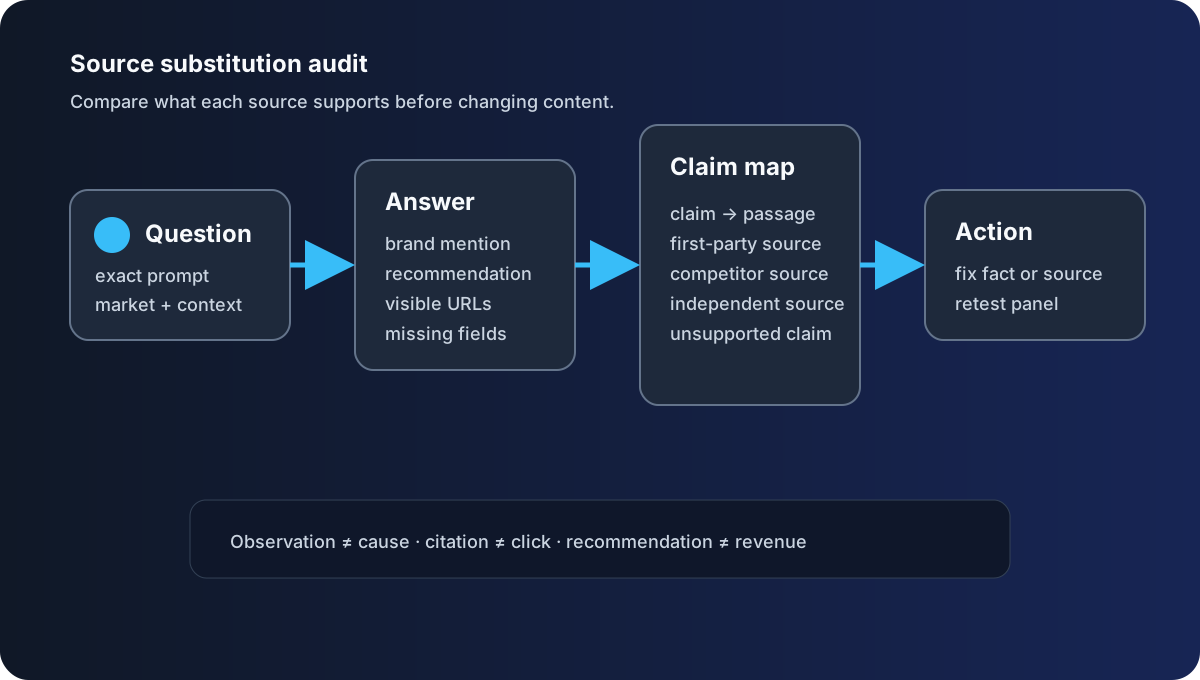
This guide addresses searches such as “why does ChatGPT cite a competitor?”, “how do I get my page cited instead?”, and “how should I compare AI Search sources?” It complements AI Search Citation Gap Analysis, AI Search Answer Claim Audit, and AI Search Competitor Analysis.
What source substitution does—and does not—mean
For this article, source substitution means that a captured answer used one visible source where another source might have been expected. The expectation could come from a brand owner, a controlled test, a previous run, or a buyer’s request. It is an observation about a defined answer, not a universal search result.
Google says AI features may show links to supporting web resources and recommends maintaining ordinary technical and content fundamentals, while also stating that appearing in an AI feature is not guaranteed (Google Search Central: AI features and your website, checked October 7, 2026). OpenAI documents citations and source information for its web-search tool (OpenAI Developer Docs: Web search, checked October 7, 2026). These sources describe documented contexts; neither establishes one shared selection algorithm for every AI Search surface.
| Observation | It supports | It does not prove |
|---|---|---|
| A competitor URL appears in an answer | That URL was visible in the captured response | A universal competitor ranking |
| Your URL is absent in one run | It was not visible in that run | That the page is blocked or permanently ineligible |
| The competitor page answers one fact more directly | A possible relevance or clarity difference | That the difference caused retrieval |
| Your URL appears after a page edit | A before-and-after difference under the recorded conditions | That the edit caused the change |
| A tool reports a citation gap | A metric calculated under that tool’s method | That tools measuring “gap” are interchangeable |
| A source is cited | The system exposed that source | That a user clicked it or that revenue followed |
The independent paper GEO: Generative Engine Optimization studies visibility in a defined experimental setting (Aggarwal et al., arXiv, checked October 7, 2026). It is useful research context, not proof of current production retrieval, a commercial dashboard score, traffic, or revenue. Keep that boundary visible in the audit.
1. Freeze the question before comparing sources
A source comparison fails when the original prompt is paraphrased after seeing the result. Preserve:
- Exact wording, punctuation, and qualifiers
- Audience and use case
- Market, language, and location
- Budget, plan, platform, or integration constraints
- Surface and mode
- Model or version when disclosed
- Conversation state and collection timestamp
A minimum capture record might be:
Prompt ID: SRC-017 v1
Exact question: Which AI visibility tool fits a five-person B2B agency that needs weekly client reports?
Audience: agency marketing team
Market/language: United States / English
Surface: recorded answer surface; mode recorded if disclosed
Collected: 2026-10-07 UTC
Target page: https://example.com/tools/product
Expected decision: shortlist a tool, not prove a ranking
Do not use a broad discovery question to judge a page written for a narrow implementation task. “Best AI visibility tool” and “which tool supports weekly agency reporting?” may surface different evidence because they request different decisions.
2. Preserve the whole answer, not just the URL
Save the answer text, visible links, citations, follow-up context, unavailable states, and any answer metadata exposed by the surface. A URL without the sentence around it cannot tell you what the source was used to support.
Separate these units:
- Mention: the brand name appears.
- Recommendation: the answer presents the brand as a fit.
- Citation: a visible URL appears.
- Claim support: the source supports the particular statement.
- Referral: analytics separately record a visit from a measured source.
A competitor can be cited for a definition while your product is recommended. Your brand can be mentioned without a link. A source can be visible while failing to support an adjacent price or performance statement. AI Search Mentions vs Recommendations covers these distinctions in more detail.
Suggested capture table
| Field | Example | Why it matters |
|---|---|---|
| Prompt and version | SRC-017 v1 | Prevents silent prompt drift |
| Answer excerpt | Exact sentence naming the competitor | Defines the claim under review |
| Visible URL | Direct URL as displayed | Allows source inspection |
| Source role | Official, independent, community, vendor-selected | Sets evidence expectations |
| Target URL state | Absent, present, or unavailable | Avoids treating missing as blocked |
| Claim ID | C-04 | Makes review auditable |
| Conditions | Market, surface, date, repeat | Limits the conclusion |
3. Map the competitor’s claim to a passage
Read the competitor page as evidence, not as a winner’s badge. Break the answer into atomic claims and ask what each source actually supports.
| Claim | Competitor passage supports it? | Your page supports it? | Safe finding |
|---|---|---|---|
| The product monitors a named surface | Check current feature documentation | Check current feature documentation | Product fact may be verifiable from both pages |
| The product fits a small agency | Usually requires criteria, not a slogan | Usually requires criteria, not a slogan | Editorial fit judgment; disclose criteria |
| The plan includes a stated limit | Verify official pricing or documentation | Verify official pricing or documentation | Time-sensitive commercial fact |
| The product is more accurate | Rarely established by a product page | Rarely established by a product page | Unsupported without a matched method |
| Customers achieved a stated outcome | May be vendor-selected evidence | May be vendor-selected evidence | Not independent proof of causality |
A source may be more directly written for the question without being more authoritative overall. Conversely, an official page may document a feature but not independently validate its quality. The AI Search Product Fact Audit gives a separate process for pricing, limits, and availability.
4. Check access and canonical identity separately
If your target URL is absent, test technical hypotheses without promoting them to causes. Inspect:
- Whether the page returns a successful response to ordinary users.
- Whether important text is present in the rendered page, not only in a client-side interaction.
- Whether canonical tags, redirects, and alternate language versions are coherent.
- Whether the page is included in the relevant sitemap.
- Whether robots directives or authentication prevent access for the relevant crawler or search surface.
- Whether duplicate URLs split the same product fact across several pages.
Google’s guidance supports following general Search technical practices; it does not say that any one technical fix guarantees an AI-feature citation. AI Search Access Audit covers robots.txt, sitemaps, and llms.txt as separate checks.
Do not use a server-log crawler request as proof that a user-facing answer read or cited the page. A request is an access observation. A citation is an answer observation. They should remain different rows in the evidence ledger.
5. Compare source fit, not page length
A competitor may be selected because its page makes one answerable fact easier to verify. Compare both pages against the exact question:
- Does the page answer the requested use case in the opening section?
- Are product facts stated in stable, unambiguous language?
- Are pricing, limits, dates, and availability labeled and current?
- Does the page distinguish features from outcomes?
- Are comparison criteria explicit rather than implied?
- Can a reader identify the source owner and update context?
- Are important claims corroborated by independent sources where appropriate?
These checks are editorial diagnostics, not a secret formula for retrieval. Avoid adding repetitive keywords or unsupported superlatives merely to resemble the cited page. Clearer evidence can improve human usability while the effect on any particular answer remains unproven.
Independent research can inform the design of a test, but it cannot answer whether your particular edit caused a citation. For example, the GEO paper’s experimental results should not be turned into a guaranteed content recipe for a production platform.
6. Run a controlled comparison panel
One answer is too small a sample for a durable conclusion. Build a panel with real questions and keep the core conditions fixed:
- Baseline: run the original question in a new, recorded conversation.
- Repeat: collect again without changing the prompt.
- Constraint test: add one buyer constraint, such as agency size.
- Source follow-up: ask which source supports one specific claim.
- Competitor-neutral test: remove brand names and preserve the decision criteria.
- Retest: use a new panel version after an edit; do not overwrite the baseline.
Record unavailable answers, timeouts, retries, and partial captures in the denominator. If a surface does not expose model, retrieval, or query-expansion details, write not disclosed or not exposed rather than guessing.
A useful result might read:
In 5 of 12 captured US-English runs of SRC-017 v1, a competitor URL was visible for the pricing-limit claim; in 2 runs, the target URL was visible; 5 runs had no comparable source field. The result describes this panel and collection window. It does not estimate universal source preference or explain causality.
7. Choose the smallest defensible action
Match the action to the finding:
| Finding | Reasonable next action | Do not claim |
|---|---|---|
| Your page omits a required product fact | Add a clear, dated fact with an official source | That the addition will force citation |
| Your page answers a different intent | Create or revise a page for the actual decision | That longer content wins retrieval |
| A price or limit is stale | Recheck official terms and update the page | That freshness alone caused omission |
| Your URL is inaccessible or duplicated | Fix access, canonical, or information architecture | That technical repair guarantees visibility |
| The competitor claim lacks support | Preserve the uncertainty and seek corroboration | That your brand is objectively better |
| Results vary across repeats | Increase the panel or narrow the conclusion | That one answer is a trend |
After an edit, rerun the same panel and compare claim-level outcomes. Keep the original capture. If the prompt, market, surface, or panel membership changes, call it a new test rather than a clean before-and-after.
For tool-assisted monitoring, compare what each product actually records. Pages for AI Search Console, Peec AI, Otterly.AI, PromptWatch, Profound, and Rankscale can be useful starting points for workflow research, but their metrics and collection methods should not be treated as interchangeable without verification.
Common misreadings
“The competitor was cited, so it outranked us.”
The captured answer shows source selection in that context. It does not expose every retrieval candidate, ordering rule, or universal ranking. Use “the competitor URL was visible in this run.”
“Our page was not cited, so it is blocked.”
Absence can result from intent mismatch, source choice, answer composition, sampling variation, or technical access. Test access directly and report the alternatives separately.
“We changed the page and then appeared.”
That is a before-and-after association. A stronger causal claim requires controlled conditions, repeated observations, and protection against concurrent changes. Even then, citation change is not evidence of traffic or revenue impact by itself.
“The cited page proves the recommendation.”
Inspect claim support. A citation can support a feature description while failing to support superiority, customer outcomes, or current pricing.
“More citations means more business.”
A citation is not a click. A click is not a qualified visit. A visit is not a conversion. Collect each outcome separately and do not fill the gaps with a visibility score.
A weekly source substitution workflow
- Choose one buyer decision and a fixed prompt panel.
- Capture exact answers, visible URLs, conditions, and unavailable states.
- Split each answer into atomic claims.
- Read the cited passages and label source type and commercial bias.
- Compare the target page against the same claim list.
- Check access, canonical identity, freshness, and intent as separate hypotheses.
- Select one bounded change or document that no change is justified.
- Retest using the same panel version before comparing a new version.
- Report observations, evidence boundaries, and unknowns together.
The strongest output is not “we beat the competitor.” It is a traceable record showing what the question asked, what the answer exposed, what each source supports, and what remains unproven.
FAQ
How do I get AI Search to cite my page instead of a competitor?
There is no documented universal switch or guaranteed tactic. Make the relevant facts clear, current, accessible, and directly aligned with the real question; then test a fixed panel. Report any change as an observation under the recorded conditions.
Should I copy the competitor’s wording?
No. Use the competitor page to identify the claim or decision criterion that was easy to verify, then write accurate original content supported by appropriate sources. Copying language does not establish retrieval causality and can create legal, editorial, or factual problems.
How many prompts are enough?
There is no universal number. Start with a fixed core covering category, comparison, constraints, and follow-up questions. Expand only when the decision requires it, and keep the panel version and denominator visible. AI Search Prompt Sampling explains why prompt composition matters.
Does a vendor’s case study prove source quality?
No. It documents vendor-selected customer evidence. It may illustrate a workflow or reported result, but it is not independent proof of a general outcome. Label the relationship and seek independent corroboration where the claim matters.
What should I do if tools disagree about the citation gap?
First compare their prompt, platform, market, timing, source definition, retry behavior, and unavailable-state handling. Then compare raw captures if available. A disagreement may reflect different methods rather than a factual contradiction.
Can this audit prove that a competitor is preferred by AI Search?
No. It can document a competitor URL in a defined set of answers and compare the supported claims. A universal preference claim needs broader, transparent, independently repeatable evidence and still would not prove business impact.
Sources and verification
- Google Search Central: AI features and your website — checked October 7, 2026; used for the boundary around AI-feature links, technical fundamentals, and non-guaranteed appearance.
- OpenAI Developer Docs: Web search — checked October 7, 2026; used for the documented distinction between a web-search tool, citations, and source information.
- Microsoft Bing Webmaster Tools — checked October 7, 2026; used as official context for Bing webmaster tooling, not as proof of AI answer selection.
- Aggarwal et al., “GEO: Generative Engine Optimization” — checked October 7, 2026; independent academic research context, not a production ranking or causal benchmark.
- AICiteKit: AI Search Citation Gap Analysis — internal companion for separating missing sources from unsupported causal claims.
- AICiteKit: AI Search Answer Claim Audit — internal companion for mapping claims to source passages.
The evidence boundary is deliberate: official documentation supports documented product behavior and webmaster guidance; the academic paper supports research context; the audit framework is AICiteKit editorial judgment. No source cited here proves a universal AI Search ranking, guaranteed citation, traffic increase, conversion increase, or revenue outcome.