Marketplace GEO: How to Audit AI Product Discovery Across Sellers
A practical marketplace GEO framework for testing whether AI answers recommend the right products, sellers, prices, and sources—without treating catalog feeds or citations as guaranteed visibility.
The short answer
Marketplace GEO is the work of making product and seller information findable, interpretable, and verifiable when an AI system helps a buyer choose what to purchase. It is not the same as uploading a product feed, adding Product structured data, or monitoring whether a marketplace name appears in one answer.
A useful audit connects four evidence layers:
catalog facts → buyer prompt panel → answer and source evidence → bounded correction and retestThe goal is not a guaranteed recommendation. The goal is to discover where an AI answer is missing a relevant product, confusing sellers, using stale commercial facts, or citing a source that does not support the claim.
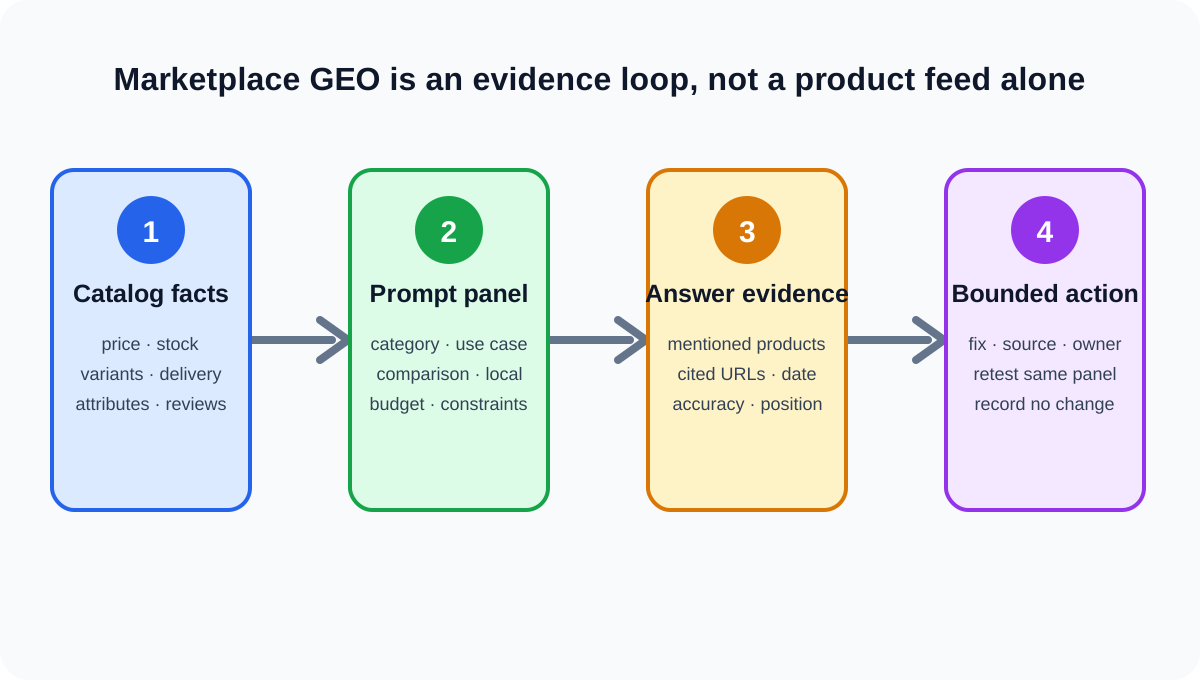
This guide is for marketplaces, retailers with large catalogs, agencies, and teams responsible for seller or product data. It complements How AI Shopping Changes Product Visibility and How to Audit AI Product Recommendations. Those articles cover adjacent measurement questions; this one focuses on multi-seller catalog ambiguity and the evidence needed to investigate it.
Why marketplace AI discovery is harder than brand visibility
A single brand page can be wrong in one way: the system may omit or misdescribe the brand. A marketplace has several identities that can be mixed together:
- The marketplace or retailer as a destination
- A seller or merchant operating inside it
- A product family and its variants
- A specific offer, price, availability, and delivery promise
- Reviews, editorial content, and third-party references
An answer can therefore mention the right product but the wrong seller, quote an outdated price, collapse several variants, or cite a review that supports a feature but not current availability. Counting the marketplace name is not enough to diagnose these failures.
Google’s guidance on AI features says the same foundational search practices continue to matter and that there are no additional technical requirements specific to appearing in AI Overviews or AI Mode. That does not mean a marketplace has no work to do: product facts, page accessibility, internal consistency, and answer evidence still need to be audited. It also means there is no official switch that guarantees a product will be recommended.
1. Define the marketplace entity before measuring it
Write down which object the audit is measuring. Use separate identifiers for:
| Object | Example audit question | Evidence to preserve |
|---|---|---|
| Marketplace | Is the destination recognized for this category? | Brand name, domain, category scope |
| Seller | Is this merchant distinguished from the marketplace? | Seller name, profile URL, policies |
| Product | Is the product described accurately? | Product ID, canonical URL, brand, model |
| Variant | Are size, color, capacity, or edition differences preserved? | Variant ID and attributes |
| Offer | Is the current price, stock, and delivery claim accurate? | Offer ID, timestamp, market |
Do not place every product-level observation into a marketplace-level visibility score. A marketplace can be visible while one seller is missing. A product can be cited while the offer is unavailable. These are different findings with different owners.
For product entities, Schema.org’s Product vocabulary gives a shared vocabulary for properties such as brand, model, offers, and aggregate ratings. Schema is useful for expressing facts, but valid markup is not proof that an AI system will use those facts or recommend the item.
2. Build prompts around shopping decisions, not only product names
A product-name panel mostly tests whether an AI system can repeat a known entity. A discovery audit should model how a buyer describes a need. Start with these groups:
| Prompt group | Example pattern | What it tests |
|---|---|---|
| Category | “What are good options for [need]?” | Discovery and category association |
| Constraint | “Find [product type] under [budget] with [attribute].” | Attribute and price handling |
| Comparison | “Compare [A], [B], and alternatives.” | Competitive framing and variant clarity |
| Seller | “Where can I buy [product] from a reliable seller?” | Merchant identity and trust signals |
| Availability | “Which options are available in [market]?” | Region, stock, and fulfillment evidence |
| Review | “Which option has the strongest evidence for [use case]?” | Review and source quality |
| Risk | “What should I check before buying [product]?” | Caveats, returns, warranty, and fit |
Keep the prompt text, location, language, device context, date, and surface. A question asked in a general chat interface is not automatically equivalent to a query in a search-grounded shopping experience. OpenAI’s web-search documentation describes sources and citations as part of its web-search tool behavior; that is useful technical context, but it is not a promise that every consumer answer uses the same retrieval path.
A practical first panel might contain 30–60 questions split across these groups. That range is a starting editorial recommendation, not a statistical standard. The correct size depends on the catalog, markets, product risk, and how many decisions the team can actually review.
How to Build a Reliable AI Search Prompt Set provides a broader taxonomy. For a marketplace, add seller, availability, fulfillment, and variant prompts rather than treating every question as a generic category query.
3. Audit the source-of-truth chain
For each important product or offer, create a source record before looking at AI answers:
product_id, variant_id, seller_id, canonical_url,
product_name, brand, category, attributes,
price, currency, availability, delivery_region,
return_policy_url, review_count, last_checked
Then compare the record with the pages that a buyer or crawler can access. Check:
- Whether the canonical page identifies the product, seller, and variant clearly
- Whether structured data matches visible page content
- Whether price and availability are timestamped or likely to change rapidly
- Whether the product page exposes shipping, returns, warranty, and condition
- Whether seller policies are distinct from marketplace policies
- Whether discontinued or duplicate URLs remain discoverable
- Whether review summaries make their scope and date clear
Google’s Product structured data documentation explains how product pages can describe product information for search features. It does not establish that structured data is consumed by every AI answer engine, nor does it validate the accuracy of the values supplied by a marketplace.
This distinction matters when a team says, “The feed is correct.” Correct in the feed is a prerequisite for a useful investigation; it is not evidence that a user-facing answer will be correct.
4. Capture complete answers, not just mentions
For every prompt run, store:
prompt_id, prompt_text, surface, model_or_mode, country,
language, run_date, full_answer, cited_urls,
mentioned_marketplace, mentioned_seller, mentioned_product,
variant_or_offer, price_claim, availability_claim,
accuracy_label, reviewer, prompt_set_version
Review the complete answer for five separate outcomes:
- Presence: Was the relevant marketplace, seller, product, or offer mentioned?
- Fit: Did the recommendation satisfy the prompt’s constraints?
- Identity: Was the product matched to the correct seller and variant?
- Evidence: Were claims supported by a cited or inspectable source?
- Freshness: Were price, stock, delivery, and policy claims current when checked?
Do not compress these into one score until the underlying fields are available. “Recommended” can mean a product was listed, ranked first, described positively, or merely included as an option. Publish the rule used by the audit.
5. Classify marketplace-specific failure modes
Use a failure taxonomy so the next action is not simply “publish more content.”
Missing product or seller
The answer does not include a relevant option. Possible causes include weak category association, limited third-party references, incomplete product language, retrieval differences, or a prompt that does not fit the product. A single omission cannot identify the cause.
Wrong product match
The answer names a product with similar language but the wrong model, capacity, or intended use. Investigate titles, attributes, comparison pages, and duplicate content before assuming the answer engine misunderstood the catalog.
Seller collapse
The product is present, but the answer treats the marketplace, seller, and manufacturer as interchangeable. Clarify seller profiles, offer ownership, warranty, returns, and product-to-offer relationships.
Stale commercial claim
The answer quotes a price, stock state, discount, or delivery time that no longer matches the page. Record the answer date and page check date. Fast-changing claims should be reported as time-bound observations, not permanent properties.
Unsupported review or quality claim
The answer says an item is “best rated” or “most reliable” without a traceable basis. Preserve the cited source, its date, review scope, and whether it is owned, editorial, community, or vendor-selected evidence.
Source mismatch
A cited URL is relevant to the category but does not support the exact product, seller, or commercial claim. This is a citation-quality problem, not automatically a visibility problem.
6. Separate owned data from independent evidence
Marketplace teams control catalog pages, feeds, policies, and often review presentation. They do not control every source an AI system may retrieve. Create a source ledger with ownership and evidence boundaries:
| Source type | What it can support | What it cannot prove by itself |
|---|---|---|
| Product or offer page | Current stated facts at check time | That an AI system will retrieve or recommend it |
| Structured data | Machine-readable values supplied by the site | Accuracy beyond the supplied values |
| Seller profile and policy | Seller identity and stated terms | Independent trust or conversion |
| Independent review | External product or marketplace observations | Current inventory or universal preference |
| Community discussion | User-reported experience or objections | Representative satisfaction |
| AI answer | What one sampled response contained | Market-wide visibility or causation |
Vendor-selected customer stories should remain labeled vendor-selected customer evidence. Traditional ecommerce reviews can inform product experience, but they do not automatically validate GEO monitoring or AI recommendation behavior. This boundary is important when comparing a marketplace platform with a dedicated monitoring tool such as AI Search Console or Otterly.AI.
7. Choose actions that can be retested
Match the correction to the observed failure:
| Finding | First action to test | Retest evidence |
|---|---|---|
| Product attributes are ambiguous | Normalize visible attributes and structured data | Same prompt, full answer, product match |
| Seller and marketplace are conflated | Clarify seller pages, policies, and offer ownership | Identity and policy claims |
| Category prompts omit the product | Improve category language and relevant editorial context | Non-branded discovery prompts |
| Cited page is stale | Update or retire the page and record publication date | Cited URL and claim freshness |
| Price or stock is wrong | Check feed-to-page synchronization and timestamp | Offer claim at the same market/date |
| Reviews are overgeneralized | Add scope, dates, and product/variant boundaries | Review claim and supporting source |
A retest is not a controlled experiment unless the prompt, surface, model or mode, market, date, and scoring rule are recorded. Even then, a changed answer can reflect retrieval or model changes rather than the marketplace edit. Report the result as an observation under the defined conditions.
Product experience platforms such as Yotpo Discover, search infrastructure such as Algolia, and merchandising systems such as Nosto solve different parts of a commerce stack. Their presence in a workflow does not mean they provide identical AI answer measurement. Confirm the product scope, export fields, and current integrations before selecting one.
8. Measure business outcomes separately
A marketplace can track ordinary commerce outcomes—product views, add-to-carts, orders, returns, and seller performance—without knowing whether an AI answer caused the session. Tagging links or inspecting referrers may reveal some AI-originated visits. It will not reveal every influenced journey.
Keep these columns separate:
- Answer visibility: what the sampled response said
- Citation evidence: which source URLs appeared
- Observed referral: what analytics can identify as a visit
- Commerce outcome: what the site’s systems recorded
- Causal interpretation: what the evidence can and cannot establish
Google Analytics campaign guidance explains how campaign parameters can identify tagged traffic. It does not turn an untagged or multi-step journey into complete AI attribution. Likewise, a crawler request is not a product view, and a cited URL is not a confirmed click.
See AI Visibility vs AI Citations vs AI Traffic for the broader measurement boundary and AI Shopping Visibility Audit for a commerce-oriented evidence framework.
A minimum viable marketplace GEO audit
For a first monthly cycle, use a bounded scope:
- Select one category and one market.
- Choose 5–10 products with multiple sellers or variants.
- Create 30–60 prompts across discovery, constraints, comparison, seller, availability, and risk.
- Run the same panel on the selected surface or tool configuration.
- Save complete answers, cited URLs, and the catalog snapshot.
- Review product identity, seller identity, commercial freshness, and source fit.
- Assign one or two corrections with owners.
- Retest the unchanged panel and report no-change results as valid outcomes.
This is enough to reveal whether the team can actually review evidence. Expand markets, categories, platforms, and refresh frequency only after the workflow is reproducible.
What marketplace GEO does not prove
Even a well-maintained catalog and repeated audit do not prove:
- Universal product visibility across AI systems
- That a product will be recommended to a particular user
- That a first-listed option is objectively the best option
- That a cited page caused a sale
- That a content or feed change caused more revenue
- That independent reviews represent all customers
- That a valid structured-data implementation is consumed by every answer engine
The defensible claim is narrower: “Under this prompt panel, surface, market, model or mode, and date, the answer contained these products, sellers, claims, and sources.”
Marketplace GEO checklist
Before publishing a report, confirm:
- Marketplace, seller, product, variant, and offer IDs are distinct.
- Prompts include non-branded discovery and constraint questions.
- Surface, model or mode, market, language, and date are recorded.
- Full answers and direct cited URLs are retained.
- Mention, recommendation, product match, seller match, and citation have separate definitions.
- Price, stock, delivery, and policy claims have check dates.
- Owned, independent, community, and vendor-selected sources are labeled.
- Feed or structured-data validity is not reported as AI recommendation proof.
- AI referrals and commerce outcomes are separate from answer visibility.
- Every action has an owner, unchanged prompt panel, and retest date.
FAQ
Does product structured data guarantee AI recommendations?
No. Structured data can help express product information in a machine-readable way, but it does not guarantee retrieval, citation, ranking, or recommendation in an AI answer. Validate the values and test actual answers separately.
Should a marketplace monitor product names or categories first?
Start with the buying decisions that matter. Product-name prompts test known-entity recognition; category, constraint, comparison, seller, and availability prompts test discovery and fit. Use both, but do not mistake branded or product-name presence for broad category visibility.
How often should prices and stock be checked?
Use a cadence appropriate to the catalog’s volatility and the risk of an incorrect claim. Record the answer timestamp and the page or feed check timestamp. Never present a time-sensitive observation as a permanent product fact.
Are ecommerce search tools also GEO tools?
Not automatically. On-site search, merchandising, catalog enrichment, and AI answer monitoring can work together, but they answer different questions. Verify whether a tool captures external AI answers, citations, prompt metadata, and raw exports before calling it a GEO solution.
What should a marketplace fix first?
Fix identity and factual consistency before optimizing for visibility: product-to-variant relationships, seller ownership, price and availability, policy pages, and source quality. A larger prompt score is not useful if the answer recommends the wrong offer.
Sources and verification
- Google Search Central: AI features and your website — official guidance on AI features and foundational search requirements; checked September 19, 2026.
- Google Search Central: Product structured data — official product structured-data documentation; checked September 19, 2026.
- Schema.org Product — vocabulary for product, offer, brand, and aggregate-rating properties; checked September 19, 2026.
- OpenAI: Web search tool — official technical documentation for web-search tool behavior and citations; checked September 19, 2026.
- Google Analytics: Campaign URL builder and campaign parameters — official guidance for identifying tagged traffic; checked September 19, 2026.
- AICiteKit: How AI Shopping Changes Product Visibility — adjacent shopping visibility framework.
- AICiteKit: AI Shopping Visibility Audit — commerce audit and evidence boundaries.
- AICiteKit: How to Build a Reliable AI Search Prompt Set — prompt taxonomy and panel design.
Verification date: September 19, 2026. Platform behavior, product feeds, structured-data guidance, and tool capabilities can change; recheck live documentation and run a bounded pilot before making procurement or performance claims.