Field notes / ai-search
AI Search Source Freshness Audit: How to Find Stale Citations and Product Facts
A practical AI Search freshness audit for detecting outdated citations, prices, features, policies, and availability claims without confusing source age with ranking or traffic causality.
The short answer
An AI Search source freshness audit checks whether a cited page is current enough, relevant enough, and scoped correctly for the claim an answer makes. It is not a test of whether a page is “fresh” in the abstract.
Use this sequence:
freeze the question → capture the answer and URLs → verify the claim against current sources → classify the risk → retestA source can be recent but still be the wrong source for a price, region, plan, or product condition. A source can be old but still be appropriate for a stable definition. The audit should therefore inspect claim age, source scope, and answer context together.
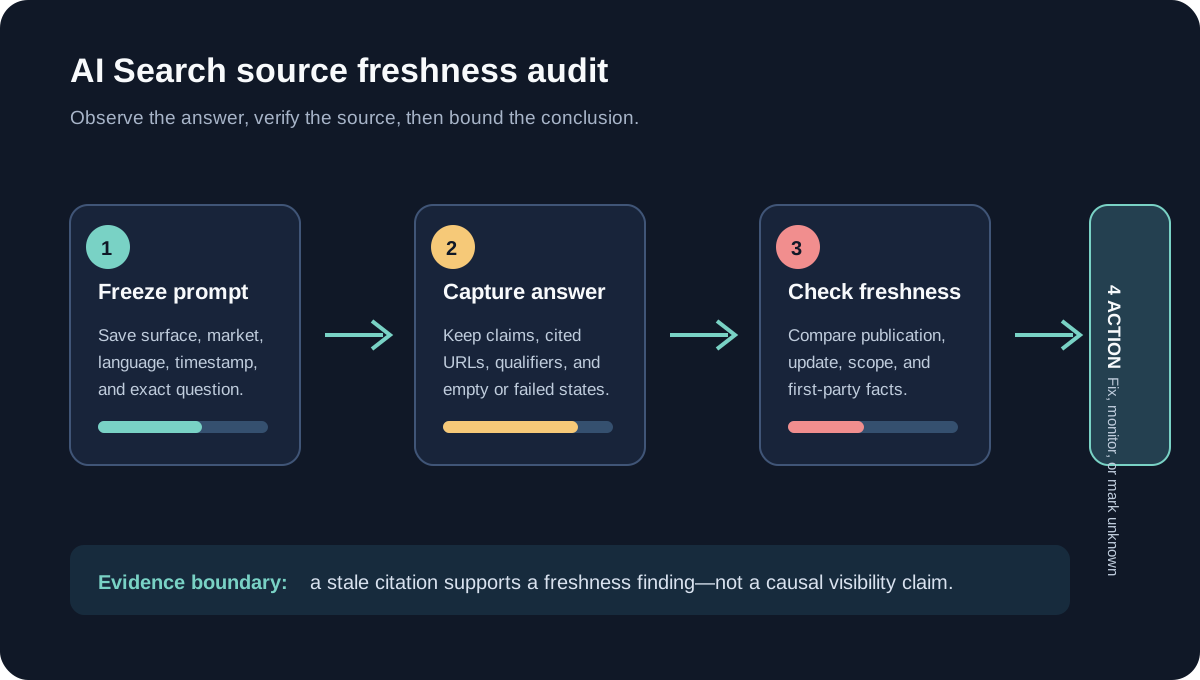
This guide addresses searches such as “why is ChatGPT showing an old price?”, “how do I check stale AI citations?”, and “how can I audit product facts in AI Search?” It does not promise that updating a page will produce a citation, ranking, click, or revenue increase.
What “fresh” means in an AI Search audit
Freshness has at least four dimensions:
| Dimension | Audit question | Example failure |
|---|---|---|
| Time | When was the source published or last updated? | An answer uses last year’s plan limit |
| Scope | Does the source cover the same product, market, plan, and date? | A US pricing page is used for an EU question |
| Claim fit | Does the cited passage support the exact statement? | A changelog is used to prove current availability |
| Answer context | Did the answer preserve qualifiers and uncertainty? | “Available” loses an enterprise-only condition |
The date alone is not enough. Search and answer systems may retrieve a page whose visible date is missing, may show a cached or indexed representation, or may combine several sources. If the relevant retrieval state is not exposed, record it as unknown rather than inferring why the source appeared.
Google’s documentation on AI features and your website, checked October 24, 2026, says that AI features may show links to supporting web resources and recommends foundational Search practices. It does not define a universal freshness score or guarantee inclusion in an AI answer.
OpenAI’s web search documentation, checked October 24, 2026, documents citations and source fields for that API tool. That supports auditing what the tool exposes for a particular call; it does not prove that every ChatGPT surface, model, or other answer engine uses the same retrieval and freshness behavior.
Why stale AI Search facts are a high-priority audit issue
An outdated opinion is inconvenient. An outdated product fact can change a purchase decision, implementation plan, compliance review, or support response.
Prioritize claims that change often or have a high cost of error:
- Prices, currencies, billing intervals, and discounts
- Plan limits, credits, seats, retention, and usage quotas
- Product features, integrations, API availability, and model coverage
- Eligibility, geography, service areas, and industry restrictions
- Security, privacy, legal, and regulatory statements
- Product availability, discontinuations, and migration deadlines
- Comparisons that depend on a competitor’s current offer
Do not give every paragraph the same freshness threshold. A historical definition, original research result, and current price are different evidence classes.
A practical claim-risk matrix
Before collecting answers, define the risk of being wrong. This prevents a team from treating a stale marketing adjective and an incorrect legal condition as equivalent.
| Claim type | Change frequency | Cost of error | Suggested review priority |
|---|---|---|---|
| Definition or historical context | Low | Low to medium | Periodic source check |
| Product positioning | Medium | Medium | Check after major releases |
| Price, limit, or plan feature | High | High | First-party check before publication |
| Availability or eligibility | High | High | Check by market and date |
| Security, privacy, or compliance | High | High | Route to the responsible reviewer |
| Recommendation or comparison | Variable | Medium to high | Recheck criteria and alternatives |
These priorities are AICiteKit editorial guidance, not a platform rule. Your review interval should reflect the product and the decision the answer informs.
Step 1: Freeze the observation before checking it
Do not start by searching for the answer you expect. Save the observation first.
Record:
- Exact prompt text and prompt-set version
- AI Search surface, mode, and model label when exposed
- Country, language, device, account assumptions, and date/time
- Full answer or an allowed near-raw capture
- Every visible source title and direct URL
- Mentioned product, price, feature, condition, or recommendation
- Empty, failed, gated, and no-source states
A source list without the surrounding answer is not enough. The same URL can support one sentence and fail to support another. The AI Search answer provenance guide explains why claim-to-source mapping matters.
For repeated observations, use the reproducibility method in AI Search Answer Reproducibility. Hold the prompt and declared conditions steady when the question is whether a source or claim changed.
Step 2: Split the answer into auditable claims
Do not audit an answer as one blob. Split material statements into rows.
| Claim ID | Answer statement | Claim class | Source shown? | Initial status |
|---|---|---|---|---|
price-01 | “Plan A costs X per month” | Current commercial fact | Yes / no | Needs first-party check |
limit-02 | “The plan includes Y credits” | Current limit | Yes / no | Needs scope check |
feature-03 | “The product integrates with Z” | Capability | Yes / no | Needs documentation check |
region-04 | “The service is available in Canada” | Availability | Yes / no | Needs market check |
history-05 | “The company launched in 2022” | Historical fact | Yes / no | Lower freshness risk |
Mark the answer wording separately from the source status. “The source is old” is not yet the same as “the claim is false.” The current first-party page may confirm that the claim remains valid, or the cited page may be an evergreen document whose date is not meaningful.
Step 3: Check the source against the current first-party record
For dynamic product facts, begin with the responsible official source: pricing, documentation, changelog, status page, terms, policy, or availability page. Then compare the exact scope.
Use a record like this:
| Field | Example | Why it matters |
|---|---|---|
| Answer claim | “Business includes 10 seats” | Defines what is being tested |
| Cited URL | Direct URL from the answer | Preserves the observed evidence |
| First-party URL | Current pricing or docs URL | Provides the comparison baseline |
| Source dates | Published, updated, or not exposed | Helps classify time risk |
| Scope | Plan, market, currency, product version | Prevents false mismatch |
| Result | Supported, contradicted, partial, or unresolved | Keeps uncertainty visible |
| Checked at | ISO timestamp and timezone | Makes the audit rerunnable |
If the source does not expose a date, write date not exposed. Do not manufacture a timestamp from a page footer, URL, sitemap, or HTTP header unless you can explain what that field represents.
A page’s Last-Modified response header, for example, is not automatically proof that the visible content changed at that time. Treat technical metadata as a separate signal and document its meaning.
Step 4: Test claim support, not just source recency
A recent source can still be a weak citation. Check four relationships:
- Entity: Is it about the same company, product, plan, or version?
- Scope: Does it cover the same geography, currency, audience, and eligibility?
- Time: Does it apply to the date of the answer and the decision?
- Text: Does it support the exact claim, including qualifiers and exceptions?
A useful classification is:
- Supported: current source directly supports the claim at the same scope.
- Partially supported: source supports only part of the wording or omits a material qualifier.
- Contradicted: current authoritative evidence conflicts with the answer.
- Stale risk: the cited source is outdated or superseded, but the current truth is not yet established.
- Unresolved: the available sources do not allow a responsible conclusion.
Do not convert “citation present” into “claim supported.” The AI Search claim coverage audit and AI Search answer claim audit provide related ways to preserve that distinction.
Step 5: Separate source freshness from answer freshness
There are two different observations:
The cited source is stale
The answer points to an old, superseded, or inappropriate page. This supports a source-quality or retrieval finding for the observed sample.
The answer claim is stale
The statement itself is contradicted by current evidence. This supports a factual-accuracy finding for that answer and scope.
The first does not automatically prove the second. A page published two years ago may still accurately describe an unchanged definition. Conversely, an undated page may contain a recently changed price.
Report both fields:
| Observation | Safe statement | Unsafe leap |
|---|---|---|
| Old citation, current fact still matches | “The cited source is old; the claim matched the checked first-party record.” | “The answer is wrong.” |
| New citation, wrong plan scope | “The source is recent but does not support this plan.” | “Fresh sources are reliable.” |
| Current page contradicts answer | “The sampled answer conflicts with the checked current source.” | “The engine always uses stale facts.” |
| Answer changes after a page update | “The answer differed after the update.” | “The update caused the change.” |
This boundary is especially important when reporting to leadership. A freshness audit can identify risk and prioritize correction; it cannot, by itself, establish a universal visibility change or causal business outcome.
Step 6: Build a source portfolio, not a single-page fix
A company may have a current pricing page and still be represented by old comparison pages, reseller listings, documentation mirrors, reviews, or community discussions. The answer surface can draw from more than one source type.
Map the source portfolio:
| Source type | Typical role | Audit question |
|---|---|---|
| Official pricing | Current commercial facts | Is the plan and billing scope explicit? |
| Official docs | Capabilities and limits | Is the version or date clear? |
| Changelog | Change history | Does it prove current availability or only a past release? |
| Status page | Operational state | Is the incident or component still relevant? |
| Independent review | Workflow observations | Is the review date and product version clear? |
| Marketplace or directory | Discovery context | Is the listing maintained and geographically relevant? |
| Community discussion | Edge cases and user experience | Is the claim anecdotal, dated, or corroborated? |
The AI Search source portfolio guide covers how to compare source roles. Independent reviews can help explain practical behavior, but they do not automatically validate current pricing or a specific GEO feature.
Step 7: Choose an action that matches the evidence
A freshness audit should end in a controlled action, not a generic instruction to “publish more content.”
| Finding | Appropriate action |
|---|---|
| Current first-party page is clear but never cited in the sample | Monitor source selection; investigate competing source coverage; do not claim a ranking penalty |
| Official page is ambiguous or missing a qualifier | Improve the page, document the change, then retest |
| Third-party source has an old fact | Request correction or publish a clearer current first-party reference |
| Answer repeats a material contradiction | Escalate as a factual-accuracy issue and preserve examples |
| Date or scope cannot be verified | Mark unresolved and avoid a confident correction |
| Change appears after a release | Log the association and run the declared repeat set |
For monitoring, tools such as AI Search Console, Otterly.AI, Peec AI, Profound, PromptWatch, Rankscale, and AI Rank Checker may expose different combinations of prompts, answers, citations, sources, and history. Verify the actual plan, refresh interval, retention, export fields, and engine coverage before treating a dashboard metric as comparable evidence.
A repeatable freshness-audit worksheet
Use one row per claim and retain the raw evidence:
observation_id:
prompt_set_version:
prompt:
surface_and_mode:
model_label:
market_and_language:
collected_at:
answer_capture:
claim:
claim_class:
cited_source_url:
cited_source_date_or_not_exposed:
first_party_check_url:
first_party_date_or_not_exposed:
scope_checked:
result: supported | partial | contradicted | stale-risk | unresolved
risk_level:
action_owner:
next_check_at:
Before reporting a trend, define:
- The prompt cohort and denominator
- The source definition and whether repeated URLs are deduplicated
- How missing, failed, gated, and no-source answers are handled
- The time window and market
- Whether the metric concerns mentions, citations, supported claims, referrals, or conversions
The AI Search monitoring data-retention guide explains why retention and raw evidence matter when a later audit must reproduce an earlier conclusion.
What independent research can and cannot tell you
The independent paper GEO: Generative Engine Optimization, checked October 24, 2026, is useful research context for studying visibility in a defined experimental setting. It is not evidence for the current freshness behavior of a commercial answer engine, a vendor score, a citation guarantee, traffic growth, or revenue impact.
The W3C Web Content Accessibility Guidelines, checked October 24, 2026, are not an AI Search ranking guide. They are useful as a reminder that clear, perceivable, navigable content and accurate text serve human users independently of whether an AI system cites the page. Accessibility conformance should not be represented as proof of AI visibility.
Evidence boundaries matter here:
- Official documentation supports what a platform documents about its own surface.
- Independent research supports the conditions and findings of that research, not every current product behavior.
- A vendor case study is vendor-selected customer evidence, not independent proof.
- A tool dashboard supports a metric under its method and sample; it does not make that metric universal.
- A before-and-after answer difference is an observation; it is not automatically causal.
FAQ
How often should I audit AI Search source freshness?
There is no universal interval. Start with the change frequency and cost of error for the claim. Review prices, limits, availability, security, and policy claims more often than stable definitions. Record the interval as an operational policy and change it when the product or risk changes.
Does updating a page make an AI answer use the new version?
Not necessarily. It may improve the page’s clarity or currentness, but retrieval, indexing, source selection, answer generation, competing sources, and timing remain separate factors. Retest under declared conditions and report the observed result without claiming causality from one comparison.
Is a recent citation always better than an old citation?
No. A recent source can have the wrong scope or fail to support the claim. An older source can remain valid for stable information. Evaluate time together with entity, scope, text support, and answer qualifiers.
How do I report a stale citation to a vendor?
Provide the exact prompt, surface, timestamp, answer excerpt, cited URL, current comparison source, affected claim, market, and why the source is stale or mismatched. Preserve the original evidence and avoid sharing sensitive personal data. Ask how the product defines freshness, source updates, retries, and corrections.
Can a freshness audit prove that GEO work increased traffic?
No. It can document source and claim changes in a defined sample. Traffic requires separate analytics evidence, and revenue or conversion claims require a stronger measurement design. See AI Visibility vs AI Citations vs AI Traffic for the distinction.
Sources and verification
- Google Search Central: AI features and your website — checked October 24, 2026 for documented supporting-link and AI-feature context; not a universal freshness or citation guarantee.
- OpenAI Developer Docs: Web search — checked October 24, 2026 for the citation and source fields documented for that API tool; not evidence for every ChatGPT surface.
- Aggarwal et al., GEO: Generative Engine Optimization — checked October 24, 2026 as independent research context; not evidence for current commercial metrics or outcomes.
- W3C Web Content Accessibility Guidelines (WCAG) 2.2 — checked October 24, 2026 for independent accessibility guidance; not an AI Search ranking claim.
Evidence boundary and last reviewed
This article presents an audit method for source age, scope, and claim support. It does not claim that any platform is deterministic, that a newer page will be cited, or that freshness work guarantees rankings, citations, traffic, leads, or revenue.
Last reviewed: October 24, 2026
Data confidence: High for the linked platform and standards documentation; medium for the operational framework, which is AICiteKit editorial guidance and should be adapted to the tested surface.